This time we’re going bigger than ever. Fabric, Power BI, SQL, AI and more. We're covering it all. You won't want to miss it.
Learn moreJoin the FabCon + SQLCon recap series. Up next: Power BI, Real-Time Intelligence, IQ and AI, and Data Factory take center stage. All sessions are available on-demand after the live show. Register now
Hello all!
I have a doubt regarding Power Query.
I have 2 columns, with duplicates. I want to keep only those that are unique in both. For instance:
If I remove duplicates from column1, I only want to remove if they stay unique in column2.
I.e, if I remove row 1 I can't remove row 3 otherwise I would have two "11".
I hope my explanation made sense.
Thanks in advance.
Solved! Go to Solution.
Use below Query to achieve this output
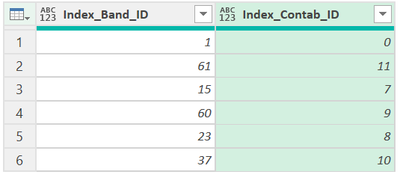
let
Source = Excel.CurrentWorkbook(){[Name="Table1"]}[Content],
#"Added Index" = Table.AddIndexColumn(Source, "Index", 0, 1, Int64.Type),
#"Inserted Modulo" = Table.AddColumn(#"Added Index", "Modulo", each Number.Mod([Index], 4), type number),
#"Filtered Rows" = Table.SelectRows(#"Inserted Modulo", each ([Modulo] = 0 or [Modulo] = 3)),
#"Removed Columns" = Table.RemoveColumns(#"Filtered Rows",{"Index", "Modulo"})
in
#"Removed Columns"
To achieve the below output, replace [Modulo] = 0 or [Modulo] = 3 in 5th row of the code above
with [Modulo] = 1 or [Modulo] = 2
Updated code is below
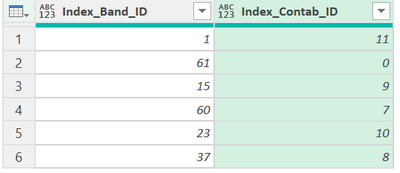
let
Source = Excel.CurrentWorkbook(){[Name="Table1"]}[Content],
#"Added Index" = Table.AddIndexColumn(Source, "Index", 0, 1, Int64.Type),
#"Inserted Modulo" = Table.AddColumn(#"Added Index", "Modulo", each Number.Mod([Index], 4), type number),
#"Filtered Rows" = Table.SelectRows(#"Inserted Modulo", each [Modulo] = 1 or [Modulo] = 2),
#"Removed Columns" = Table.RemoveColumns(#"Filtered Rows",{"Index", "Modulo"})
in
#"Removed Columns"
Use below Query to achieve this output
let
Source = Excel.CurrentWorkbook(){[Name="Table1"]}[Content],
#"Added Index" = Table.AddIndexColumn(Source, "Index", 0, 1, Int64.Type),
#"Inserted Modulo" = Table.AddColumn(#"Added Index", "Modulo", each Number.Mod([Index], 4), type number),
#"Filtered Rows" = Table.SelectRows(#"Inserted Modulo", each ([Modulo] = 0 or [Modulo] = 3)),
#"Removed Columns" = Table.RemoveColumns(#"Filtered Rows",{"Index", "Modulo"})
in
#"Removed Columns"
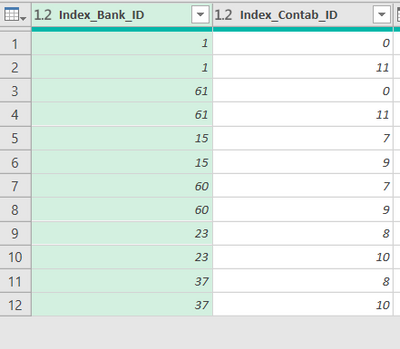
To achieve the below output, replace [Modulo] = 0 or [Modulo] = 3 in 5th row of the code above
with [Modulo] = 1 or [Modulo] = 2
Updated code is below
let
Source = Excel.CurrentWorkbook(){[Name="Table1"]}[Content],
#"Added Index" = Table.AddIndexColumn(Source, "Index", 0, 1, Int64.Type),
#"Inserted Modulo" = Table.AddColumn(#"Added Index", "Modulo", each Number.Mod([Index], 4), type number),
#"Filtered Rows" = Table.SelectRows(#"Inserted Modulo", each [Modulo] = 1 or [Modulo] = 2),
#"Removed Columns" = Table.RemoveColumns(#"Filtered Rows",{"Index", "Modulo"})
in
#"Removed Columns"
That worked, thank you.
Check out the April 2026 Power BI update to learn about new features.
If you have recently started exploring Fabric, we'd love to hear how it's going. Your feedback can help with product improvements.
A new Power BI DataViz World Championship is coming this June! Don't miss out on submitting your entry.
| User | Count |
|---|---|
| 3 | |
| 3 | |
| 3 | |
| 2 | |
| 2 |
| User | Count |
|---|---|
| 5 | |
| 4 | |
| 4 | |
| 4 | |
| 4 |