cancel
Showing results for 
Search instead for 
Did you mean: 

Learn from the best! Meet the four finalists headed to the FINALS of the Power BI Dataviz World Championships! Register now

Reply
ringocheng618
Frequent Visitor

Pivot/Unpivot Messy Data

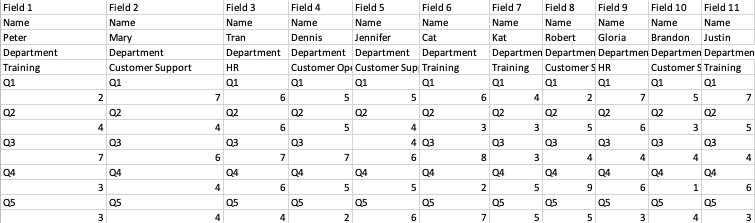
Hello I have given this messy data as attached: 


Screen Shot 2021-03-01 at 7.01.17 PM.png


What if I want to convert this into like the following, what should I do?


Screen Shot 2021-03-01 at 7.20.46 PM.png


1 ACCEPTED SOLUTION
CNENFRNL
Community Champion
Community Champion

@ringocheng618 , you might want to try,

let
    Source = Table.FromRows(Json.Document(Binary.Decompress(Binary.FromText("i45W8kvMTVXSQaFidaKVAlJLUouAAr6JRZVAKqQoMQ8s7pJakFhUkpuaVwIUxcUBKQTqyMzLzEsHyjgHAwmPILBwoCGQDSNAAkZApjkQm0KkQVwYARIwATJNENLGIBkoARIA6TQDmwCWBqmEESABY1TdpiAZKIEsDbQqFgA=", BinaryEncoding.Base64), Compression.Deflate)), let _t = ((type nullable text) meta [Serialized.Text = true]) in type table [Column1 = _t, Column2 = _t, Column3 = _t]),
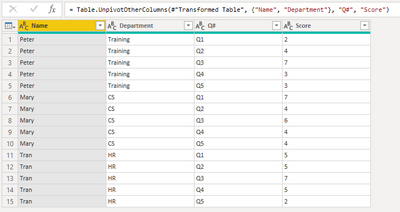
    #"Transformed Table" = Table.Combine(List.Transform(Table.ToColumns(Source), each Table.PromoteHeaders(Table.FromColumns(List.Split(_,2))))),
    #"Unpivoted Other Columns" = Table.UnpivotOtherColumns(#"Transformed Table", {"Name", "Department"}, "Q#", "Score")
in
    #"Unpivoted Other Columns"

Screenshot 2021-03-02 091942.png


Thanks to the great efforts by MS engineers to simplify syntax of DAX! Most beginners are SUCCESSFULLY MISLED to think that they could easily master DAX; but it turns out that the intricacy of the most frequently used RANKX() is still way beyond their comprehension!

DAX is simple, but NOT EASY!

View solution in original post

2 REPLIES 2
CNENFRNL
Community Champion
Community Champion

@ringocheng618 , you might want to try,

let
    Source = Table.FromRows(Json.Document(Binary.Decompress(Binary.FromText("i45W8kvMTVXSQaFidaKVAlJLUouAAr6JRZVAKqQoMQ8s7pJakFhUkpuaVwIUxcUBKQTqyMzLzEsHyjgHAwmPILBwoCGQDSNAAkZApjkQm0KkQVwYARIwATJNENLGIBkoARIA6TQDmwCWBqmEESABY1TdpiAZKIEsDbQqFgA=", BinaryEncoding.Base64), Compression.Deflate)), let _t = ((type nullable text) meta [Serialized.Text = true]) in type table [Column1 = _t, Column2 = _t, Column3 = _t]),
    #"Transformed Table" = Table.Combine(List.Transform(Table.ToColumns(Source), each Table.PromoteHeaders(Table.FromColumns(List.Split(_,2))))),
    #"Unpivoted Other Columns" = Table.UnpivotOtherColumns(#"Transformed Table", {"Name", "Department"}, "Q#", "Score")
in
    #"Unpivoted Other Columns"

Screenshot 2021-03-02 091942.png


Thanks to the great efforts by MS engineers to simplify syntax of DAX! Most beginners are SUCCESSFULLY MISLED to think that they could easily master DAX; but it turns out that the intricacy of the most frequently used RANKX() is still way beyond their comprehension!

DAX is simple, but NOT EASY!

Anonymous
Not applicable

Hi @ringocheng618 


I believe there are other ways to do it. Paste the code in Advanced Editor, see the output
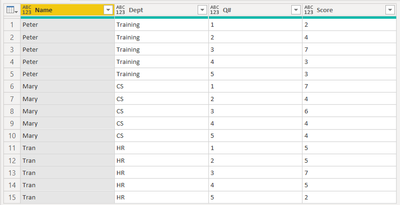
 

Vera_33_0-1614667339590.png

let
  Source = Table.FromRows(
    Json.Document(
      Binary.Decompress(
        Binary.FromText(
          "i45W8kvMTVXSQaFidaKVAlJLUouAAr6JRZVAKqQoMQ8s7pJaUALkI1MgYaB8Zl5mXjpQzDkYSHgEgYUDDYFsGAESMAIyzYHYFCIN4sIIkIAJkGmCkDYGyUAJkABIpxnYBLA0SCWMAAkYo+o2BclACWRpoFWxAA==",
          BinaryEncoding.Base64
        ),
        Compression.Deflate
      )
    ),
    let
      _t = ((type nullable text) meta [Serialized.Text = true])
    in
      type table [#"Field 1" = _t, #"Field 2" = _t, #"Field 3" = _t]
  ),
  #"Changed Type" = Table.TransformColumnTypes(
    Source,
    {{"Field 1", type text}, {"Field 2", type text}, {"Field 3", type text}}
  ),
  #"Transposed Table" = Table.Transpose(#"Changed Type"),
  #"Grouped Rows" = Table.Group(
    #"Transposed Table",
    {"Column1", "Column2", "Column3", "Column4"},
    {{"allrows", each Table.Skip(Table.Transpose(_), 4), type table}}
  ),
  #"Added Custom" = Table.AddColumn(
    #"Grouped Rows",
    "Custom",
    each [
      a = Table.AddIndexColumn([allrows], "Index", 0, 1, Int64.Type),
      b = Table.AddColumn(a, "Custom", each Number.RoundDown([Index] / 2)),
      c = Table.Group(b, {"Custom"}, {{"Q", each Table.Transpose(Table.FromList(_[Column1]))}})
    ][c]
  ),
  #"Expanded Custom" = Table.ExpandTableColumn(#"Added Custom", "Custom", {"Q"}, {"Q"}),
  #"Expanded Q" = Table.ExpandTableColumn(
    #"Expanded Custom",
    "Q",
    {"Column1", "Column2"},
    {"Column1.1", "Column2.1"}
  ),
  #"Added Custom1" = Table.AddColumn(#"Expanded Q", "Custom", each Text.At([Column1.1], 1)),
  #"Renamed Columns" = Table.RenameColumns(
    #"Added Custom1",
    {{"Column2", "Name"}, {"Column4", "Dept"}, {"Custom", "Q#"}, {"Column2.1", "Score"}}
  ),
  #"Removed Other Columns" = Table.SelectColumns(
    #"Renamed Columns",
    {"Name", "Dept", "Q#", "Score"}
  )
in
  #"Removed Other Columns"

 

Helpful resources

Announcements
Join our Fabric User Panel

Join our Fabric User Panel

Share feedback directly with Fabric product managers, participate in targeted research studies and influence the Fabric roadmap.

February Power BI Update Carousel

Power BI Monthly Update - February 2026

Check out the February 2026 Power BI update to learn about new features.

FabCon Atlanta 2026 carousel

FabCon Atlanta 2026

Join us at FabCon Atlanta, March 16-20, for the ultimate Fabric, Power BI, AI and SQL community-led event. Save $200 with code FABCOMM.

Top Solution Authors