This time we’re going bigger than ever. Fabric, Power BI, SQL, AI and more. We're covering it all. You won't want to miss it.
Learn moreLevel up your Power BI skills this month - build one visual each week and tell better stories with data! Get started
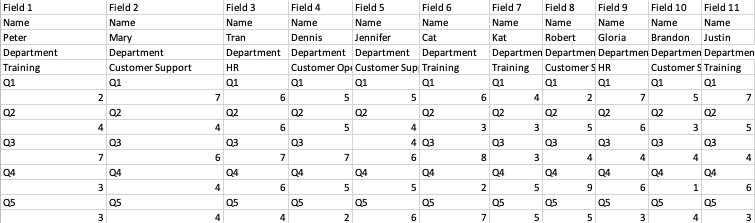
Hello I have given this messy data as attached:
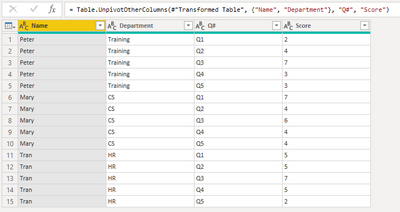
What if I want to convert this into like the following, what should I do?
Solved! Go to Solution.
@ringocheng618 , you might want to try,
let
Source = Table.FromRows(Json.Document(Binary.Decompress(Binary.FromText("i45W8kvMTVXSQaFidaKVAlJLUouAAr6JRZVAKqQoMQ8s7pJakFhUkpuaVwIUxcUBKQTqyMzLzEsHyjgHAwmPILBwoCGQDSNAAkZApjkQm0KkQVwYARIwATJNENLGIBkoARIA6TQDmwCWBqmEESABY1TdpiAZKIEsDbQqFgA=", BinaryEncoding.Base64), Compression.Deflate)), let _t = ((type nullable text) meta [Serialized.Text = true]) in type table [Column1 = _t, Column2 = _t, Column3 = _t]),
#"Transformed Table" = Table.Combine(List.Transform(Table.ToColumns(Source), each Table.PromoteHeaders(Table.FromColumns(List.Split(_,2))))),
#"Unpivoted Other Columns" = Table.UnpivotOtherColumns(#"Transformed Table", {"Name", "Department"}, "Q#", "Score")
in
#"Unpivoted Other Columns"
| Thanks to the great efforts by MS engineers to simplify syntax of DAX! Most beginners are SUCCESSFULLY MISLED to think that they could easily master DAX; but it turns out that the intricacy of the most frequently used RANKX() is still way beyond their comprehension! |
DAX is simple, but NOT EASY! |
@ringocheng618 , you might want to try,
let
Source = Table.FromRows(Json.Document(Binary.Decompress(Binary.FromText("i45W8kvMTVXSQaFidaKVAlJLUouAAr6JRZVAKqQoMQ8s7pJakFhUkpuaVwIUxcUBKQTqyMzLzEsHyjgHAwmPILBwoCGQDSNAAkZApjkQm0KkQVwYARIwATJNENLGIBkoARIA6TQDmwCWBqmEESABY1TdpiAZKIEsDbQqFgA=", BinaryEncoding.Base64), Compression.Deflate)), let _t = ((type nullable text) meta [Serialized.Text = true]) in type table [Column1 = _t, Column2 = _t, Column3 = _t]),
#"Transformed Table" = Table.Combine(List.Transform(Table.ToColumns(Source), each Table.PromoteHeaders(Table.FromColumns(List.Split(_,2))))),
#"Unpivoted Other Columns" = Table.UnpivotOtherColumns(#"Transformed Table", {"Name", "Department"}, "Q#", "Score")
in
#"Unpivoted Other Columns"
| Thanks to the great efforts by MS engineers to simplify syntax of DAX! Most beginners are SUCCESSFULLY MISLED to think that they could easily master DAX; but it turns out that the intricacy of the most frequently used RANKX() is still way beyond their comprehension! |
DAX is simple, but NOT EASY! |
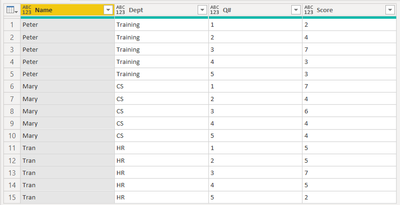
I believe there are other ways to do it. Paste the code in Advanced Editor, see the output
let
Source = Table.FromRows(
Json.Document(
Binary.Decompress(
Binary.FromText(
"i45W8kvMTVXSQaFidaKVAlJLUouAAr6JRZVAKqQoMQ8s7pJaUALkI1MgYaB8Zl5mXjpQzDkYSHgEgYUDDYFsGAESMAIyzYHYFCIN4sIIkIAJkGmCkDYGyUAJkABIpxnYBLA0SCWMAAkYo+o2BclACWRpoFWxAA==",
BinaryEncoding.Base64
),
Compression.Deflate
)
),
let
_t = ((type nullable text) meta [Serialized.Text = true])
in
type table [#"Field 1" = _t, #"Field 2" = _t, #"Field 3" = _t]
),
#"Changed Type" = Table.TransformColumnTypes(
Source,
{{"Field 1", type text}, {"Field 2", type text}, {"Field 3", type text}}
),
#"Transposed Table" = Table.Transpose(#"Changed Type"),
#"Grouped Rows" = Table.Group(
#"Transposed Table",
{"Column1", "Column2", "Column3", "Column4"},
{{"allrows", each Table.Skip(Table.Transpose(_), 4), type table}}
),
#"Added Custom" = Table.AddColumn(
#"Grouped Rows",
"Custom",
each [
a = Table.AddIndexColumn([allrows], "Index", 0, 1, Int64.Type),
b = Table.AddColumn(a, "Custom", each Number.RoundDown([Index] / 2)),
c = Table.Group(b, {"Custom"}, {{"Q", each Table.Transpose(Table.FromList(_[Column1]))}})
][c]
),
#"Expanded Custom" = Table.ExpandTableColumn(#"Added Custom", "Custom", {"Q"}, {"Q"}),
#"Expanded Q" = Table.ExpandTableColumn(
#"Expanded Custom",
"Q",
{"Column1", "Column2"},
{"Column1.1", "Column2.1"}
),
#"Added Custom1" = Table.AddColumn(#"Expanded Q", "Custom", each Text.At([Column1.1], 1)),
#"Renamed Columns" = Table.RenameColumns(
#"Added Custom1",
{{"Column2", "Name"}, {"Column4", "Dept"}, {"Custom", "Q#"}, {"Column2.1", "Score"}}
),
#"Removed Other Columns" = Table.SelectColumns(
#"Renamed Columns",
{"Name", "Dept", "Q#", "Score"}
)
in
#"Removed Other Columns"
Check out the April 2026 Power BI update to learn about new features.
Sign up to receive a private message when registration opens and key events begin.
If you have recently started exploring Fabric, we'd love to hear how it's going. Your feedback can help with product improvements.