Join us at FabCon Atlanta from March 16 - 20, 2026, for the ultimate Fabric, Power BI, AI and SQL community-led event. Save $200 with code FABCOMM.
Register now!Learn from the best! Meet the four finalists headed to the FINALS of the Power BI Dataviz World Championships! Register now
Hello!
I`m connecting to folder which contains multiply different .xlsx files. Every filename somewhere contains 20 digit account number. At first I need extract account number, recive some number based data from 'dimension table' and make some filtering. After that I want expand 'content' and start working with data inside those files.
That is how my folder looks:
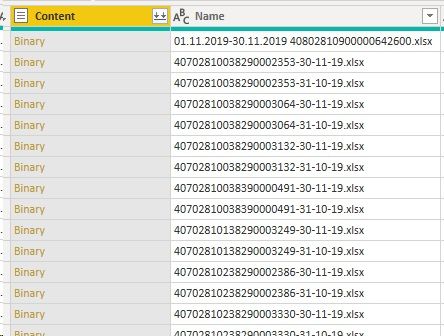
I was unable to get steady result with 'column from examples' so I use small Python code to extract account numbers in my dataset.
# 'dataset' содержит входные данные для этого сценария
regex = r'(\d{20})'
dataset['Номер расчетного счета'] = dataset['Name'].str.extract(regex)Code works well and returns dataset but in 'Value.Content' instead of previous content I recieve 'System.Byte' value.
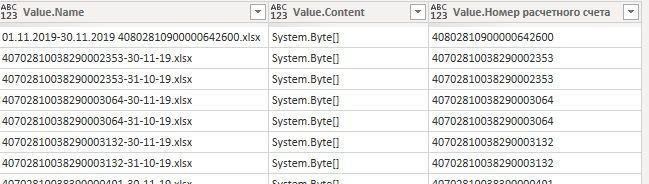
It is important for me to make some filtering on regex`ed dataset before expanding 'content'. Is it possible to save all content in one query after regex?
P.S. There is workaround with doubling and merging queries but I would like to stay in one query.
Thank you!
Solved! Go to Solution.
Hi @HeliosOne ,
to my knowledge, these "nested" columns will not survive a passage through Python.
So you have to parse out /expand the columns you need later before applying the Python-Script.
Imke Feldmann (The BIccountant)
If you liked my solution, please give it a thumbs up. And if I did answer your question, please mark this post as a solution. Thanks!
How to integrate M-code into your solution -- How to get your questions answered quickly -- How to provide sample data -- Check out more PBI- learning resources here -- Performance Tipps for M-queries
Hi @HeliosOne ,
to my knowledge, these "nested" columns will not survive a passage through Python.
So you have to parse out /expand the columns you need later before applying the Python-Script.
Imke Feldmann (The BIccountant)
If you liked my solution, please give it a thumbs up. And if I did answer your question, please mark this post as a solution. Thanks!
How to integrate M-code into your solution -- How to get your questions answered quickly -- How to provide sample data -- Check out more PBI- learning resources here -- Performance Tipps for M-queries
Share feedback directly with Fabric product managers, participate in targeted research studies and influence the Fabric roadmap.
Check out the February 2026 Power BI update to learn about new features.