Get certified for free when you join Fabric Data Days 2026 and dive into Fabric, Power BI, SQL, AI, and other essential data skills.
Join nowJuly 7 - July 17 | Round 2 of the Power BI Dataviz World Championships. Don't miss your chance! Learn more
Tablemeasure = Union( selectcolumns(Table A,"Opening_Date", Table A[Opening_Date]), selectcolumns(Table B,"Business_Date", Table B[Business_Date]), )
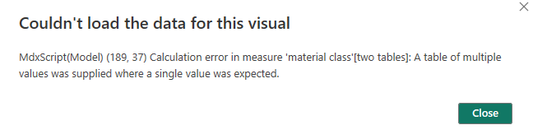
I created a measure using this format above but when I try to put it into a visual I get the error below. Anyone have an idea of what I might be doing wrong?
Solved! Go to Solution.
If you need a list of dates for a visual, create a calculated table instead of a measure :
CombinedDatesTable = UNION(
SELECTCOLUMNS(TableA, "Date", TableA[Opening_Date]),
SELECTCOLUMNS(TableB, "Date", TableB[Business_Date])
)then for the measure :
UniqueDateCount = DISTINCTCOUNT(UNION(SELECTCOLUMNS(TableA, "Date", TableA[Opening_Date]), SELECTCOLUMNS(TableB, "Date", TableB[Business_Date])))
If you need a list of dates for a visual, create a calculated table instead of a measure :
CombinedDatesTable = UNION(
SELECTCOLUMNS(TableA, "Date", TableA[Opening_Date]),
SELECTCOLUMNS(TableB, "Date", TableB[Business_Date])
)then for the measure :
UniqueDateCount = DISTINCTCOUNT(UNION(SELECTCOLUMNS(TableA, "Date", TableA[Opening_Date]), SELECTCOLUMNS(TableB, "Date", TableB[Business_Date])))
This is what I created but I'm only getting the Material column in the resulting table?
Can you please share your pbix file ?
Your solution worked, I just had to tweek it a bit for my situation. I accepted your solution.
Join us in Barcelona for FabCon and SQLCon, the Fabric, Power BI, SQL, and AI community event. Save €200 with code FABCMTY200.
Join Data Days 2026: 60 days of free live/on-demand sessions, challenges, study groups, and certification opportunities.
| User | Count |
|---|---|
| 27 | |
| 24 | |
| 18 | |
| 15 | |
| 15 |
| User | Count |
|---|---|
| 63 | |
| 42 | |
| 41 | |
| 38 | |
| 37 |