This is best Fabric, Power BI, SQL and AI community event. How do we know? The last event sold out! Save €200 with code FABCMTY200.
Register nowA new Data Days event is coming soon! This time we’re going bigger than ever. Fabric, Power BI, SQL, AI and more. Don't miss out.
Tablemeasure = Union( selectcolumns(Table A,"Opening_Date", Table A[Opening_Date]), selectcolumns(Table B,"Business_Date", Table B[Business_Date]), )
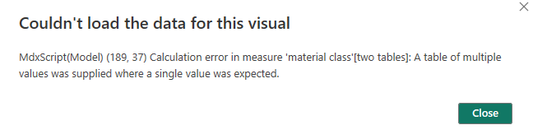
I created a measure using this format above but when I try to put it into a visual I get the error below. Anyone have an idea of what I might be doing wrong?
Solved! Go to Solution.
If you need a list of dates for a visual, create a calculated table instead of a measure :
CombinedDatesTable = UNION(
SELECTCOLUMNS(TableA, "Date", TableA[Opening_Date]),
SELECTCOLUMNS(TableB, "Date", TableB[Business_Date])
)then for the measure :
UniqueDateCount = DISTINCTCOUNT(UNION(SELECTCOLUMNS(TableA, "Date", TableA[Opening_Date]), SELECTCOLUMNS(TableB, "Date", TableB[Business_Date])))
If you need a list of dates for a visual, create a calculated table instead of a measure :
CombinedDatesTable = UNION(
SELECTCOLUMNS(TableA, "Date", TableA[Opening_Date]),
SELECTCOLUMNS(TableB, "Date", TableB[Business_Date])
)then for the measure :
UniqueDateCount = DISTINCTCOUNT(UNION(SELECTCOLUMNS(TableA, "Date", TableA[Opening_Date]), SELECTCOLUMNS(TableB, "Date", TableB[Business_Date])))
This is what I created but I'm only getting the Material column in the resulting table?
Can you please share your pbix file ?
Your solution worked, I just had to tweek it a bit for my situation. I accepted your solution.
Check out the May 2026 Power BI update to learn about new features.
Sign up to receive a private message when registration opens and key events begin.
If you have recently started exploring Fabric, we'd love to hear how it's going. Your feedback can help with product improvements.
| User | Count |
|---|---|
| 31 | |
| 25 | |
| 25 | |
| 22 | |
| 14 |
| User | Count |
|---|---|
| 61 | |
| 49 | |
| 25 | |
| 20 | |
| 20 |