Get certified for free when you join Fabric Data Days 2026 and dive into Fabric, Power BI, SQL, AI, and other essential data skills.
Join nowData Days is here! Join us now for 60+ days of learning, challenges, and connection. Learn more
It appears that Merge Queries are case-sensitive, what are you recommendations for composite keys that are of text type?
build another column that transforms the column to lower-case/uppers for both tables? or is there a much more elegant way of doing this?
Solved! Go to Solution.
It would be prefered to have numeric keys.
If you need to stick to text, then I think your proposal is the best suggestion.
Table.NestedJoin has an additional parameter "keyEqualityComparers" that would suggest the possibility to use case-insensitive comparison, but this doesn't seem to work with local evaluation (maybe it works with a database source and query folding).
This parameter was discussed here.
The following code performs a case sensitive left outerjoin from Table1 to Table2, however "performs" is not very applicable as this is a real performance killer and I wouldn't recommend it for any tables with more than 100 records.
let
Source1 = Table.Buffer(Table1),
Source2 = Table.Buffer(Table2),
#"Added Custom" = Table.AddColumn(Source1, "Table2", (Record1) => Table.SelectRows(Source2, (Record2) => Comparer.Equals(Comparer.OrdinalIgnoreCase, Record1[Key1], Record2[Key2]))),
#"Expanded Table2" = Table.ExpandTableColumn(#"Added Custom", "Table2", {"Key2", "Value2"}, {"Key2", "Value2"})
in
#"Expanded Table2"
It would be prefered to have numeric keys.
If you need to stick to text, then I think your proposal is the best suggestion.
Table.NestedJoin has an additional parameter "keyEqualityComparers" that would suggest the possibility to use case-insensitive comparison, but this doesn't seem to work with local evaluation (maybe it works with a database source and query folding).
This parameter was discussed here.
The following code performs a case sensitive left outerjoin from Table1 to Table2, however "performs" is not very applicable as this is a real performance killer and I wouldn't recommend it for any tables with more than 100 records.
let
Source1 = Table.Buffer(Table1),
Source2 = Table.Buffer(Table2),
#"Added Custom" = Table.AddColumn(Source1, "Table2", (Record1) => Table.SelectRows(Source2, (Record2) => Comparer.Equals(Comparer.OrdinalIgnoreCase, Record1[Key1], Record2[Key2]))),
#"Expanded Table2" = Table.ExpandTableColumn(#"Added Custom", "Table2", {"Key2", "Value2"}, {"Key2", "Value2"})
in
#"Expanded Table2"
Thanks Marcel, at least I have 2 choices now.
Its an old post.
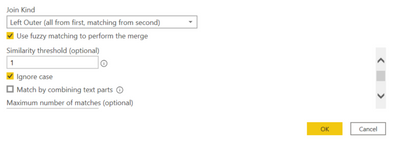
We do have a fuzzy merge option now.
Use [IgnoreCase=true, Threshold=1.0] should do a case agonostic merge.
Thanks @Anonymous .
It resolved my needs and those who are looking for the solution,
You can also refer to the below article,
https://www.ehansalytics.com/blog/2020/4/27/case-insensitive-merges-in-power-query
Thanks,
Karthik
But as Mat mention in artcilce
Unfortunately this seems to ignore + - signs.I have three items:
19719201
19719201+
19719201-With this fuzzy matching it's returning all three for item 19719201
Don't miss out on Data Days, June 15 through August 7. Learn Fabric, Power BI, SQL, AI and more.
Check out the May 2026 Power BI update to learn about new features.
| User | Count |
|---|---|
| 23 | |
| 23 | |
| 21 | |
| 20 | |
| 15 |
| User | Count |
|---|---|
| 58 | |
| 54 | |
| 42 | |
| 30 | |
| 24 |