cancel
Showing results for 
Search instead for 
Did you mean: 

The Power BI Data Visualization World Championships is back! Get ahead of the game and start preparing now! Learn more

Reply
vedansh
Frequent Visitor

Dynamic data source based on date

Hi Team,


I have requirement like, from a folder of Excel files i have to pick the data file of MAX datekey files will be maintained in particular fashion i.e, Data Datekeyfiles will be maintained in particular fashion i.e, Data Datekey

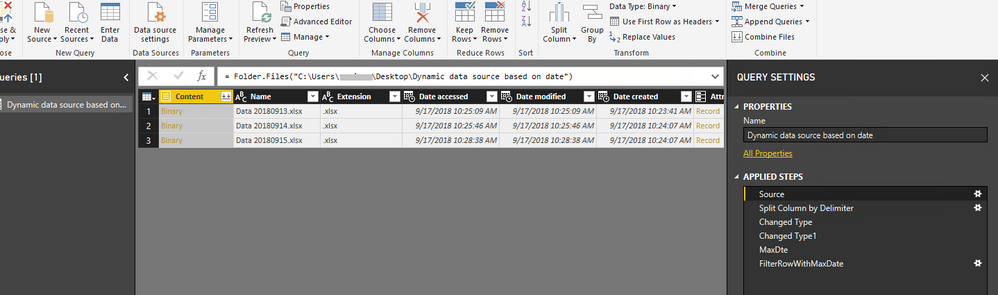
As mentioned in the image file with max date key to be picked.

I believe it is possible by passing parameter to MQuery. 

Thanks in advance..


1 ACCEPTED SOLUTION
v-qiuyu-msft
Community Support
Community Support

Hi @vedansh,


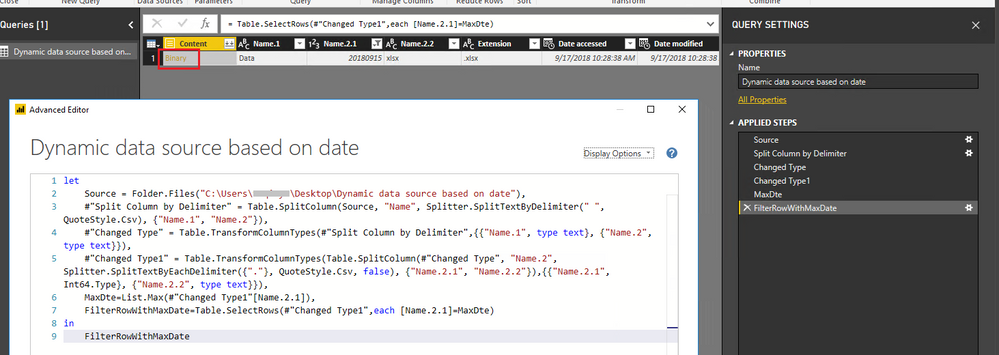
You can use query below to find the Excel file with the maximum date in Power BI desktop: 


let
    Source = Folder.Files("<folder path>"),
    #"Split Column by Delimiter" = Table.SplitColumn(Source, "Name", Splitter.SplitTextByDelimiter(" ", QuoteStyle.Csv), {"Name.1", "Name.2"}),
    #"Changed Type" = Table.TransformColumnTypes(#"Split Column by Delimiter",{{"Name.1", type text}, {"Name.2", type text}}),   
    #"Changed Type1" = Table.TransformColumnTypes(Table.SplitColumn(#"Changed Type", "Name.2", Splitter.SplitTextByEachDelimiter({"."}, QuoteStyle.Csv, false), {"Name.2.1", "Name.2.2"}),{{"Name.2.1", Int64.Type}, {"Name.2.2", type text}}),
    MaxDte=List.Max(#"Changed Type1"[Name.2.1]),
    FilterRowWithMaxDate=Table.SelectRows(#"Changed Type1",each [Name.2.1]=MaxDte)
in
    FilterRowWithMaxDate
q3.PNGq4.PNG


Then you can click Binary to extract data from the Excel file. 


Best Regards,
Qiuyun Yu 

Community Support Team _ Qiuyun Yu
If this post helps, then please consider Accept it as the solution to help the other members find it more quickly.


View solution in original post

2 REPLIES 2
v-qiuyu-msft
Community Support
Community Support

Hi @vedansh,


You can use query below to find the Excel file with the maximum date in Power BI desktop: 


let
    Source = Folder.Files("<folder path>"),
    #"Split Column by Delimiter" = Table.SplitColumn(Source, "Name", Splitter.SplitTextByDelimiter(" ", QuoteStyle.Csv), {"Name.1", "Name.2"}),
    #"Changed Type" = Table.TransformColumnTypes(#"Split Column by Delimiter",{{"Name.1", type text}, {"Name.2", type text}}),   
    #"Changed Type1" = Table.TransformColumnTypes(Table.SplitColumn(#"Changed Type", "Name.2", Splitter.SplitTextByEachDelimiter({"."}, QuoteStyle.Csv, false), {"Name.2.1", "Name.2.2"}),{{"Name.2.1", Int64.Type}, {"Name.2.2", type text}}),
    MaxDte=List.Max(#"Changed Type1"[Name.2.1]),
    FilterRowWithMaxDate=Table.SelectRows(#"Changed Type1",each [Name.2.1]=MaxDte)
in
    FilterRowWithMaxDate

q3.PNGq4.PNG


Then you can click Binary to extract data from the Excel file. 


Best Regards,
Qiuyun Yu 

Community Support Team _ Qiuyun Yu
If this post helps, then please consider Accept it as the solution to help the other members find it more quickly.

Hi @v-qiuyu-msft,


Great it worked, Thanks dear !!!!

Helpful resources

Announcements
Power BI DataViz World Championships

Power BI Dataviz World Championships

The Power BI Data Visualization World Championships is back! Get ahead of the game and start preparing now!

December 2025 Power BI Update Carousel

Power BI Monthly Update - December 2025

Check out the December 2025 Power BI Holiday Recap!

FabCon Atlanta 2026 carousel

FabCon Atlanta 2026

Join us at FabCon Atlanta, March 16-20, for the ultimate Fabric, Power BI, AI and SQL community-led event. Save $200 with code FABCOMM.