Join us at FabCon Atlanta from March 16 - 20, 2026, for the ultimate Fabric, Power BI, AI and SQL community-led event. Save $200 with code FABCOMM.
Register now!The Power BI Data Visualization World Championships is back! Get ahead of the game and start preparing now! Learn more
I have a parameter I am trying to create in order to determine the revenue associated with a dynamic number of customers. This formula gives me all of the revenue rather than limiting it to the number of customers selected by the parameter. How would I fix this?
Top N =
Calculate(sum([Rev]),
TopN(Parameter Value, VALUES([Customer Rank]), sum([Rev]), ASC)
)
Hi @czuniga ,
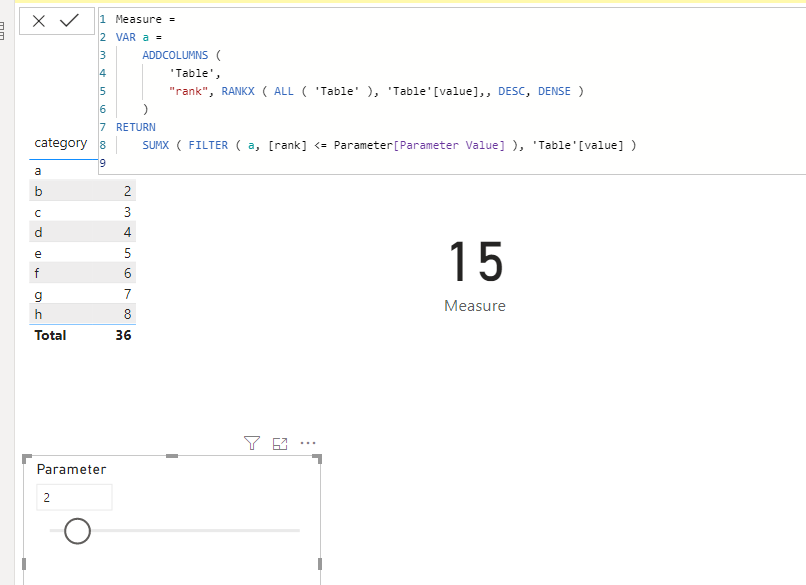
We can create a measure as below to work on it.
Measure =
VAR a =
ADDCOLUMNS (
'Table',
"rank", RANKX ( ALL ( 'Table' ), 'Table'[value],, DESC, DENSE )
)
RETURN
SUMX ( FILTER ( a, [rank] <= Parameter[Parameter Value] ), 'Table'[value] )
Pbix as attached.
Hi @czuniga ,
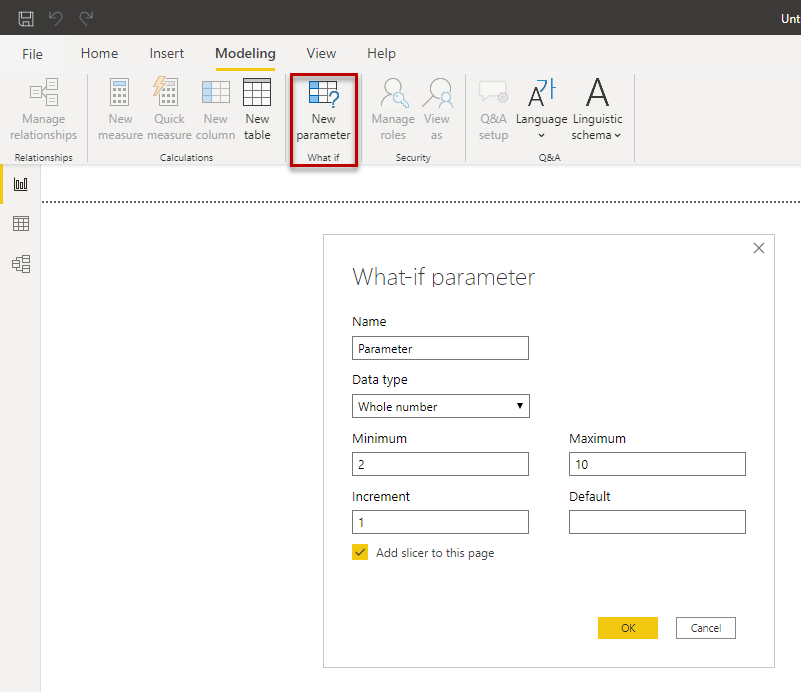
use the what-if parameter, see figure. It creates a new table with a measure. Insert this measure in your TopN measure.
Regards FrankAT
The Power BI Data Visualization World Championships is back! Get ahead of the game and start preparing now!
| User | Count |
|---|---|
| 38 | |
| 38 | |
| 37 | |
| 28 | |
| 28 |
| User | Count |
|---|---|
| 124 | |
| 89 | |
| 73 | |
| 66 | |
| 65 |