This time we’re going bigger than ever. Fabric, Power BI, SQL, AI and more. We're covering it all. You won't want to miss it.
Learn moreLevel up your Power BI skills this month - build one visual each week and tell better stories with data! Get started
I see lots of posts on converting a unix timestamp integer into a datetime (timestamp). How would one take a DateTime value (2018-08-22 10:11:12) and convert it into a a unix timestamp integer (i.e. number of seconds after Jan 1 1970).
I would like to do it in a calculated column (M), but it would be nice to know how to do it in a measure as well (DAX). Thanks.
Solved! Go to Solution.
Hi @Anonymous
You may try to create a column as below.
Column=Duration.TotalSeconds([Column1]-#datetime(1970, 1, 1, 0, 0, 0))
Regards,
Cherie
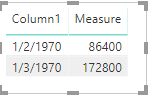
Hi @Anonymous
You may try this measure to convert Date Time into Unix Timestamp integer.
Measure = DATEDIFF ( DATE ( 1970, 1, 1 ), MAX ( Table2[Column1] ), SECOND )
Regards,
Cherie
Thank you.
I did some trial and error with a Calculated Column (M code) and think I got this to work correctly.
= Table.AddColumn(#"Changed Type", "TimestampUNIX", each Duration.TotalSeconds([Timestamp] - DateTime.FromText("1970-01-01 00:00:00")))Someone can tell me if they see a problem with this or have a more efficient method.
Hi @Anonymous
You may try to create a column as below.
Column=Duration.TotalSeconds([Column1]-#datetime(1970, 1, 1, 0, 0, 0))
Regards,
Cherie
hmm I get an error when I use this in M query:
Expression.Error: We cannot apply operator - to types Number and DateTime.
Details:
Operator=-
Left=1583959530
Right=1/1/1970 12:00:00
Check out the April 2026 Power BI update to learn about new features.
Sign up to receive a private message when registration opens and key events begin.
If you have recently started exploring Fabric, we'd love to hear how it's going. Your feedback can help with product improvements.
| User | Count |
|---|---|
| 35 | |
| 32 | |
| 25 | |
| 22 | |
| 18 |
| User | Count |
|---|---|
| 67 | |
| 36 | |
| 32 | |
| 25 | |
| 23 |