Join us at FabCon Atlanta from March 16 - 20, 2026, for the ultimate Fabric, Power BI, AI and SQL community-led event. Save $200 with code FABCOMM.
Register now!The Power BI Data Visualization World Championships is back! Get ahead of the game and start preparing now! Learn more
I see lots of posts on converting a unix timestamp integer into a datetime (timestamp). How would one take a DateTime value (2018-08-22 10:11:12) and convert it into a a unix timestamp integer (i.e. number of seconds after Jan 1 1970).
I would like to do it in a calculated column (M), but it would be nice to know how to do it in a measure as well (DAX). Thanks.
Solved! Go to Solution.
Hi @Anonymous
You may try to create a column as below.
Column=Duration.TotalSeconds([Column1]-#datetime(1970, 1, 1, 0, 0, 0))
Regards,
Cherie
Hi @Anonymous
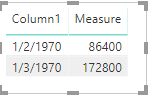
You may try this measure to convert Date Time into Unix Timestamp integer.
Measure = DATEDIFF ( DATE ( 1970, 1, 1 ), MAX ( Table2[Column1] ), SECOND )
Regards,
Cherie
Thank you.
I did some trial and error with a Calculated Column (M code) and think I got this to work correctly.
= Table.AddColumn(#"Changed Type", "TimestampUNIX", each Duration.TotalSeconds([Timestamp] - DateTime.FromText("1970-01-01 00:00:00")))Someone can tell me if they see a problem with this or have a more efficient method.
Hi @Anonymous
You may try to create a column as below.
Column=Duration.TotalSeconds([Column1]-#datetime(1970, 1, 1, 0, 0, 0))
Regards,
Cherie
hmm I get an error when I use this in M query:
Expression.Error: We cannot apply operator - to types Number and DateTime.
Details:
Operator=-
Left=1583959530
Right=1/1/1970 12:00:00
The Power BI Data Visualization World Championships is back! Get ahead of the game and start preparing now!
Check out the November 2025 Power BI update to learn about new features.
| User | Count |
|---|---|
| 63 | |
| 46 | |
| 43 | |
| 26 | |
| 19 |
| User | Count |
|---|---|
| 198 | |
| 125 | |
| 102 | |
| 69 | |
| 53 |