This is best Fabric, Power BI, SQL and AI community event. How do we know? The last event sold out! Save €200 with code FABCMTY200.
Register nowA new Data Days event is coming soon! This time we’re going bigger than ever. Fabric, Power BI, SQL, AI and more. Don't miss out.
Hi,
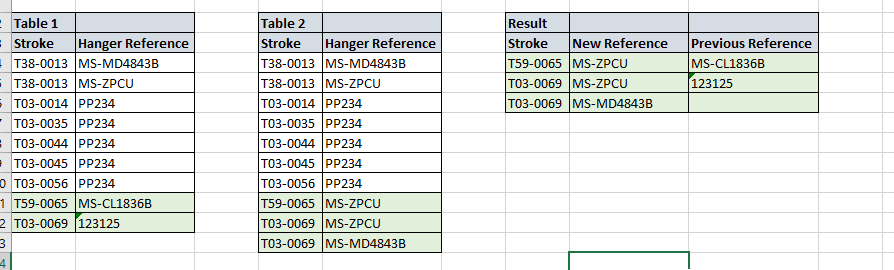
I have two tables and I want to show any changes in table two from table one. For example:
1. The stroke can have more than one row of data
2. Table 2, not all strokes will have made a change of hanger reference
3. Table 2, new stroke references can be seen (though these should be excluded.
How do I get a table that matches the result table?
Solved! Go to Solution.
One approach would be to start with Table 2, merge in Table 1 matching on Stroke, expand the Table 1 reference column, and then filter the resulting table with the rule [New Reference] <> [Previous Reference]. Note: this would give 123125 twice in the final table instead of having a blank cell.
=let a=Table.Buffer(Table.Group(Table1,"Stroke",{"t",each [Hanger Reference]})) in #table({"Stroke","New Reference","Previous Reference"},List.TransformMany(Table.ToRows(Table.Group(Table2,"Stroke",{"t",each [Hanger Reference]})),each let r1=a{[Stroke=_{0}]}?[t]? ??{} in if List.ContainsAll(r1,_{1}) then {} else List.Zip({List.RemoveItems(_{1},r1),List.RemoveItems(r1,_{1})}),(x,y)=>{x{0}}&y))
Thanks Daniel. will I add this as a query?
just copy this code in your new step
Sorry i am not following. Where would I add the code? Will this be a new measure or a new column?
One approach would be to start with Table 2, merge in Table 1 matching on Stroke, expand the Table 1 reference column, and then filter the resulting table with the rule [New Reference] <> [Previous Reference]. Note: this would give 123125 twice in the final table instead of having a blank cell.
Sign up to receive a private message when registration opens and key events begin.
If you have recently started exploring Fabric, we'd love to hear how it's going. Your feedback can help with product improvements.