This is best Fabric, Power BI, SQL and AI community event. How do we know? The last event sold out! Save €200 with code FABCMTY200.
Register nowA new Data Days event is coming soon! This time we’re going bigger than ever. Fabric, Power BI, SQL, AI and more. Don't miss out.
Hi, I have this kind of data and I want to create a grouped table by G1,G2,G3 counting the rows of C column that are distinct from null with power query
| G1 | G2 | G3 | K | C |
| 1 | 1 | 1 | 1 | null |
| 1 | 1 | 1 | 2 | 1 |
| 2 | 2 | 2 | 3 | null |
| 2 | 2 | 2 | 4 | 1 |
| 2 | 2 | 2 | 5 | 1 |
| 3 | 3 | 1 | 6 | null |
| 3 | 3 | 2 | 7 | 1 |
| 3 | 3 | 3 | 8 | 1 |
| 3 | 3 | 4 | 9 | null |
So the result I want to achieve is
| G1 | G2 | G3 | Count |
| 1 | 1 | 1 | 1 |
| 2 | 2 | 2 | 2 |
| 3 | 3 | 1 | 0 |
| 3 | 3 | 2 | 1 |
| 3 | 3 | 3 | 1 |
| 3 | 3 | 4 | 0 |
Any help would be appreciated. I was trying to create a function but I can´t figure how to pass the G1, G2, G3 as parameter. Perhaps I need another approach
Thanks,
Julio
Solved! Go to Solution.
Hi @Anonymous
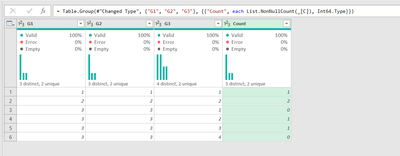
You can directly groupby
Table.Group(yourPreviousStep, {"G1", "G2", "G3"}, {{"Count", each List.NonNullCount(_[C]), Int64.Type}})
Thank you @Anonymous
Hi @Anonymous
You can directly groupby
Table.Group(yourPreviousStep, {"G1", "G2", "G3"}, {{"Count", each List.NonNullCount(_[C]), Int64.Type}})
Check out the May 2026 Power BI update to learn about new features.
Sign up to receive a private message when registration opens and key events begin.
If you have recently started exploring Fabric, we'd love to hear how it's going. Your feedback can help with product improvements.