This time we’re going bigger than ever. Fabric, Power BI, SQL, AI and more. We're covering it all. You won't want to miss it.
Learn moreDid you hear? There's a new SQL AI Developer certification (DP-800). Start preparing now and be one of the first to get certified. Register now
Hi, I have this kind of data and I want to create a grouped table by G1,G2,G3 counting the rows of C column that are distinct from null with power query
| G1 | G2 | G3 | K | C |
| 1 | 1 | 1 | 1 | null |
| 1 | 1 | 1 | 2 | 1 |
| 2 | 2 | 2 | 3 | null |
| 2 | 2 | 2 | 4 | 1 |
| 2 | 2 | 2 | 5 | 1 |
| 3 | 3 | 1 | 6 | null |
| 3 | 3 | 2 | 7 | 1 |
| 3 | 3 | 3 | 8 | 1 |
| 3 | 3 | 4 | 9 | null |
So the result I want to achieve is
| G1 | G2 | G3 | Count |
| 1 | 1 | 1 | 1 |
| 2 | 2 | 2 | 2 |
| 3 | 3 | 1 | 0 |
| 3 | 3 | 2 | 1 |
| 3 | 3 | 3 | 1 |
| 3 | 3 | 4 | 0 |
Any help would be appreciated. I was trying to create a function but I can´t figure how to pass the G1, G2, G3 as parameter. Perhaps I need another approach
Thanks,
Julio
Solved! Go to Solution.
Hi @Anonymous
You can directly groupby
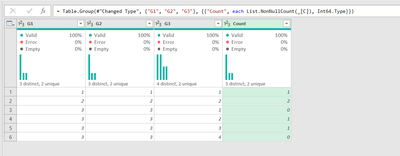
Table.Group(yourPreviousStep, {"G1", "G2", "G3"}, {{"Count", each List.NonNullCount(_[C]), Int64.Type}})
Thank you @Anonymous
Hi @Anonymous
You can directly groupby
Table.Group(yourPreviousStep, {"G1", "G2", "G3"}, {{"Count", each List.NonNullCount(_[C]), Int64.Type}})
Check out the April 2026 Power BI update to learn about new features.
Sign up to receive a private message when registration opens and key events begin.
If you have recently started exploring Fabric, we'd love to hear how it's going. Your feedback can help with product improvements.