This time we’re going bigger than ever. Fabric, Power BI, SQL, AI and more. We're covering it all. You won't want to miss it.
Learn moreLevel up your Power BI skills this month - build one visual each week and tell better stories with data! Get started
Hello everybody.
I have problem with power query
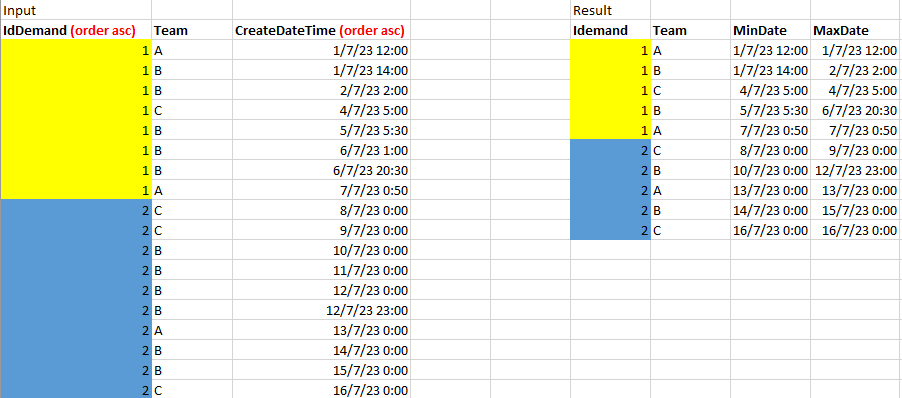
I would like to transform a table like the exemple by grouping with IdDemand + Team with. I want the Min DateTime and the Max DateTime for each continuous sequence of IdDemand + Team
The team can learn at different times later
Below the example:
Datas
| IdDemand | Team | CreateDateTime |
| 1 | A | 1/7/23 12:00 |
| 1 | B | 1/7/23 14:00 |
| 1 | B | 2/7/23 2:00 |
| 1 | C | 4/7/23 5:00 |
| 1 | B | 5/7/23 5:30 |
| 1 | B | 6/7/23 1:00 |
| 1 | B | 6/7/23 20:30 |
| 1 | A | 7/7/23 0:50 |
| 2 | C | 8/7/23 0:00 |
| 2 | C | 9/7/23 0:00 |
| 2 | B | 10/7/23 0:00 |
| 2 | B | 11/7/23 0:00 |
| 2 | B | 12/7/23 0:00 |
| 2 | B | 12/7/23 23:00 |
| 2 | A | 13/7/23 0:00 |
| 2 | B | 14/7/23 0:00 |
| 2 | B | 15/7/23 0:00 |
| 2 | C | 16/7/23 0:00 |
Thank you all for your attention
Solved! Go to Solution.
Hi @Anonymous ,
You can use the GroupKind argument to do this.
First, multi-select (Ctrl+Click) [IdDmand] and [Team].
Go to the Home tab > Group By.
In the dialog, create aggreagted columns for [MinDate] as MIN of [CreatedDateTime], and similar for MAX.
Once you've applied this, just add this little bit to the end of your Group By step:

Full example query:
let
Source = Table.FromRows(Json.Document(Binary.Decompress(Binary.FromText("hZBJCoAwDEWvIlkLZmisulOPId7/Gg5poS0GF9m8l0+G4wCCHta7aIgDS0e8IMLZm9gKEVrBJqrAflcwrm2/Zi41H9OAtj9xxjLwrBpN4KLGOQ2eMseazx/8vQw9QZ7gH8FSmvev4kWCJ9S5g8ZSnBc=", BinaryEncoding.Base64), Compression.Deflate)), let _t = ((type nullable text) meta [Serialized.Text = true]) in type table [#"IdDemand " = _t, Team = _t, CreateDateTime = _t]),
chgTypes = Table.TransformColumnTypes(Source,{{"IdDemand ", Int64.Type}, {"Team", type text}, {"CreateDateTime", type datetime}}),
groupIdTeamLocal = Table.Group(chgTypes, {"IdDemand ", "Team"}, {{"minDate", each List.Min([CreateDateTime]), type nullable datetime}, {"maxDate", each List.Max([CreateDateTime]), type nullable datetime}}, GroupKind.Local)
in
groupIdTeamLocal
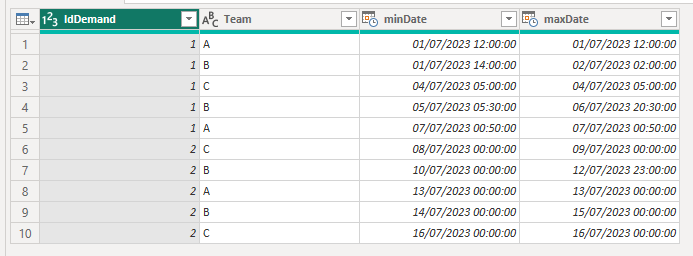
Example query output:
Pete
Proud to be a Datanaut!
I'm so happy, I spent a few hours on this problem only to discover that I was missing two words GroupKind.Local...
Thank you so much
No problem, happy to help.
Feel free to give a thumbs-up on any posts that help you 👍
Pete
Proud to be a Datanaut!
Hi @Anonymous ,
You can use the GroupKind argument to do this.
First, multi-select (Ctrl+Click) [IdDmand] and [Team].
Go to the Home tab > Group By.
In the dialog, create aggreagted columns for [MinDate] as MIN of [CreatedDateTime], and similar for MAX.
Once you've applied this, just add this little bit to the end of your Group By step:
Full example query:
let
Source = Table.FromRows(Json.Document(Binary.Decompress(Binary.FromText("hZBJCoAwDEWvIlkLZmisulOPId7/Gg5poS0GF9m8l0+G4wCCHta7aIgDS0e8IMLZm9gKEVrBJqrAflcwrm2/Zi41H9OAtj9xxjLwrBpN4KLGOQ2eMseazx/8vQw9QZ7gH8FSmvev4kWCJ9S5g8ZSnBc=", BinaryEncoding.Base64), Compression.Deflate)), let _t = ((type nullable text) meta [Serialized.Text = true]) in type table [#"IdDemand " = _t, Team = _t, CreateDateTime = _t]),
chgTypes = Table.TransformColumnTypes(Source,{{"IdDemand ", Int64.Type}, {"Team", type text}, {"CreateDateTime", type datetime}}),
groupIdTeamLocal = Table.Group(chgTypes, {"IdDemand ", "Team"}, {{"minDate", each List.Min([CreateDateTime]), type nullable datetime}, {"maxDate", each List.Max([CreateDateTime]), type nullable datetime}}, GroupKind.Local)
in
groupIdTeamLocal
Example query output:
Pete
Proud to be a Datanaut!
Check out the April 2026 Power BI update to learn about new features.
Sign up to receive a private message when registration opens and key events begin.
If you have recently started exploring Fabric, we'd love to hear how it's going. Your feedback can help with product improvements.