This time we’re going bigger than ever. Fabric, Power BI, SQL, AI and more. We're covering it all. You won't want to miss it.
Learn moreLevel up your Power BI skills this month - build one visual each week and tell better stories with data! Get started
i have two columns with the following values
col A col B
a 1
b 2
c 2
d 1
e 2
I would like to have a count from column B with rows that have only '2' as an entry.
I.E in this case 3 is the answer i am looking for
i have been using this formula :
Solved! Go to Solution.
Hi @hulk_deka ,
According to your description, here's my solution.
Create a measure.
M =
COUNTROWS ( FILTER ( 'Query1', 'Query1'[col B] = 2 ) )
Get the result.
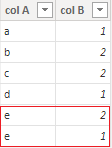
As you say "column B with rows that have only '2' as an entry", I'm not sure if you mean for example the below sample, the 2 of e should not be included, as it still as a value 1.
If this is the case, modify the formula to:
Measure =
CALCULATE (
DISTINCTCOUNT ( Query1[col A] ),
FILTER (
'Query1',
COUNTROWS (
FILTER (
'Query1',
'Query1'[col A] = EARLIER ( 'Query1'[col A] )
&& 'Query1'[col B] <> 2
)
) = 0
)
)
Get the correct result according to the modified sample.
I attach my sample below for your reference.
Best Regards,
Community Support Team _ kalyj
If this post helps, then please consider Accept it as the solution to help the other members find it more quickly.
Hi @hulk_deka ,
According to your description, here's my solution.
Create a measure.
M =
COUNTROWS ( FILTER ( 'Query1', 'Query1'[col B] = 2 ) )
Get the result.
As you say "column B with rows that have only '2' as an entry", I'm not sure if you mean for example the below sample, the 2 of e should not be included, as it still as a value 1.
If this is the case, modify the formula to:
Measure =
CALCULATE (
DISTINCTCOUNT ( Query1[col A] ),
FILTER (
'Query1',
COUNTROWS (
FILTER (
'Query1',
'Query1'[col A] = EARLIER ( 'Query1'[col A] )
&& 'Query1'[col B] <> 2
)
) = 0
)
)
Get the correct result according to the modified sample.
I attach my sample below for your reference.
Best Regards,
Community Support Team _ kalyj
If this post helps, then please consider Accept it as the solution to help the other members find it more quickly.
Use this one
= List.Count(List.Select(Query1[col B], each _=2 or _="2"))
is there any way we can use it as a measure? the above formula doesnt seem to be accepted as a measure and gives out an error.
Check out the April 2026 Power BI update to learn about new features.
Sign up to receive a private message when registration opens and key events begin.
If you have recently started exploring Fabric, we'd love to hear how it's going. Your feedback can help with product improvements.
| User | Count |
|---|---|
| 3 | |
| 2 | |
| 2 | |
| 2 | |
| 2 |