Learn from the best! Meet the four finalists headed to the FINALS of the Power BI Dataviz World Championships! Register now
I understand that we cannot use measure value as a visual level filter.
However, I'd like to filter visualization depending on measure value.
Would you know how to implement the function below?
| cat_1 | cat_2 | value |
| A | A | 2 |
| A | A | 1 |
| A | B | 3 |
| B | B | 4 |
| B | C | 5 |
[function]
・setting "cat_1" & "cat_2" as slicers
・making some visualization of measure of "value"
・if a number of rows with slicer's settings is less than 2, a visualization is hidden.
e.g.)
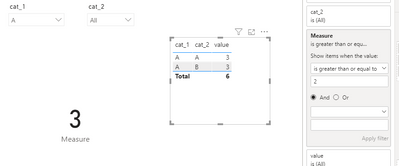
When we chose "A" in cat_1 and "all" in cat_2, a visualization is not hidden. (a number of rows is 3.)
When we chose "A" in cat_1 and "A" in cat_2, a visualization is not hidden. (a number of rows is 2.)
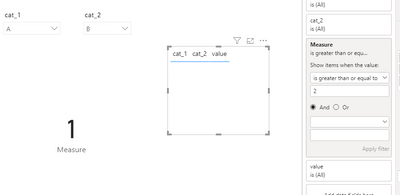
When we chose "A" in cat_1 and "B" in cat_2, a visualization is hidden. (a number of rows is 1.)
*** In my first idea, I set measure counting numbers of rows and set it as visual level filter.
Solved! Go to Solution.
Hi @joade2co ,
Create a measure and add it to visual filter as below.
Measure = COUNTROWS(ALLSELECTED('Table'))
Best Regards,
Jay
Hi @joade2co ,
Create a measure and add it to visual filter as below.
Measure = COUNTROWS(ALLSELECTED('Table'))
Best Regards,
Jay
@joade2co , You will not be able to hide visual. You create a measure and return null.
example
Switch( true(),
Max([cat_1]) = "All" && isfiltered([cat_2]) =False() , blank(),
[Measure]
)
| User | Count |
|---|---|
| 54 | |
| 37 | |
| 27 | |
| 17 | |
| 16 |
| User | Count |
|---|---|
| 70 | |
| 58 | |
| 38 | |
| 22 | |
| 21 |