cancel
Showing results for 
Search instead for 
Did you mean: 

Did you hear? There's a new SQL AI Developer certification (DP-800). Start preparing now and be one of the first to get certified. Register now

Reply
Anonymous
Not applicable

Status Tracking

Hello everyone, I have the following table;


ID               Date          Status

105/05/2023A
106/05/2023B
201/02/2023A
201/04/2023C
305/05/2023A
306/05/2023C


I would like to define the following ;


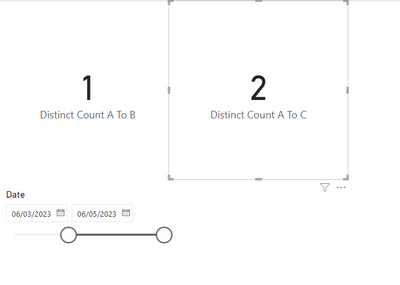
Measure 1 = COUNT (Status A to Status B) = 1 Total


Measure 2 = COUNT (Status A to Status C) = 2 Total 


Which would allow to me to count how many unique IDs have changed from A to B and from A to C over time.


Could anyone provide me with some help on this?


Many Thanks 

1 ACCEPTED SOLUTION
Ritaf1983
Super User
Super User

Hi @Anonymous 
Dax formula for your first request :

Distinct Count A To B =
CALCULATE(
    DISTINCTCOUNT('Table'[ID]),
    FILTER(
        'Table',
        'Table'[Status] = "B" &&
        CALCULATE(
            MAX('Table'[Date]),
            FILTER(
                'Table',
                'Table'[ID] = EARLIER('Table'[ID]) &&
                'Table'[Status] = "A"
            )
        ) <'Table'[Date]
    )
)
 
For Second :
Distinct Count A To C =
CALCULATE(
    DISTINCTCOUNT('Table'[ID]),
    FILTER(
        'Table',
        'Table'[Status] = "C" &&
        CALCULATE(
            MAX('Table'[Date]),
            FILTER(
                'Table',
                'Table'[ID] = EARLIER('Table'[ID]) &&
                'Table'[Status] = "A"
            )
        ) <'Table'[Date]
    )
)
 
If this post helps, then please consider Accept it as the solution to help the other members find it more quickly


Regards,
Rita Fainshtein | Microsoft MVP
https://www.linkedin.com/in/rita-fainshtein/
Blog : https://www.madeiradata.com/profile/ritaf/profile

View solution in original post

3 REPLIES 3
Ritaf1983
Super User
Super User

Hi @Anonymous 
Dax formula for your first request :

Distinct Count A To B =
CALCULATE(
    DISTINCTCOUNT('Table'[ID]),
    FILTER(
        'Table',
        'Table'[Status] = "B" &&
        CALCULATE(
            MAX('Table'[Date]),
            FILTER(
                'Table',
                'Table'[ID] = EARLIER('Table'[ID]) &&
                'Table'[Status] = "A"
            )
        ) <'Table'[Date]
    )
)
 
For Second :
Distinct Count A To C =
CALCULATE(
    DISTINCTCOUNT('Table'[ID]),
    FILTER(
        'Table',
        'Table'[Status] = "C" &&
        CALCULATE(
            MAX('Table'[Date]),
            FILTER(
                'Table',
                'Table'[ID] = EARLIER('Table'[ID]) &&
                'Table'[Status] = "A"
            )
        ) <'Table'[Date]
    )
)
 
If this post helps, then please consider Accept it as the solution to help the other members find it more quickly


Regards,
Rita Fainshtein | Microsoft MVP
https://www.linkedin.com/in/rita-fainshtein/
Blog : https://www.madeiradata.com/profile/ritaf/profile
Anonymous
Not applicable

Thank you this is perfect 🙂 

It was my pleasure to assist 🙂 

Regards,
Rita Fainshtein | Microsoft MVP
https://www.linkedin.com/in/rita-fainshtein/
Blog : https://www.madeiradata.com/profile/ritaf/profile

Helpful resources

Announcements
April Power BI Update Carousel

Power BI Monthly Update - April 2026

Check out the April 2026 Power BI update to learn about new features.

Fabric SQL PBI Data Days

Data Days 2026 coming soon!

Sign up to receive a private message when registration opens and key events begin.

New to Fabric survey Carousel

New to Fabric Survey

If you have recently started exploring Fabric, we'd love to hear how it's going. Your feedback can help with product improvements.

Power BI DataViz World Championships carousel

Power BI DataViz World Championships - June 2026

A new Power BI DataViz World Championship is coming this June! Don't miss out on submitting your entry.