Don't miss your chance to take the Fabric Data Engineer (DP-600) exam for FREE! Find out how by watching the DP-600 session on-demand now through April 28th.
Learn moreJoin the FabCon + SQLCon recap series. Up next: Power BI, Real-Time Intelligence, IQ and AI, and Data Factory take center stage. All sessions are available on-demand after the live show. Register now
I have a table with deliveries and items in each delivery. I want to get the cost for each delivery but each item has the cost for the delivery. How do I create a measure to get the cost for a delivery. My data looks like this:
| Deliver | Item | Delivery Cost |
| A | 1 | $1 |
| A | 2 | $1 |
| A | 3 | $1 |
| A | 4 | $1 |
| A | 5 | $1 |
| B | 6 | $20 |
| B | 7 | $20 |
| B | 8 | $5 |
| C | 9 | $5 |
Solved! Go to Solution.
Hi @TomSinAA ,
Here we go 🙂
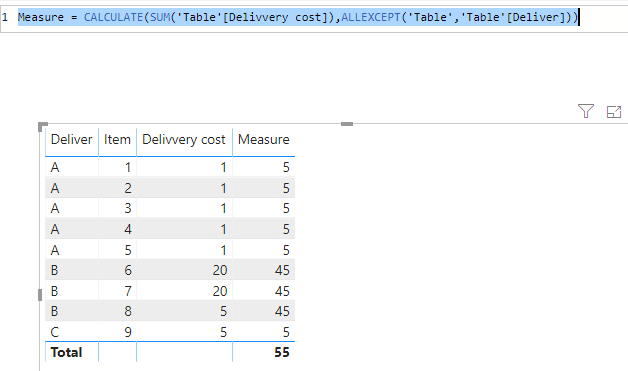
Measure = CALCULATE(SUM('Table'[Delivvery cost]),ALLEXCEPT('Table','Table'[Deliver]))
Hi @TomSinAA ,
Here we go 🙂
Measure = CALCULATE(SUM('Table'[Delivvery cost]),ALLEXCEPT('Table','Table'[Deliver]))
So, to confirm: the cost of the delivery is represented on each item line, so that the total cost for the delivery is not a SUM of the line costs, but just that one value?
You could write a measure like this:
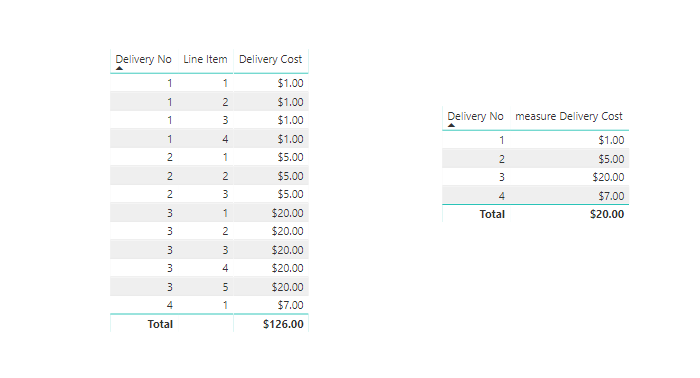
Delivery Cost = MAX( 'TableName'[Delivery Cost] )
Then build a table vizualization with your delivery field, and delivery cost measure.
Check out the April 2026 Power BI update to learn about new features.
If you have recently started exploring Fabric, we'd love to hear how it's going. Your feedback can help with product improvements.
A new Power BI DataViz World Championship is coming this June! Don't miss out on submitting your entry.
| User | Count |
|---|---|
| 41 | |
| 37 | |
| 34 | |
| 21 | |
| 16 |
| User | Count |
|---|---|
| 64 | |
| 58 | |
| 31 | |
| 25 | |
| 25 |