Join us at FabCon Atlanta from March 16 - 20, 2026, for the ultimate Fabric, Power BI, AI and SQL community-led event. Save $200 with code FABCOMM.
Register now!Get Fabric certified for FREE! Don't miss your chance! Learn more
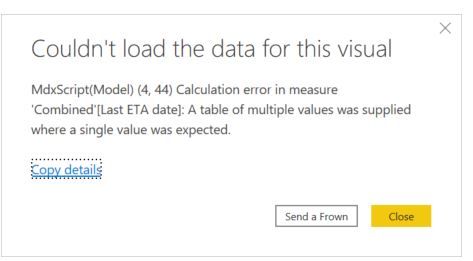
I have tried to retrieve the ETA date independently when the inserted date is the earliest and when it is the latest, then calculate the variation in days.
When I use the following formula:
Solved! Go to Solution.
Hi @MarioCadena ,
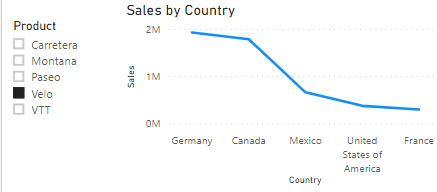
You could edit interaction in Format.
https://docs.microsoft.com/en-us/power-bi/create-reports/service-reports-visual-interactions
@MarioCadena , you can not use values there
CALCULATE(Max(Combined[ETA Date]),FILTER(ALL(Combined[DW_InsertedDateTime]),Combined[DW_InsertedDateTime]=max(Combined[DW_InsertedDateTime])))
or
CALCULATE(max(Combined[ETA Date]),FILTER(ALL(Combined[DW_InsertedDateTime]),Combined[DW_InsertedDateTime]=max(Combined[DW_InsertedDateTime])),values(Combined[ETA Date]))
It worked, thank you.
Also, could you tell me how to change it; so, the calculation is not affected by filters?
Regards,
Mario
Hi @MarioCadena ,
You could edit interaction in Format.
https://docs.microsoft.com/en-us/power-bi/create-reports/service-reports-visual-interactions
Share feedback directly with Fabric product managers, participate in targeted research studies and influence the Fabric roadmap.
Check out the February 2026 Power BI update to learn about new features.
| User | Count |
|---|---|
| 68 | |
| 59 | |
| 48 | |
| 20 | |
| 16 |
| User | Count |
|---|---|
| 107 | |
| 106 | |
| 39 | |
| 27 | |
| 27 |