Join us in Barcelona for FabCon and SQLCon, September 28 - October 1, 2026.
This is best Fabric, Power BI, SQL and AI community event. How do we know? The last event sold out! Save €200 with code FABCMTY200.
Register now- Power BI forums
- Get Help with Power BI
- Desktop
- Service
- Report Server
- Power Query
- Mobile Apps
- Developer
- DAX Commands and Tips
- Custom Visuals Development Discussion
- Health and Life Sciences
- Power BI Spanish forums
- Translated Spanish Desktop
- Training and Consulting
- Instructor Led Training
- Dashboard in a Day for Women, by Women
- Galleries
- Data Stories Gallery
- Themes Gallery
- Contests Gallery
- QuickViz Gallery
- Quick Measures Gallery
- Visual Calculations Gallery
- Fabric Apps Gallery
- Notebook Gallery
- Translytical Task Flow Gallery
- TMDL Gallery
- R Script Showcase
- Webinars and Video Gallery
- Ideas
- Custom Visuals Ideas (read-only)
- Issues
- Issues
- Events
- Upcoming Events
The Fabric community is now in read-only for platform upgrade. Learn more
- Power BI forums
- Forums
- Get Help with Power BI
- Desktop
- Re: Help using matrix
- Subscribe to RSS Feed
- Mark Topic as New
- Mark Topic as Read
- Float this Topic for Current User
- Bookmark
- Subscribe
- Printer Friendly Page

- Mark as New
- Bookmark
- Subscribe
- Mute
- Subscribe to RSS Feed
- Permalink
Help using matrix
Hi guys,
I have those databases for example:
categories.csv
id;name;category
1;fiat;ford
2;onix;gm
3;etios;toyota
4;macan;porsche
5;enzo;ferrari
history.csv
date;value;id
17/01/2019;1100;1
17/01/2019;1500;2
17/01/2019;700;3
17/01/2019;950;4
17/01/2019;230;5
18/01/2019;1100;1
18/01/2019;1500;2
18/01/2019;700;3
18/01/2019;950;4
18/01/2019;230;5
19/01/2019;1100;1
19/01/2019;1500;2
19/01/2019;700;3
19/01/2019;950;4
19/01/2019;230;5
predict_two.csv
date;value;id
20/01/2019;220;1
20/01/2019;500;2
20/01/2019;120;3
20/01/2019;230;4
20/01/2019;770;5
predict_one.csv
date;value;id
21/01/2019;830;1
21/01/2019;120;2
21/01/2019;250;3
21/01/2019;700;4
21/01/2019;430;5
I wish I could build this using matrix or maybe a table if it's possible:

I tried everything that I know, but I couldn't. I can't move data of predicts to history, because they need to be separated.
Thank you.
Solved! Go to Solution.


- Mark as New
- Bookmark
- Subscribe
- Mute
- Subscribe to RSS Feed
- Permalink
Hi @andfx,
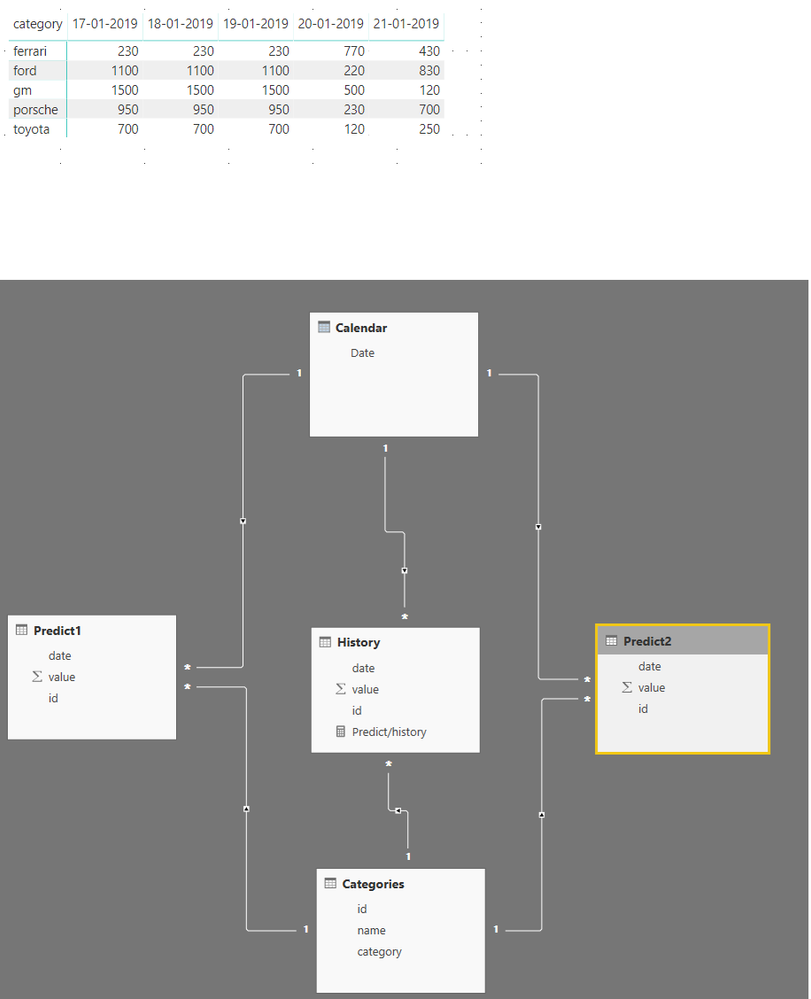
You need to have a 1 to Many relationship wiht a single cross filter direction, then add the following measure to your data:
Predict/history =
SWITCH (
    TRUE ();
    SUM ( History[value] ) <> 0; SUM ( History[value] );
    SUM ( Predict1[value] ) <> 0; SUM ( Predict1[value] );
    SUM ( Predict2[value] ) <> 0; SUM ( Predict2[value] );
    BLANK ()
)
Be aware that this formula is assuming that predit 1 and predict 2 includes diferrente dates and they are also not on the history table.
Result is below and attached PBIX file.
Regards,
MFelix
Regards
Miguel Félix
Did I answer your question? Mark my post as a solution!
Proud to be a Super User!
Check out my blog: Power BI em Português
- Mark as New
- Bookmark
- Subscribe
- Mute
- Subscribe to RSS Feed
- Permalink
I assume that the I'd of categories tables connects with the history and predicts, you should create a calendar table and make relationships between calendar table and the history and calendar and predictions tables based on the date.
Then you just need to use the calendar table as you column headers ans place your historic and prediction on the values should give expected result.
Regards
MFelix
Regards
Miguel Félix
Did I answer your question? Mark my post as a solution!
Proud to be a Super User!
Check out my blog: Power BI em Português- Mark as New
- Bookmark
- Subscribe
- Mute
- Subscribe to RSS Feed
- Permalink
I tried it.. Not worked.
I made calendar
Calendar =
CALENDAR ( MIN ( history[date] ); MAX ( predict_one[date] ) )
Did the relationships
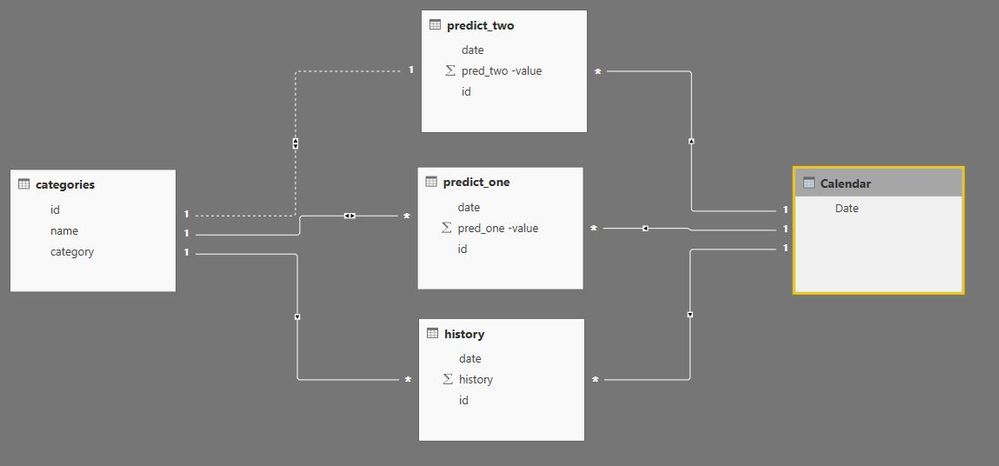
The result:

Thank you.
- Mark as New
- Bookmark
- Subscribe
- Mute
- Subscribe to RSS Feed
- Permalink
Hi @andfx,
You need to have a 1 to Many relationship wiht a single cross filter direction, then add the following measure to your data:
Predict/history =
SWITCH (
    TRUE ();
    SUM ( History[value] ) <> 0; SUM ( History[value] );
    SUM ( Predict1[value] ) <> 0; SUM ( Predict1[value] );
    SUM ( Predict2[value] ) <> 0; SUM ( Predict2[value] );
    BLANK ()
)
Be aware that this formula is assuming that predit 1 and predict 2 includes diferrente dates and they are also not on the history table.
Result is below and attached PBIX file.
Regards,
MFelix
Regards
Miguel Félix
Did I answer your question? Mark my post as a solution!
Proud to be a Super User!
Check out my blog: Power BI em Português- Mark as New
- Bookmark
- Subscribe
- Mute
- Subscribe to RSS Feed
- Permalink
Thanks a lot, you're the best!
Be aware that this formula is assuming that predit 1 and predict 2 includes diferrente dates and they are also not on the history table.
Do you think it's possible to adapt that formula if dates on predit 1 and 2 they are on the history table too ?
Thank yo :))
- Mark as New
- Bookmark
- Subscribe
- Mute
- Subscribe to RSS Feed
- Permalink
How do you want ti handle that?
What values should be kept?
Regards,
MFelix
Regards
Miguel Félix
Did I answer your question? Mark my post as a solution!
Proud to be a Super User!
Check out my blog: Power BI em Português
Helpful resources

FabCon & SQLCon – Barcelona 2026
Join us in Barcelona for FabCon and SQLCon, the Fabric, Power BI, SQL, and AI community event. Save €200 with code FABCMTY200.

Power BI DataViz World Championships - June 2026
A new Power BI DataViz World Championship is coming this June! Don't miss out on submitting your entry.

| User | Count |
|---|---|
| 23 | |
| 22 | |
| 14 | |
| 14 | |
| 13 |


| User | Count |
|---|---|
| 47 | |
| 39 | |
| 24 | |
| 20 | |
| 20 |


