
Join us at FabCon Atlanta from March 16 - 20, 2026, for the ultimate Fabric, Power BI, AI and SQL community-led event. Save $200 with code FABCOMM.
Register now!The Power BI Data Visualization World Championships is back! Get ahead of the game and start preparing now! Learn more
Hi guys,
I have those databases for example:
categories.csv
id;name;category 1;fiat;ford 2;onix;gm 3;etios;toyota 4;macan;porsche 5;enzo;ferrari
history.csv
date;value;id 17/01/2019;1100;1 17/01/2019;1500;2 17/01/2019;700;3 17/01/2019;950;4 17/01/2019;230;5 18/01/2019;1100;1 18/01/2019;1500;2 18/01/2019;700;3 18/01/2019;950;4 18/01/2019;230;5 19/01/2019;1100;1 19/01/2019;1500;2 19/01/2019;700;3 19/01/2019;950;4 19/01/2019;230;5
predict_two.csv
date;value;id 20/01/2019;220;1 20/01/2019;500;2 20/01/2019;120;3 20/01/2019;230;4 20/01/2019;770;5
predict_one.csv
date;value;id 21/01/2019;830;1 21/01/2019;120;2 21/01/2019;250;3 21/01/2019;700;4 21/01/2019;430;5
I wish I could build this using matrix or maybe a table if it's possible:
I tried everything that I know, but I couldn't. I can't move data of predicts to history, because they need to be separated.
Thank you.
Solved! Go to Solution.
Hi @andfx,
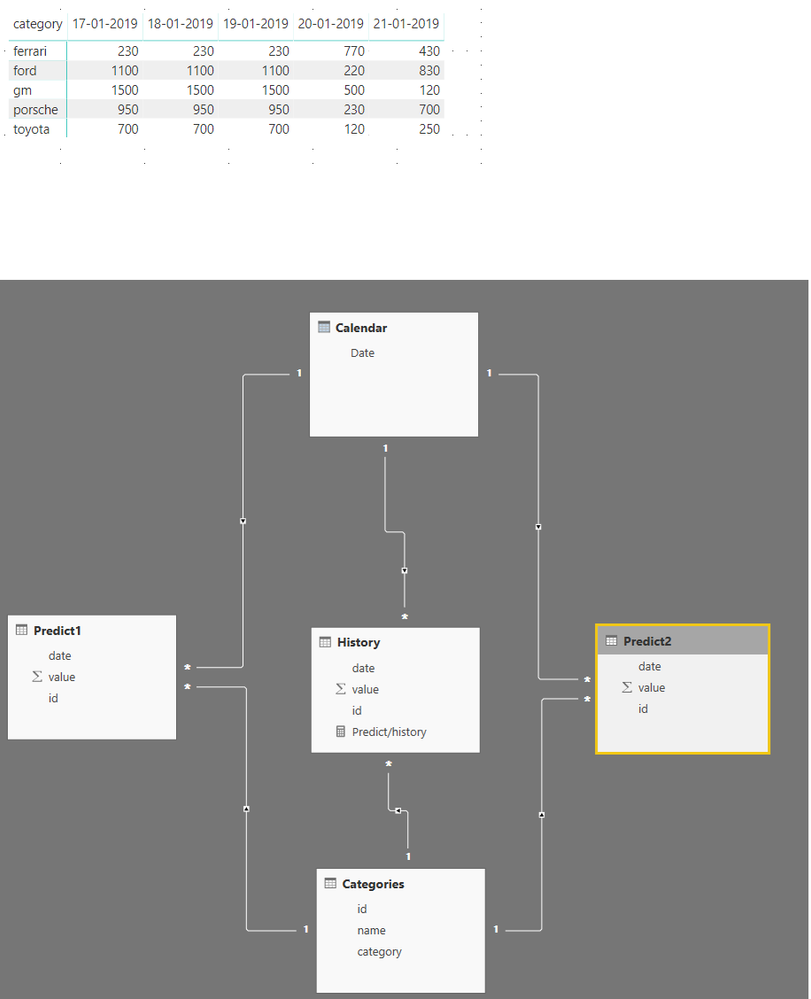
You need to have a 1 to Many relationship wiht a single cross filter direction, then add the following measure to your data:
Predict/history =
SWITCH (
TRUE ();
SUM ( History[value] ) <> 0; SUM ( History[value] );
SUM ( Predict1[value] ) <> 0; SUM ( Predict1[value] );
SUM ( Predict2[value] ) <> 0; SUM ( Predict2[value] );
BLANK ()
)
Be aware that this formula is assuming that predit 1 and predict 2 includes diferrente dates and they are also not on the history table.
Result is below and attached PBIX file.
Regards,
MFelix
Regards
Miguel Félix
Proud to be a Super User!
Check out my blog: Power BI em PortuguêsRegards
Miguel Félix
Proud to be a Super User!
Check out my blog: Power BI em PortuguêsI tried it.. Not worked.
I made calendar
Calendar = CALENDAR ( MIN ( history[date] ); MAX ( predict_one[date] ) )
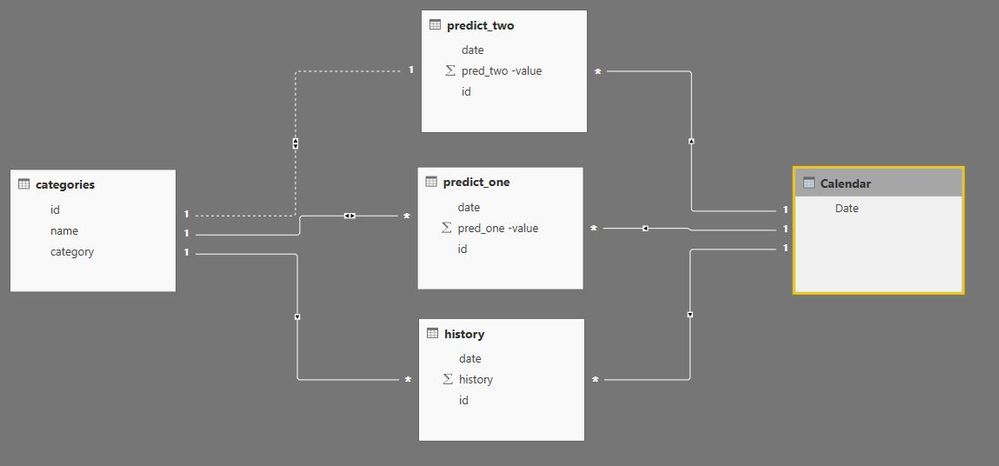
Did the relationships
The result:
Thank you.
Hi @andfx,
You need to have a 1 to Many relationship wiht a single cross filter direction, then add the following measure to your data:
Predict/history =
SWITCH (
TRUE ();
SUM ( History[value] ) <> 0; SUM ( History[value] );
SUM ( Predict1[value] ) <> 0; SUM ( Predict1[value] );
SUM ( Predict2[value] ) <> 0; SUM ( Predict2[value] );
BLANK ()
)
Be aware that this formula is assuming that predit 1 and predict 2 includes diferrente dates and they are also not on the history table.
Result is below and attached PBIX file.
Regards,
MFelix
Regards
Miguel Félix
Proud to be a Super User!
Check out my blog: Power BI em PortuguêsThanks a lot, you're the best!
Be aware that this formula is assuming that predit 1 and predict 2 includes diferrente dates and they are also not on the history table.
Do you think it's possible to adapt that formula if dates on predit 1 and 2 they are on the history table too ?
Thank yo :))
Regards
Miguel Félix
Proud to be a Super User!
Check out my blog: Power BI em PortuguêsThe Power BI Data Visualization World Championships is back! Get ahead of the game and start preparing now!
| User | Count |
|---|---|
| 39 | |
| 37 | |
| 33 | |
| 32 | |
| 29 |
| User | Count |
|---|---|
| 133 | |
| 88 | |
| 85 | |
| 68 | |
| 64 |