cancel
Showing results for 
Search instead for 
Did you mean: 

The Power BI Data Visualization World Championships is back! Get ahead of the game and start preparing now! Learn more

Reply
Anonymous
Not applicable

Compounding Interest Table

Hello,


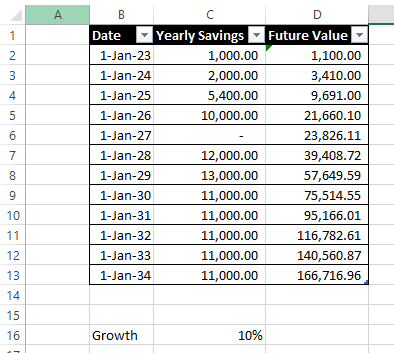
I would like to replicate this table in Excel below, but using Power BI.


shamsulramli_1-1675567741588.png


and there is interest rate in cell C16.


In Excel, for Cell D2, the value would be:  D2 =C2*(1+$C$16)

and for D3, it would be  D3=(D2+C3)*(1+$C$16) and so on and so forth.


I tried using running total but the compounding effect is not calculated correctly, this is what I found in Power BI:

shamsulramli_0-1675567478245.png


The Measure I created for FV3 is 


FV3 = SUMX(FILTER(ALLSELECTED(Table3),Table3[Date]<=MAX(Table3[Date])),Table3[Yearly Savings])*(1+Interest[Interest Value])


Any help is appreciated, thank you in advance!

1 ACCEPTED SOLUTION
Ashish_Mathur
Super User
Super User

Hi,

You may download my PBI file from here.

Hope this helps.

Untitled.png


Regards,
Ashish Mathur
http://www.ashishmathur.com
https://www.linkedin.com/in/excelenthusiasts/

View solution in original post

6 REPLIES 6
Ashish_Mathur
Super User
Super User

Hi,

You may download my PBI file from here.

Hope this helps.

Untitled.png


Regards,
Ashish Mathur
http://www.ashishmathur.com
https://www.linkedin.com/in/excelenthusiasts/
Anonymous
Not applicable

Thank you very much! I have been cracking my brain over this. I will go over your solution and learn from it before using it.

You are welcome.


Regards,
Ashish Mathur
http://www.ashishmathur.com
https://www.linkedin.com/in/excelenthusiasts/

@Ashish_Mathur great approach. Here is a slightly simpler version, but the idea is the same.


FV2 = 
var y = max(Data[Date])
var a = SUMMARIZE(ALLSELECTED(Data),Data[Date],"comp",sum(Data[Yearly savings]),"pow",year(y)-year([Date])+1)
return sumx(filter(a,[pow]>0),[comp]*1.1^[pow])


Thank you @lbendlin for sharing your knowledge.  It indeed is a much shorter formula than mine.


Regards,
Ashish Mathur
http://www.ashishmathur.com
https://www.linkedin.com/in/excelenthusiasts/
lbendlin
Super User
Super User

Power Query version:


let
    Source = Table.FromRows(Json.Document(Binary.Decompress(Binary.FromText("Xc3LDQAhCEXRXli7eALOpxZj/20MmIkQlvcAYU5isFCjDoBW263WnHpYD42+/v0Dt8GJx6f5/HWQAIFDeii9AleQChqwPg==", BinaryEncoding.Base64), Compression.Deflate)), let _t = ((type nullable text) meta [Serialized.Text = true]) in type table [Year = _t, Savings = _t]),
    #"Changed Type" = Table.TransformColumnTypes(Source,{{"Year", Int64.Type}, {"Savings", Currency.Type}}),
    #"Added Index" = Table.AddIndexColumn(#"Changed Type", "Index", 0, 1, Int64.Type),
    #"Added Custom" = Table.AddColumn(#"Added Index", "Future Value", each List.Accumulate({0..[Index]},0,(state,current)=>(state+#"Added Index"[Savings]{current})*1.1)),
    #"Changed Type1" = Table.TransformColumnTypes(#"Added Custom",{{"Future Value", Currency.Type}})
in
    #"Changed Type1"


Since you are adding data in each iteration you cannot do this calculation in DAX.

Helpful resources

Announcements
Power BI DataViz World Championships

Power BI Dataviz World Championships

The Power BI Data Visualization World Championships is back! Get ahead of the game and start preparing now!

December 2025 Power BI Update Carousel

Power BI Monthly Update - December 2025

Check out the December 2025 Power BI Holiday Recap!

FabCon Atlanta 2026 carousel

FabCon Atlanta 2026

Join us at FabCon Atlanta, March 16-20, for the ultimate Fabric, Power BI, AI and SQL community-led event. Save $200 with code FABCOMM.