cancel
Showing results for 
Search instead for 
Did you mean: 

Learn from the best! Meet the four finalists headed to the FINALS of the Power BI Dataviz World Championships! Register now

Reply
Anonymous
Not applicable

Multipoint GeoJson data to map

Hi,


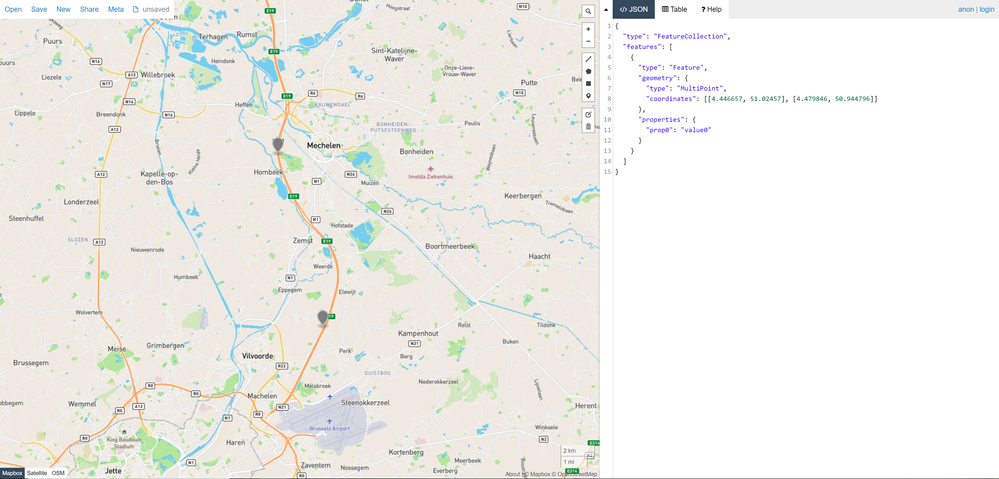
I'm new to Power Bi and I would like to achieve a map with multipoints from a geoJson data.


Here is an example geoJson data with 2 points (coordinates)


{
"type": "FeatureCollection",
"features": [
{
"type": "Feature",
"geometry": {
"type": "MultiPoint",
"coordinates": [
[
4.446657,
51.02457
],
[
4.479846,
50.944796
]
]
},
"properties": {
"prop0": "value0"
}
}
]
}

And here is an example what I would like to achieve.

2020-07-31_10-19-34.png


I couldn't find much information on web how I can use Power Bi with geoJson data. Is that possible to achieve multipoint map with Power Bi? How can i do that? Thanx

1 ACCEPTED SOLUTION
Anonymous
Not applicable

Step 1. Save your geojson in Json format : GeoJson.Json

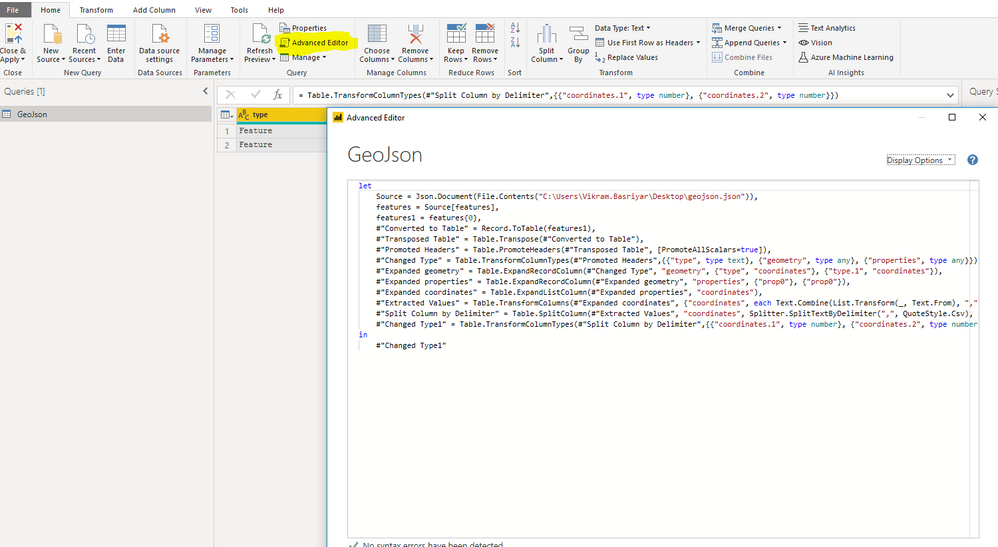
Step 2. Paste below advanced query in the advanced editor in transform data :
 let
Source = Json.Document(File.Contents("C:\Users\Desktop\geojson.json")),
features = Source[features],
features1 = features{0},
#"Converted to Table" = Record.ToTable(features1),
#"Transposed Table" = Table.Transpose(#"Converted to Table"),
#"Promoted Headers" = Table.PromoteHeaders(#"Transposed Table", [PromoteAllScalars=true]),
#"Changed Type" = Table.TransformColumnTypes(#"Promoted Headers",{{"type", type text}, {"geometry", type any}, {"properties", type any}}),
#"Expanded geometry" = Table.ExpandRecordColumn(#"Changed Type", "geometry", {"type", "coordinates"}, {"type.1", "coordinates"}),
#"Expanded properties" = Table.ExpandRecordColumn(#"Expanded geometry", "properties", {"prop0"}, {"prop0"}),
#"Expanded coordinates" = Table.ExpandListColumn(#"Expanded properties", "coordinates"),
#"Extracted Values" = Table.TransformColumns(#"Expanded coordinates", {"coordinates", each Text.Combine(List.Transform(_, Text.From), ","), type text}),
#"Split Column by Delimiter" = Table.SplitColumn(#"Extracted Values", "coordinates", Splitter.SplitTextByDelimiter(",", QuoteStyle.Csv), {"coordinates.1", "coordinates.2"}),
#"Changed Type1" = Table.TransformColumnTypes(#"Split Column by Delimiter",{{"coordinates.1", type number}, {"coordinates.2", type number}})
in
#"Changed Type1"

Step 3: Close and Apply 

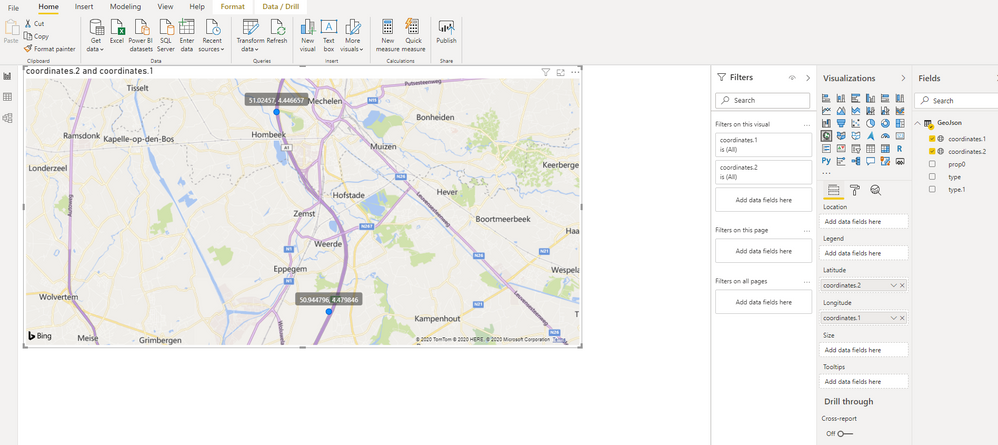
step 4: Change the data type of cordinates.1 and cordinates.2 by selecting the columns to logitude and latitude respectively.
step 5 : pull the logitude and latitude in map visual.Final.PNGTransformdata-->Getdata-->Newquery-->advancededitor--> cody the code and paste--> applyTransformdata-->Getdata-->Newquery-->advancededitor--> cody the code and paste--> apply
View solution in original post

1 REPLY 1
Anonymous
Not applicable

Step 1. Save your geojson in Json format : GeoJson.Json

Step 2. Paste below advanced query in the advanced editor in transform data :
 let
Source = Json.Document(File.Contents("C:\Users\Desktop\geojson.json")),
features = Source[features],
features1 = features{0},
#"Converted to Table" = Record.ToTable(features1),
#"Transposed Table" = Table.Transpose(#"Converted to Table"),
#"Promoted Headers" = Table.PromoteHeaders(#"Transposed Table", [PromoteAllScalars=true]),
#"Changed Type" = Table.TransformColumnTypes(#"Promoted Headers",{{"type", type text}, {"geometry", type any}, {"properties", type any}}),
#"Expanded geometry" = Table.ExpandRecordColumn(#"Changed Type", "geometry", {"type", "coordinates"}, {"type.1", "coordinates"}),
#"Expanded properties" = Table.ExpandRecordColumn(#"Expanded geometry", "properties", {"prop0"}, {"prop0"}),
#"Expanded coordinates" = Table.ExpandListColumn(#"Expanded properties", "coordinates"),
#"Extracted Values" = Table.TransformColumns(#"Expanded coordinates", {"coordinates", each Text.Combine(List.Transform(_, Text.From), ","), type text}),
#"Split Column by Delimiter" = Table.SplitColumn(#"Extracted Values", "coordinates", Splitter.SplitTextByDelimiter(",", QuoteStyle.Csv), {"coordinates.1", "coordinates.2"}),
#"Changed Type1" = Table.TransformColumnTypes(#"Split Column by Delimiter",{{"coordinates.1", type number}, {"coordinates.2", type number}})
in
#"Changed Type1"

Step 3: Close and Apply 

step 4: Change the data type of cordinates.1 and cordinates.2 by selecting the columns to logitude and latitude respectively.
step 5 : pull the logitude and latitude in map visual.Final.PNGTransformdata-->Getdata-->Newquery-->advancededitor--> cody the code and paste--> applyTransformdata-->Getdata-->Newquery-->advancededitor--> cody the code and paste--> apply
Helpful resources

Announcements
Join our Fabric User Panel

Join our Fabric User Panel

Share feedback directly with Fabric product managers, participate in targeted research studies and influence the Fabric roadmap.

February Power BI Update Carousel

Power BI Monthly Update - February 2026

Check out the February 2026 Power BI update to learn about new features.

FabCon Atlanta 2026 carousel

FabCon Atlanta 2026

Join us at FabCon Atlanta, March 16-20, for the ultimate Fabric, Power BI, AI and SQL community-led event. Save $200 with code FABCOMM.

Top Solution Authors
Top Kudoed Authors