Get certified for free when you join Fabric Data Days 2026 and dive into Fabric, Power BI, SQL, AI, and other essential data skills.
Join nowData Days is here! Join us now for 60+ days of learning, challenges, and connection. Learn more
I have a table with the following columns:
Product, Date, Cost
I want to be able to have two slicers showing product. User can select a product from each slicer and I need to compare the cost of the two products by date.
Example:
Oil 1/1/2019 2.00
Gas 1/1/2019 1.50
Tea 1/1/2019 0.50
Oil 2/1/2019 2.10
Gas 2/1/2019 1.60
Tea 2/1/2019 0.60
Oil 3/1/2019 2.30
Gas 3/1/2019 1.90
Tea 3/1/2019 1.00
I want two slicers both showing Oil, Gas and Tea.
If user selects say Oil from one and Gas from the other, then output Graph should show
Dates as the X Coordinate, Price as the Y coordinate and bars for Oil and Gas for each date. I would also like to be able to calculate the variance between Oil price and Gas price for each date.
Solved! Go to Solution.
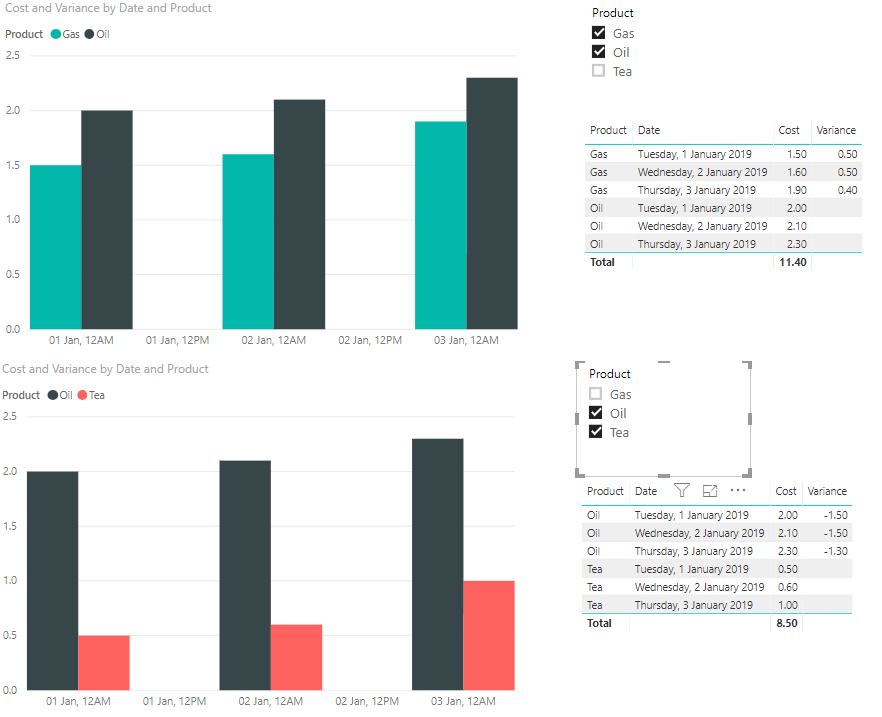
So the first part of your requirement you could just do with a single slicer on Product that is set to allow multiple selections.
Calculating the variance of a multi-select is a bit more involved, but not impossible (see the table on the right above). I did this with the following code:
Variance = var _selectedProducts = ALLSELECTED(Table1[Product]) var _countSelected = COUNTROWS(_selectedProducts) var _prod1 = MINX(_selectedProducts,[Product]) var _prod2 = MAXX(_selectedProducts,[Product]) var _prod1Cost = CALCULATE(sum(Table1[Cost]), Table1[Product] = _prod1) var _prod2Cost = CALCULATE(sum(Table1[Cost]), Table1[Product] = _prod2) var _result = IF(_countSelected = 2 && SELECTEDVALUE(Table1[Product]) = _prod1, _prod2Cost - _prod1Cost) RETURN _result
So the first part of your requirement you could just do with a single slicer on Product that is set to allow multiple selections.
Calculating the variance of a multi-select is a bit more involved, but not impossible (see the table on the right above). I did this with the following code:
Variance = var _selectedProducts = ALLSELECTED(Table1[Product]) var _countSelected = COUNTROWS(_selectedProducts) var _prod1 = MINX(_selectedProducts,[Product]) var _prod2 = MAXX(_selectedProducts,[Product]) var _prod1Cost = CALCULATE(sum(Table1[Cost]), Table1[Product] = _prod1) var _prod2Cost = CALCULATE(sum(Table1[Cost]), Table1[Product] = _prod2) var _result = IF(_countSelected = 2 && SELECTEDVALUE(Table1[Product]) = _prod1, _prod2Cost - _prod1Cost) RETURN _result
@d_gosbell Thanks for the solution. This worked for me. The requirement was to have two slicers - From Product and To Product. So I created two Distinct(product) tables and then created slicers using those table. I had to then tweat your variance code a little.
Thank You.
Don't miss out on Data Days, June 15 through August 7. Learn Fabric, Power BI, SQL, AI and more.
Check out the May 2026 Power BI update to learn about new features.
| User | Count |
|---|---|
| 3 | |
| 1 | |
| 1 | |
| 1 | |
| 1 |