Get certified for free when you join Fabric Data Days 2026 and dive into Fabric, Power BI, SQL, AI, and other essential data skills.
Join nowJuly 7 - July 17 | Round 2 of the Power BI Dataviz World Championships. Don't miss your chance! Learn more
Upon recent Salesforce updates or PBI updates, summary level SF reports are no longer pulling into PBI. With a 2,000 row limit, this is creating problems when trying to pull in any summary reports into PBI.
This was working in prior versions, any idea what changed? I saw a thread to udpate the API version being used, but that didn't solve it.
Current problem: business with 200,000 customers with one of 6 statuses. SF summary report to see how many customers per status which should be a table with 6 rows. SF summary report, customer name, grouped by status. The report in SF is correct, however when loaded into PBI, it pulls the raw table of customer name in column 1 and status in column 2. This exceeds the row limits of 2,000 and breaks. Any ideas how to fix and get back to loading a summary report.
Have tried to save as tabular, matrix and summary in SF Classic and lightning, didn't work.
Hello,
If the Salesforce report shows only 6 summary rows, but Power BI pulls the underlying customer-level rows, the model will quickly hit the Salesforce Reports 2,000-row limit.
I would first check:
Whether Power BI is importing report details instead of summary output.
Whether the report can be copied with only Status and summary count.
Whether customer name or other detail-level fields can be removed.
Whether the same logic can be rebuilt from Salesforce Objects with filters pushed as close to Salesforce as possible.
Another option is to prepare the Salesforce data source before it reaches Power BI.
Power BI Connector for Salesforce by Metrica Software can help:
https://appexchange.salesforce.com/appxListingDetail?listingId=31526f0e-abd8-4cb5-bd1a-3bd56b5c0577
It lets you create Power BI data sources from Salesforce reports or selected Salesforce objects and fields, refine fields and filters, preview the output, and connect Power BI to a prepared source.
This will not force the native Salesforce Reports connector to return summary rows, but it gives you another path to avoid the 2,000-row Reports connector limitation and design a cleaner Salesforce-to-Power BI dataset.
Docs and support:
https://metricasoftware.com/docs/salesforce/
https://metricasoftware.com/docs/salesforce/contact-support/
Cheers,
Metrica Team
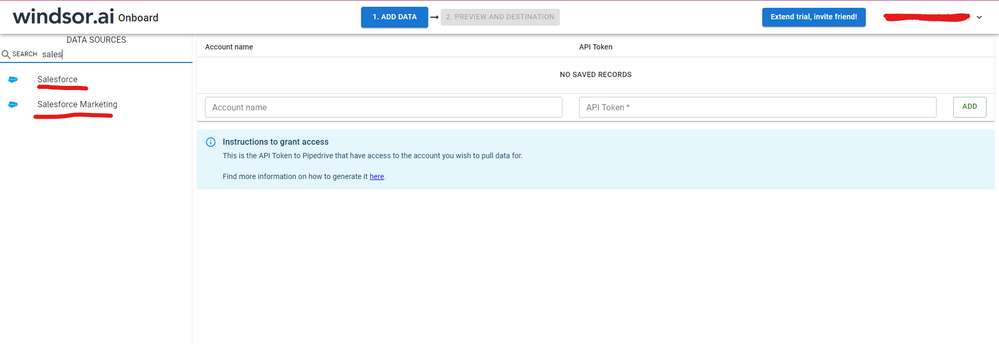
Hi, were you able to find a solution? As a workaround, maybe you can try to test your connection with a 3rd party connector. I've tried windsor.ai, supermetrics and funnel.io. I stayed with windsor because it is much cheaper so just to let you know other options. In case you wonder, to make the connection first search for the Salesforce connector in the data sources list:
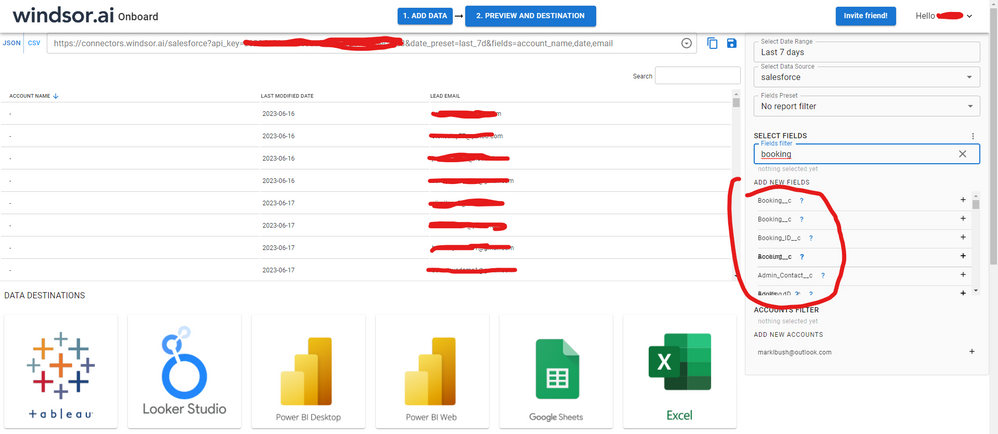
After that, just grant access to your Salesforce account using your credentials, then on preview and destination page you will see a preview of your Salesforce fields:
There just select the fields you need. It is also compatible with custom fields and custom objects, so you'll be able to export them through windsor. Finally, just select PBI as your data destination and finally just copy and paste the url on PBI --> Get Data --> Web --> Paste the url.
Hi @Anonymous ,
Hope the third - party blog can help you.
https://www.linkedin.com/pulse/power-bi-challenges-challenge-6-salesforce-only-allows-vitali-burla
This is just a link to a linkedIN article that you wrote outlining the limitations. It doesn't help at all....I understand the object connection, which doesn't help as the customer object has millions of records. Further, decreasing the report only provides sample data that isn't significant. Can we address the problem - something changed in the recent updates to SF to push detailed row data for summary reports eventhough that toggle is turned off....or perhaps PBI isn't making the request correctly.
Join us in Barcelona for FabCon and SQLCon, the Fabric, Power BI, SQL, and AI community event. Save €200 with code FABCMTY200.
Join Data Days 2026: 60 days of free live/on-demand sessions, challenges, study groups, and certification opportunities.