cancel
Showing results for 
Search instead for 
Did you mean: 

Learn from the best! Meet the four finalists headed to the FINALS of the Power BI Dataviz World Championships! Register now

Reply
tomshaw83
Helper I
Helper I

Return values in Power Query based on condition

Hi all,


I have a query for bringing through values in power query. I have a table which has values in column 1, and some values repeated in column 2 - the rest of column 2 is made up of null values. I would like a column 3 which returns the column 2 value, and the values from column 1 immediately preceding and following it. I have tried merging the table with itself, but find it difficult to generate column 3 - for which I think there may be a more elegant solution.


Column 1Column 2Column 3 
6null6
888
9null9
5nullnull
3nullnull
3null3
444
1null1
3nullnull
6null6
777
2null2
2nullnull
1 ACCEPTED SOLUTION
AlexisOlson
Super User
Super User

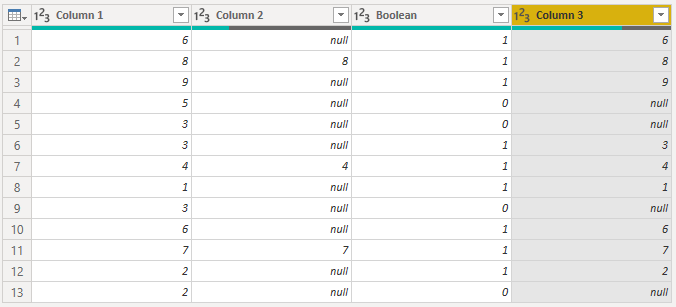
This isn't a very elegant solution but it's the first thing that I came up with:

let
    Source = Table.FromRows(Json.Document(Binary.Decompress(Binary.FromText("i45WMlPSUVKK1YlWsgAyLMAsS5iQKYxhjMEwATJMwCxDDDm4keZAhjmYZQQTgjBiAQ==", BinaryEncoding.Base64), Compression.Deflate)), let _t = ((type nullable text) meta [Serialized.Text = true]) in type table [#"Column 1" = _t, #"Column 2" = _t]),
    #"Changed Type" = Table.TransformColumnTypes(Source,{{"Column 1", Int64.Type}, {"Column 2", Int64.Type}}),
    Boolean = List.Transform(#"Changed Type"[Column 2], each if _ <> null then 1 else 0),
    Combine = List.Transform(
                List.Zip(
                    {
                        Boolean,
                        List.RemoveFirstN(Boolean, 1) & {0},
                        {0} & List.RemoveLastN(Boolean, 1)
                    }
                ), each List.Max(_)
            ),
    AddToTable = Table.FromColumns(Table.ToColumns(#"Changed Type") & {Combine}, Table.ColumnNames(#"Changed Type") & {"Boolean"}),
    AddColumn3 = Table.FromRecords(Table.TransformRows(AddToTable, each _ & [#"Column 3" = if [Boolean] = 1 then [Column 1] else null])),
    #"Changed Type1" = Table.TransformColumnTypes(AddColumn3,{{"Column 1", Int64.Type}, {"Column 2", Int64.Type}, {"Boolean", Int64.Type}, {"Column 3", Int64.Type}})
in
    #"Changed Type1"

AlexisOlson_0-1643301734692.png

View solution in original post

2 REPLIES 2
AlexisOlson
Super User
Super User

This isn't a very elegant solution but it's the first thing that I came up with:

let
    Source = Table.FromRows(Json.Document(Binary.Decompress(Binary.FromText("i45WMlPSUVKK1YlWsgAyLMAsS5iQKYxhjMEwATJMwCxDDDm4keZAhjmYZQQTgjBiAQ==", BinaryEncoding.Base64), Compression.Deflate)), let _t = ((type nullable text) meta [Serialized.Text = true]) in type table [#"Column 1" = _t, #"Column 2" = _t]),
    #"Changed Type" = Table.TransformColumnTypes(Source,{{"Column 1", Int64.Type}, {"Column 2", Int64.Type}}),
    Boolean = List.Transform(#"Changed Type"[Column 2], each if _ <> null then 1 else 0),
    Combine = List.Transform(
                List.Zip(
                    {
                        Boolean,
                        List.RemoveFirstN(Boolean, 1) & {0},
                        {0} & List.RemoveLastN(Boolean, 1)
                    }
                ), each List.Max(_)
            ),
    AddToTable = Table.FromColumns(Table.ToColumns(#"Changed Type") & {Combine}, Table.ColumnNames(#"Changed Type") & {"Boolean"}),
    AddColumn3 = Table.FromRecords(Table.TransformRows(AddToTable, each _ & [#"Column 3" = if [Boolean] = 1 then [Column 1] else null])),
    #"Changed Type1" = Table.TransformColumnTypes(AddColumn3,{{"Column 1", Int64.Type}, {"Column 2", Int64.Type}, {"Boolean", Int64.Type}, {"Column 3", Int64.Type}})
in
    #"Changed Type1"

AlexisOlson_0-1643301734692.png

Thank you

Helpful resources

Announcements
Join our Fabric User Panel

Join our Fabric User Panel

Share feedback directly with Fabric product managers, participate in targeted research studies and influence the Fabric roadmap.

February Power BI Update Carousel

Power BI Monthly Update - February 2026

Check out the February 2026 Power BI update to learn about new features.