Join us at FabCon Atlanta from March 16 - 20, 2026, for the ultimate Fabric, Power BI, AI and SQL community-led event. Save $200 with code FABCOMM.
Register now!The Power BI Data Visualization World Championships is back! Get ahead of the game and start preparing now! Learn more
Hi,
I have a table consisting of columns
| Product | Type | Metric | Year |
Each product undergoes checking twice Review and FInal. A Metric is given to it.
Sample data
| Product | Type | Metric | Year |
| A | Final | 3 | 2014 |
| A | Final | 3 | 2015 |
| A | Final | 3 | 2016 |
| A | Final | 3 | 2017 |
| A | Final | 4 | 2018 |
| A | Final | 4 | 2019 |
| A | Final | 4 | 2020 |
| A | Final | 4 | 2023 |
| A | Review | 4 | 2018 |
| A | Review | 4 | 2019 |
| A | Review | 4 | 2020 |
| A | Review | 4 | 2023 |
| CH | Final | 4 | 2014 |
| CH | Final | 4 | 2016 |
| CH | Final | 4 | 2018 |
| CH | Final | 4 | 2020 |
| CH | Final | 5 | 2022 |
| CH | Review | 4 | 2018 |
| CH | Review | 4 | 2020 |
| IA | Final | 3 | 2014 |
| IA | Final | 4 | 2016 |
| IA | Final | 4 | 2018 |
| IA | Final | 4 | 2020 |
| IA | Final | 5 | 2022 |
| IA | Review | 5 | 2018 |
| IA | Review | 5 | 2020 |
| IS | Final | 4 | 2014 |
| IS | Final | 4 | 2015 |
| IS | Final | 4 | 2016 |
| IS | Final | 4 | 2017 |
| IS | Final | 4 | 2018 |
| IS | Final | 4 | 2019 |
| IS | Final | 4 | 2020 |
| IS | Final | 4 | 2023 |
| IS | Review | 4 | 2018 |
| IS | Review | 4 | 2019 |
| IS | Review | 5 | 2020 |
| IS | Review | 4 | 2023 |
I need help in power query to retrieve the previous row value of metric by Product/Type/Year .
Expected trasnformed output in the column previous metric
| Product | Type | Metric | Year | Previous Metric |
| A | Final | 3 | 2014 | |
| A | Final | 3 | 2015 | 3 |
| A | Final | 3 | 2016 | 3 |
| A | Final | 3 | 2017 | 3 |
| A | Final | 4 | 2018 | 3 |
| A | Final | 4 | 2019 | 4 |
| A | Final | 4 | 2020 | 4 |
| A | Final | 4 | 2023 | 4 |
| A | Review | 4 | 2018 | |
| A | Review | 4 | 2019 | 4 |
| A | Review | 4 | 2020 | 4 |
| A | Review | 4 | 2023 | 4 |
| CH | Final | 4 | 2014 | |
| CH | Final | 4 | 2016 | 4 |
| CH | Final | 4 | 2018 | 4 |
| CH | Final | 4 | 2020 | 4 |
| CH | Final | 5 | 2022 | 4 |
| CH | Review | 4 | 2018 | |
| CH | Review | 4 | 2020 | 4 |
| IA | Final | 3 | 2014 | |
| IA | Final | 4 | 2016 | 3 |
| IA | Final | 4 | 2018 | 4 |
| IA | Final | 4 | 2020 | 4 |
| IA | Final | 5 | 2022 | 4 |
| IA | Review | 5 | 2018 | |
| IA | Review | 5 | 2020 | 5 |
| IS | Final | 4 | 2014 | |
| IS | Final | 4 | 2015 | 4 |
| IS | Final | 4 | 2016 | 4 |
| IS | Final | 4 | 2017 | 4 |
| IS | Final | 4 | 2018 | 4 |
| IS | Final | 4 | 2019 | 4 |
| IS | Final | 4 | 2020 | 4 |
| IS | Final | 4 | 2023 | 4 |
| IS | Review | 4 | 2018 | |
| IS | Review | 4 | 2019 | 4 |
| IS | Review | 5 | 2020 | 4 |
| IS | Review | 4 | 2023 | 5 |
Any help will be appreciated.
Cheers
Cheenusing
Solved! Go to Solution.
Hi @Anonymous ,
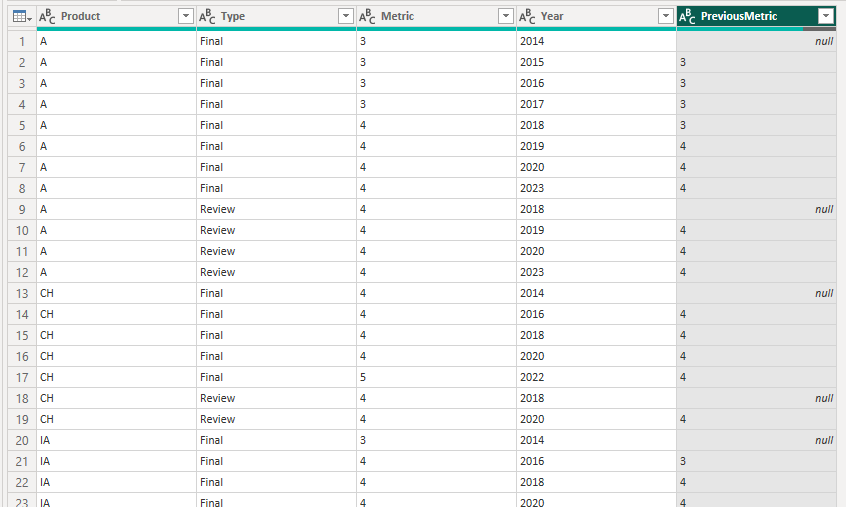
Here's one way to do it using two offset Index columns and merging the table on itself:
let
Source = Table.FromRows(Json.Document(Binary.Decompress(Binary.FromText("ddK9DoQgEATgd6G28BAQSmNijvauNBZXWJhcLPX1NcL9ADMFofiSnWWXcRSdqMSwrK/3eTfnkfVNiamCoBkYBm0BKoBl4AjImkHzhce8LfOOQnJxTP5icgk5/b3sWVExVCyT2EEiOoj8CX4qoljP00V7sAVDxTJBOUnfPhmqLspl9Kn3ZPNGoqkYKi0VS8Ux4V3H/3MJ3h4kB6gcEPir0wE=", BinaryEncoding.Base64), Compression.Deflate)), let _t = ((type nullable text) meta [Serialized.Text = true]) in type table [Product = _t, Type = _t, Metric = _t, Year = _t]),
sortProductTypeYear = Table.Sort(Source,{{"Product", Order.Ascending}, {"Type", Order.Ascending}, {"Year", Order.Ascending}}),
addIndex1 = Table.AddIndexColumn(sortProductTypeYear, "Index1", 1, 1, Int64.Type),
addIndex0 = Table.AddIndexColumn(addIndex1, "Index0", 0, 1, Int64.Type),
mergeOnSelf = Table.NestedJoin(addIndex0, {"Product", "Type", "Index0"}, addIndex0, {"Product", "Type", "Index1"}, "addIndex", JoinKind.LeftOuter),
expandPreviousMetric = Table.ExpandTableColumn(mergeOnSelf, "addIndex", {"Metric"}, {"PreviousMetric"}),
remOthCols = Table.SelectColumns(expandPreviousMetric,{"Product", "Type", "Metric", "Year", "PreviousMetric"})
in
remOthCols
To get this output:
Pete
Proud to be a Datanaut!
hello, @Anonymous
s = your_table,
f = (x) =>
[a = Table.ToColumns(x),
b = Table.FromColumns(a & {{null} & List.RemoveLastN(x[Metric], 1)}, Table.ColumnNames(x) & {"Previous Metric"})][b],
g = Table.Group(s, {"Product", "Type"}, {{"pm", (x) => f(Table.Sort(x, "Year"))}}),
z = Table.ExpandTableColumn(g, "pm", {"Metric", "Year", "Previous Metric"})
hello, @Anonymous
s = your_table,
f = (x) =>
[a = Table.ToColumns(x),
b = Table.FromColumns(a & {{null} & List.RemoveLastN(x[Metric], 1)}, Table.ColumnNames(x) & {"Previous Metric"})][b],
g = Table.Group(s, {"Product", "Type"}, {{"pm", (x) => f(Table.Sort(x, "Year"))}}),
z = Table.ExpandTableColumn(g, "pm", {"Metric", "Year", "Previous Metric"})
@Anonymous Can't do step by step. I'll explain the idea.
f = (x) => is custom function (it's not a step) that takes a table as an argument. It takes a column with metric, "shifts it down" by one item (cuts the tail of the list and adds null as first item: {null} & List.RemoveLastN(x[Metric], 1)) so that we have a list with previous metrics values. Then we simply split table x to a list of columns (Table.ToColumns), add a list with shifted metrics values to it and transform this updated list of columns back to table (Table.FromColumns).
Function f must be applied to a group of rows with the same values of Product and Type. That what Table.Group does. Then we simply create new aggregated column pm, sort each table by year and apply our transformation f . Expand some columns from transformed table in the end (Table.ExpandTableColumn).
Hi @Anonymous ,
Here's one way to do it using two offset Index columns and merging the table on itself:
let
Source = Table.FromRows(Json.Document(Binary.Decompress(Binary.FromText("ddK9DoQgEATgd6G28BAQSmNijvauNBZXWJhcLPX1NcL9ADMFofiSnWWXcRSdqMSwrK/3eTfnkfVNiamCoBkYBm0BKoBl4AjImkHzhce8LfOOQnJxTP5icgk5/b3sWVExVCyT2EEiOoj8CX4qoljP00V7sAVDxTJBOUnfPhmqLspl9Kn3ZPNGoqkYKi0VS8Ux4V3H/3MJ3h4kB6gcEPir0wE=", BinaryEncoding.Base64), Compression.Deflate)), let _t = ((type nullable text) meta [Serialized.Text = true]) in type table [Product = _t, Type = _t, Metric = _t, Year = _t]),
sortProductTypeYear = Table.Sort(Source,{{"Product", Order.Ascending}, {"Type", Order.Ascending}, {"Year", Order.Ascending}}),
addIndex1 = Table.AddIndexColumn(sortProductTypeYear, "Index1", 1, 1, Int64.Type),
addIndex0 = Table.AddIndexColumn(addIndex1, "Index0", 0, 1, Int64.Type),
mergeOnSelf = Table.NestedJoin(addIndex0, {"Product", "Type", "Index0"}, addIndex0, {"Product", "Type", "Index1"}, "addIndex", JoinKind.LeftOuter),
expandPreviousMetric = Table.ExpandTableColumn(mergeOnSelf, "addIndex", {"Metric"}, {"PreviousMetric"}),
remOthCols = Table.SelectColumns(expandPreviousMetric,{"Product", "Type", "Metric", "Year", "PreviousMetric"})
in
remOthCols
To get this output:
Pete
Proud to be a Datanaut!
The Power BI Data Visualization World Championships is back! Get ahead of the game and start preparing now!
| User | Count |
|---|---|
| 19 | |
| 9 | |
| 8 | |
| 7 | |
| 6 |