Don't miss your chance to take the Fabric Data Engineer (DP-600) exam for FREE! Find out how by attending the DP-600 session on April 23rd (pacific time), live or on-demand.
Learn moreNext up in the FabCon + SQLCon recap series: The roadmap for Microsoft SQL and Maximizing Developer experiences in Fabric. All sessions are available on-demand after the live show. Register now
Solved! Go to Solution.
Modify the T-SQL query will return one additional row which contains date "2017-4-1" compares to the original result.
You can try those two ways in your desktop.
Best Regards,
Qiuyun Yu
Hi @Anonymous,
Assume you write the T-SQL query when you get data from SQL Server database to filter data between date range '2017-03-01', '2017-03-31', you can open Query Editor -> Advanced Editor, then modify the T_SQL query to include 1st April (eg: replace "2017-3-31" as "2017-4-1")
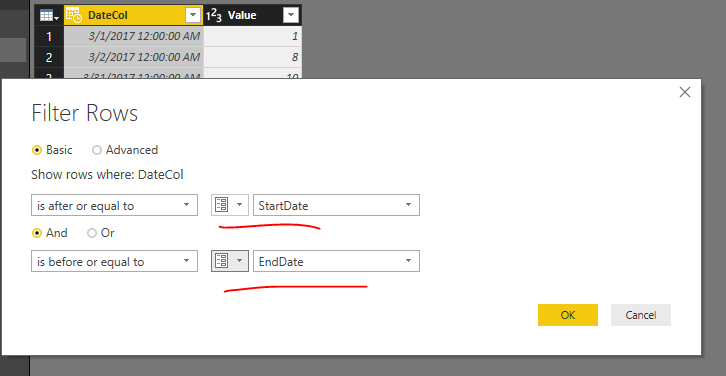
In Power BI desktop, there is Query Parameter feature for us to filter data dynamically. You can create two parameters "StartDate" and "EndDate", then use those two parameters to filter date column. For more information, see: Deep Dive into Query Parameters and Power BI Templates .
Best Regards,
Qiuyun Yu
Thanks v-qiuyu-MSFT,
But does it will replace all data in the query or just append 1st Apr data. I don't want duplicates data.
Modify the T-SQL query will return one additional row which contains date "2017-4-1" compares to the original result.
You can try those two ways in your desktop.
Best Regards,
Qiuyun Yu
If you have recently started exploring Fabric, we'd love to hear how it's going. Your feedback can help with product improvements.
A new Power BI DataViz World Championship is coming this June! Don't miss out on submitting your entry.
Share feedback directly with Fabric product managers, participate in targeted research studies and influence the Fabric roadmap.
| User | Count |
|---|---|
| 6 | |
| 3 | |
| 3 | |
| 3 | |
| 2 |