
Join us at FabCon Atlanta from March 16 - 20, 2026, for the ultimate Fabric, Power BI, AI and SQL community-led event. Save $200 with code FABCOMM.
Register now!The Power BI Data Visualization World Championships is back! It's time to submit your entry. Live now!
Hi all,
Brand new to Power BI so bear with me.
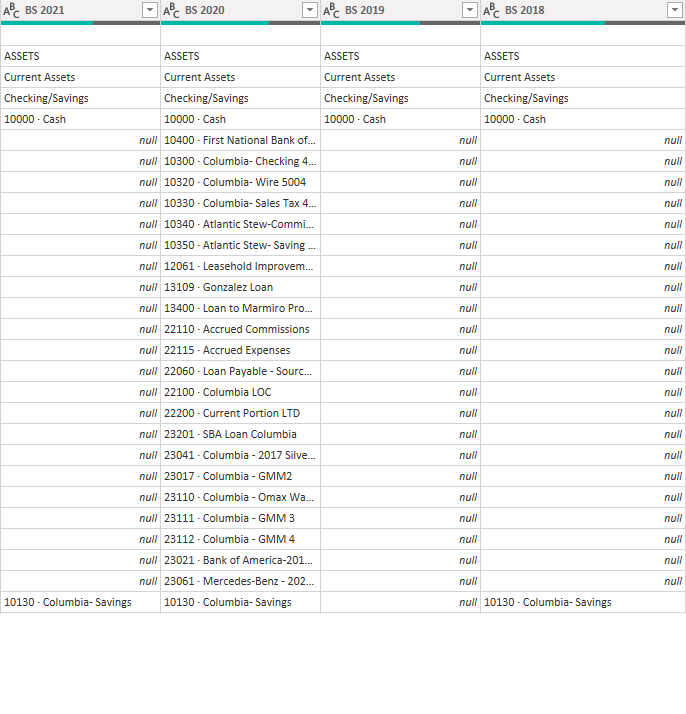
I just merged 4 queries into one generating quite a bit of data.
These were merged based on the 1st column in each query.
What I am looking to do is merge these 4 columns into one, but my issue is with the null values. Each column is a different year and each year has slightly different data in each row. How can I go about merging all 4 columns and replacing the null values with the missing data from respective columns?
Solved! Go to Solution.
Hi @DSwezey ,
Not sure if this fully meets your requirements (it should be noted that in your example [BS 2020] actually holds a complete dataset), but you could try adding a new column with the following calculation:
List.Max({[BS 2018], [BS 2019], [BS 2020], [BS 2021]})
Obviously this isn't particularly dynamic and will break if/when you change the years but, for a one-off operation, should work ok.
Pete
Proud to be a Datanaut!
Hi @DSwezey ,
Not sure if this fully meets your requirements (it should be noted that in your example [BS 2020] actually holds a complete dataset), but you could try adding a new column with the following calculation:
List.Max({[BS 2018], [BS 2019], [BS 2020], [BS 2021]})
Obviously this isn't particularly dynamic and will break if/when you change the years but, for a one-off operation, should work ok.
Pete
Proud to be a Datanaut!
List.Max(Record.ToList(_))
| Thanks to the great efforts by MS engineers to simplify syntax of DAX! Most beginners are SUCCESSFULLY MISLED to think that they could easily master DAX; but it turns out that the intricacy of the most frequently used RANKX() is still way beyond their comprehension! |
DAX is simple, but NOT EASY! |
| User | Count |
|---|---|
| 19 | |
| 12 | |
| 8 | |
| 8 | |
| 7 |