Get certified for free when you join Fabric Data Days 2026 and dive into Fabric, Power BI, SQL, AI, and other essential data skills.
Join nowData Days is here! Join us now for 60+ days of learning, challenges, and connection. Learn more
I'm looking to add a prefix to an existing column but only if it doesn't already have the prefix/conditional.
Any suggestions for how to do this?
Solved! Go to Solution.
Hi @agd50 ,
Difficult to give an exact answer without seeing an example of your data, but the basic conditional structure in Power Query M is as follows:
if <this thing is true>
then <do this thing>
else if <this other thing is true>
then <do this other thing>
else <do this escape action>
The "<do this thing>" part can be to run a function or to declare a variable etc. Therefore, a new custom QUERY STEP for your purpose might look something like this:
Table.ReplaceValue(
PreviousStepName,
each [ColumnToCheck],
each if Text.StartsWith([ColumnToCheck], "Prefix")
then [ColumnToCheck]
else "Prefix " & [ColumnToCheck],
Replacer.ReplaceText,
{"ColumnToCheck"}
)
Pete
Proud to be a Datanaut!
Hi @agd50 ,
I hope this will help you.
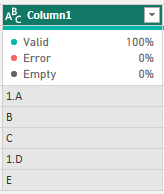
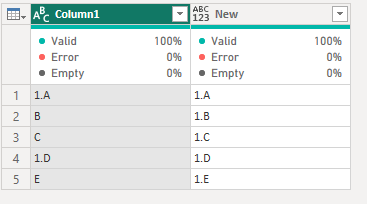
Suppose, I want to prefix all rows in column1 with "1. Here I chose to create a new column in order to allow for a clearer comparison.
Here is the content in the advanced editor:
let
Source = Table.FromRows(Json.Document(Binary.Decompress(Binary.FromText("i45WMtRzVIrViVZyApPOYNJQzwVMuyrFxgIA", BinaryEncoding.Base64), Compression.Deflate)), let _t = ((type nullable text) meta [Serialized.Text = true]) in type table [Column1 = _t]),
#"Changed Type" = Table.TransformColumnTypes(Source,{{"Column1", type text}}),
#"Added Custom" = Table.AddColumn(#"Changed Type", "New", each if Text.Start([Column1], 2) = "1." then [Column1] else "1."&[Column1])
in
#"Added Custom"
The final output is like below:
Best Regards,
Dino Tao
If this post helps, then please consider Accept it as the solution to help the other members find it more quickly.
Hi @agd50 ,
I hope this will help you.
Suppose, I want to prefix all rows in column1 with "1. Here I chose to create a new column in order to allow for a clearer comparison.
Here is the content in the advanced editor:
let
Source = Table.FromRows(Json.Document(Binary.Decompress(Binary.FromText("i45WMtRzVIrViVZyApPOYNJQzwVMuyrFxgIA", BinaryEncoding.Base64), Compression.Deflate)), let _t = ((type nullable text) meta [Serialized.Text = true]) in type table [Column1 = _t]),
#"Changed Type" = Table.TransformColumnTypes(Source,{{"Column1", type text}}),
#"Added Custom" = Table.AddColumn(#"Changed Type", "New", each if Text.Start([Column1], 2) = "1." then [Column1] else "1."&[Column1])
in
#"Added Custom"
The final output is like below:
Best Regards,
Dino Tao
If this post helps, then please consider Accept it as the solution to help the other members find it more quickly.
Hi @agd50 ,
Difficult to give an exact answer without seeing an example of your data, but the basic conditional structure in Power Query M is as follows:
if <this thing is true>
then <do this thing>
else if <this other thing is true>
then <do this other thing>
else <do this escape action>
The "<do this thing>" part can be to run a function or to declare a variable etc. Therefore, a new custom QUERY STEP for your purpose might look something like this:
Table.ReplaceValue(
PreviousStepName,
each [ColumnToCheck],
each if Text.StartsWith([ColumnToCheck], "Prefix")
then [ColumnToCheck]
else "Prefix " & [ColumnToCheck],
Replacer.ReplaceText,
{"ColumnToCheck"}
)
Pete
Proud to be a Datanaut!
Don't miss out on Data Days, June 15 through August 7. Learn Fabric, Power BI, SQL, AI and more.
Check out the May 2026 Power BI update to learn about new features.
| User | Count |
|---|---|
| 4 | |
| 4 | |
| 3 | |
| 2 | |
| 1 |
| User | Count |
|---|---|
| 11 | |
| 11 | |
| 4 | |
| 4 | |
| 4 |