
Learn from the best! Meet the four finalists headed to the FINALS of the Power BI Dataviz World Championships! Register now
Hi,
let
Source = Table.FromRows(Json.Document(Binary.Decompress(Binary.FromText("i45WUtJRiolxVIrViVbyS8xNBXKDwRznnMTiYiDPAswLTk0uyczPA/IhSjPyk5IyU0HyzmA+2BQnZFO8UUyxBPM880pSi1KLS4ACvmABx3SQUiMDhBnOyGZ4gDmJEEXGYE4x3CFOaA4JzsxLByKl2FgA", BinaryEncoding.Base64), Compression.Deflate)), let _t = ((type nullable text) meta [Serialized.Text = true]) in type table [#"Column 1" = _t, #"Column 2" = _t]),
Proper = Table.TransformColumns(Source,{{"Column 1", Text.Proper, type text}}),
Group = Table.Group(
Proper,
{"Column 1"},
{{"Data", each Table.PromoteHeaders(Table.Transpose(_))}},
GroupKind.Local,
(x,y) => if y[Column 1]="" then 1 else 0),
Formatted_Data = Table.Combine(Group[Data])
in
Formatted_Data
Stéphane
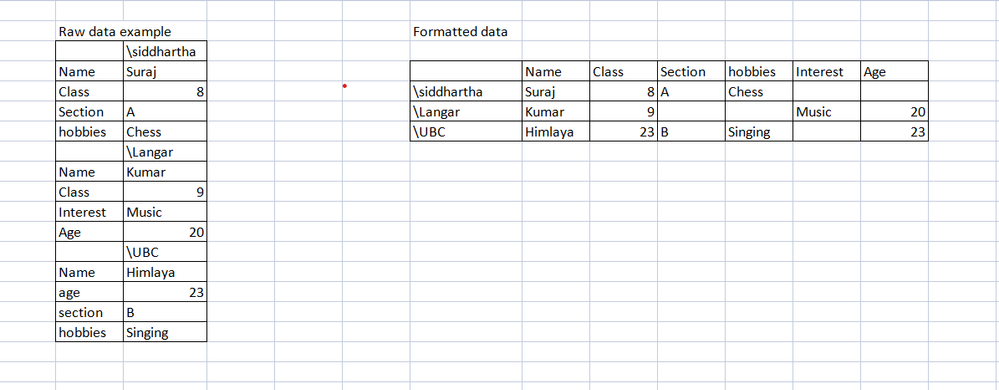
import your date without headers, then try this code.
= Table.Combine(Table.Group(Source,"Column1",{"n",each let a=Table.Skip(_) in Table.FromRows({{[Column2]{0}}&a[Column2]},{"Category"}&List.Transform(a[Column1],Text.Proper))},0,(x,y)=>Byte.From(y=null))[n])
A new Power BI DataViz World Championship is coming this June! Don't miss out on submitting your entry.
Share feedback directly with Fabric product managers, participate in targeted research studies and influence the Fabric roadmap.
| User | Count |
|---|---|
| 5 | |
| 4 | |
| 4 | |
| 3 | |
| 2 |
| User | Count |
|---|---|
| 11 | |
| 10 | |
| 7 | |
| 7 | |
| 6 |