Don't miss your chance to take the Fabric Data Engineer (DP-600) exam for FREE! Find out how by attending the DP-600 session on April 23rd (pacific time), live or on-demand.
Learn moreNext up in the FabCon + SQLCon recap series: The roadmap for Microsoft SQL and Maximizing Developer experiences in Fabric. All sessions are available on-demand after the live show. Register now
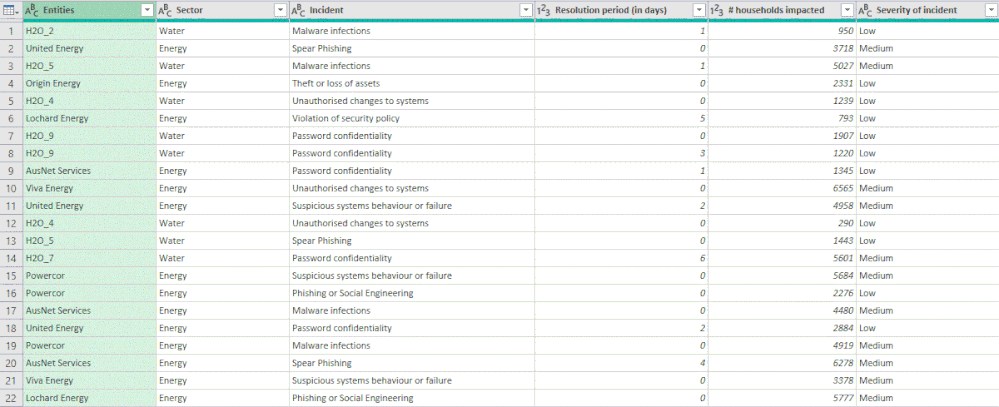
I have the following data:
Table 1
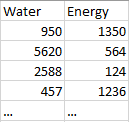
How do I use Power Query to 'pivot' the data (without summarizing, though) to end up with both values of 'Sector' as columns (so, Energy and Water) and '# households impacted' as values, like the following:
Have tried many combinations to no avail.
Please help.
Cheers
Solved! Go to Solution.
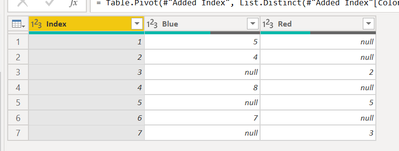
Hello! You will need to either have a unique identifier already in the table, or add an index column. Then you can select the utilities column and unpivot without summarizing the data.
BEFORE
AFTER
SCRIPT
let
Source = Table.FromRows(Json.Document(Binary.Decompress(Binary.FromText("i45WcsopTVXSUTJVitWBc0zAnKDUFCDbCFnCAkkCRYc5koSxUmwsAA==", BinaryEncoding.Base64), Compression.Deflate)), let _t = ((type nullable text) meta [Serialized.Text = true]) in type table [Color = _t, Count = _t]),
#"Changed Type" = Table.TransformColumnTypes(Source,{{"Count", Int64.Type}}),
#"Added Index" = Table.AddIndexColumn(#"Changed Type", "Index", 1, 1, Int64.Type),
#"Pivoted Column" = Table.Pivot(#"Added Index", List.Distinct(#"Added Index"[Color]), "Color", "Count")
in
#"Pivoted Column"
Hello! You will need to either have a unique identifier already in the table, or add an index column. Then you can select the utilities column and unpivot without summarizing the data.
BEFORE
AFTER
SCRIPT
let
Source = Table.FromRows(Json.Document(Binary.Decompress(Binary.FromText("i45WcsopTVXSUTJVitWBc0zAnKDUFCDbCFnCAkkCRYc5koSxUmwsAA==", BinaryEncoding.Base64), Compression.Deflate)), let _t = ((type nullable text) meta [Serialized.Text = true]) in type table [Color = _t, Count = _t]),
#"Changed Type" = Table.TransformColumnTypes(Source,{{"Count", Int64.Type}}),
#"Added Index" = Table.AddIndexColumn(#"Changed Type", "Index", 1, 1, Int64.Type),
#"Pivoted Column" = Table.Pivot(#"Added Index", List.Distinct(#"Added Index"[Color]), "Color", "Count")
in
#"Pivoted Column"
Following is M-code
Solution Excel is uploaded to https://1drv.ms/x/s!Akd5y6ruJhvhuTdyS-bbcrf3KL0Z?e=fSISO0
let
Source = Excel.CurrentWorkbook(){[Name="Table1"]}[Content],
#"Removed Columns" = Table.RemoveColumns(Source,{"Entities", "Incident", "Resolution period (in days)", "Severity of incident"}),
#"Added Index" = Table.AddIndexColumn(#"Removed Columns", "Index", 0, 1, Int64.Type),
#"Divided Column" = Table.TransformColumns(#"Added Index", {{"Index", each _ / 2, type number}}),
#"Rounded Down" = Table.TransformColumns(#"Divided Column",{{"Index", Number.RoundDown, Int64.Type}}),
#"Pivoted Column" = Table.Pivot(#"Rounded Down", List.Distinct(#"Rounded Down"[Sector]), "Sector", "# households impacted"),
#"Removed Columns1" = Table.RemoveColumns(#"Pivoted Column",{"Index"})
in
#"Removed Columns1"
If you have recently started exploring Fabric, we'd love to hear how it's going. Your feedback can help with product improvements.
A new Power BI DataViz World Championship is coming this June! Don't miss out on submitting your entry.
Share feedback directly with Fabric product managers, participate in targeted research studies and influence the Fabric roadmap.
| User | Count |
|---|---|
| 5 | |
| 3 | |
| 3 | |
| 3 | |
| 2 |