
Join us at FabCon Atlanta from March 16 - 20, 2026, for the ultimate Fabric, Power BI, AI and SQL community-led event. Save $200 with code FABCOMM.
Register now!The Power BI Data Visualization World Championships is back! It's time to submit your entry. Live now!
Dear Everyone,
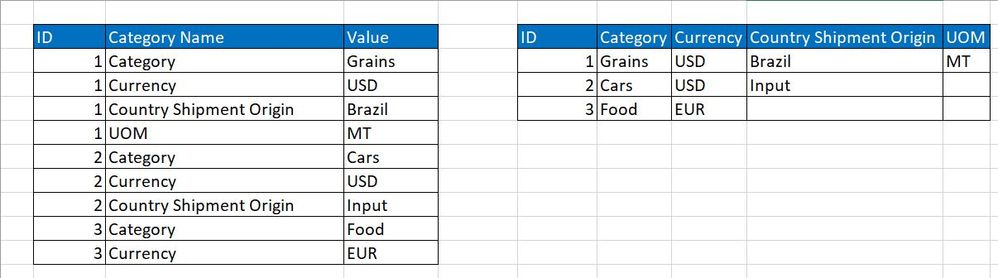
I am not sure if this is feasible, and I am guessing it will be heavy, row by row transformation with a custom M function, but I would like to get some ideas, as how to approach a problem I am currently facing. I will add the example below with mock data.
In short, one ID can have multiple properties with values associated to them. Each ID can have a different number of properties, listed in changing order, but with matching names (!). I would like to reduce the number of rows and expand the number of columns, meaning, one ID is in one row and each property name becomes a header, with a value assigned to it. This feels a bit similar to pivoting, but it is not exactly pivoting and due to the changing number of properties, it is also dynamic.
I would massively appreciate any help, as I am unsure how to approach this or even search on it. Thanks!
Solved! Go to Solution.
Hi @Anonymous ,
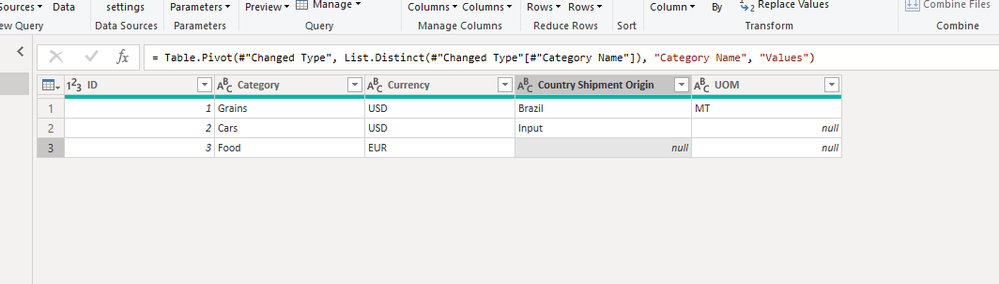
Try this m code:
let
Source = Table.FromRows(Json.Document(Binary.Decompress(Binary.FromText("i45WMlTSUXJOLElNzy+qBDLdixIz84qVYnWgMqVFRal5ySCZ0GAXhHB+aV5JUaVCcEZmQW5qXomCf1FmemYeUMapKLEqMweuMNTfF0j6hoAFjFCtck4sKkaIY1pkhNciz7yC0hKwOmNUY93y81MQ4ghjXUODlGJjAQ==", BinaryEncoding.Base64), Compression.Deflate)), let _t = ((type text) meta [Serialized.Text = true]) in type table [ID = _t, #"Category Name" = _t, Values = _t]),
#"Changed Type" = Table.TransformColumnTypes(Source,{{"ID", Int64.Type}, {"Category Name", type text}, {"Values", type text}}),
#"Pivoted Column" = Table.Pivot(#"Changed Type", List.Distinct(#"Changed Type"[#"Category Name"]), "Category Name", "Values")
in
#"Pivoted Column"
@Anonymous , refer pivot can help
Hi @Anonymous ,
Try this m code:
let
Source = Table.FromRows(Json.Document(Binary.Decompress(Binary.FromText("i45WMlTSUXJOLElNzy+qBDLdixIz84qVYnWgMqVFRal5ySCZ0GAXhHB+aV5JUaVCcEZmQW5qXomCf1FmemYeUMapKLEqMweuMNTfF0j6hoAFjFCtck4sKkaIY1pkhNciz7yC0hKwOmNUY93y81MQ4ghjXUODlGJjAQ==", BinaryEncoding.Base64), Compression.Deflate)), let _t = ((type text) meta [Serialized.Text = true]) in type table [ID = _t, #"Category Name" = _t, Values = _t]),
#"Changed Type" = Table.TransformColumnTypes(Source,{{"ID", Int64.Type}, {"Category Name", type text}, {"Values", type text}}),
#"Pivoted Column" = Table.Pivot(#"Changed Type", List.Distinct(#"Changed Type"[#"Category Name"]), "Category Name", "Values")
in
#"Pivoted Column"
Thanks @camargos88 this is the right direction, but the harder part is to make this dynamic, meaning each ID can have a different number of Properties, ordered in a changing way, so the columns should pick them up in the right order. Right now, a single pivot step will lead to the correct structure, but the columns will have mixed values, from other columns.
I will provide an example of this below.
| ID | Property Name | Value |
| 1 | Country | Brazil |
| 1 | Currency USD | |
| 2 | Currency | EUR |
| 2 | Product | Rice |
| 2 | Country | China |
-->
| ID | Currency | Product | Country |
| 1 | Brazil | ||
| 2 | EUR | Rice | China |
Yes, sorry, you are right - I was confused by the actual values in the data, as a column had very different values and I thought those are values from different fields that should not be in 1 column.
I did not expect pivoting to also recognize all the columns correctly, but it looks like it does.
Hi @Anonymous ,
I pivot the "Property" column and returns the following result.
So how do you manage "Currency USD"? You could share your thoughts here.
| User | Count |
|---|---|
| 20 | |
| 10 | |
| 8 | |
| 8 | |
| 7 |