Get Fabric or SQL Certified for Free.
Get certified for free when you join Fabric Data Days 2026 and dive into Fabric, Power BI, SQL, AI, and other essential data skills.
Join now- Power BI forums
- Get Help with Power BI
- Desktop
- Service
- Report Server
- Power Query
- Mobile Apps
- Developer
- DAX Commands and Tips
- Custom Visuals Development Discussion
- Health and Life Sciences
- Power BI Spanish forums
- Translated Spanish Desktop
- Training and Consulting
- Instructor Led Training
- Dashboard in a Day for Women, by Women
- Galleries
- Data Stories Gallery
- Themes Gallery
- Contests Gallery
- QuickViz Gallery
- Quick Measures Gallery
- Visual Calculations Gallery
- Fabric Apps Gallery
- Notebook Gallery
- Translytical Task Flow Gallery
- TMDL Gallery
- R Script Showcase
- Webinars and Video Gallery
- Ideas
- Custom Visuals Ideas (read-only)
- Issues
- Issues
- Events
- Upcoming Events
July 7 - July 17 | Round 2 of the Power BI Dataviz World Championships. Don't miss your chance! Learn more
- Power BI forums
- Forums
- Get Help with Power BI
- Power Query
- Re: Combining Common value
- Subscribe to RSS Feed
- Mark Topic as New
- Mark Topic as Read
- Float this Topic for Current User
- Bookmark
- Subscribe
- Printer Friendly Page


- Mark as New
- Bookmark
- Subscribe
- Mute
- Subscribe to RSS Feed
- Permalink
- Report Inappropriate Content
Combining Common value
Hello,
I have a field, which contains several values as below:
| A, B |
| D, E, F |
| A, C |
| B, C |
| D, E, G |
How can I group them together into a common group? Result as below:
| A, B, C |
| D, E, F, G |
| A, B, C |
| A, B, C |
| D, E, F, G |
@ImkeF please take a look. I think this has to use a custom loop function, but I dont know how
Solved! Go to Solution.


- Mark as New
- Bookmark
- Subscribe
- Mute
- Subscribe to RSS Feed
- Permalink
- Report Inappropriate Content
Hi @Iamnvt,
if you have many values on one row, split them into pairs and apply the code for relation pairs as suggested earlier.
This code splits many values on a row into pairs. For example: A,B,C => {{A,B}, {B,C}}
let
    Source = Table.FromRows(Json.Document(Binary.Decompress(Binary.FromText("i45WctRRcNJRcFaK1YlWAjF0FFx1FNzAXCDbBcxwAQqCGXApXx0FP5hUlFJsLAA=", BinaryEncoding.Base64), Compression.Deflate)), let _t = ((type text) meta [Serialized.Text = true]) in type table [Column1 = _t]),
    Pairs = Table.AddColumn(
        Source,
        "Pairs",
        (row) =>
            let
                lst =Text.Split(row[Column1], ", "),
                lstToPairs = List.Accumulate(
                    lst,
                    [lastElement = null, resultList = {}],
                    (state, current) =>
                        if state[lastElement] = null then
                            [
                                lastElement = current,
                                resultList = {}
                            ]
                        else
                            [
                                lastElement = current,
                                resultList = List.Combine(
                                    {
                                        state[resultList],
                                        {
                                            [
                                                First = state[lastElement],
                                                Second = current
                                            ]
                                        }
                                    }
                                )
                            ]
                )
            in
                lstToPairs
    ),
    #"Expanded Pairs" = Table.ExpandRecordColumn(Pairs, "Pairs", {"resultList"}, {"Pairs.resultList"}),
    #"Expanded Pairs.resultList" = Table.ExpandListColumn(#"Expanded Pairs", "Pairs.resultList"),
    #"Expanded Pairs.resultList1" = Table.ExpandRecordColumn(#"Expanded Pairs.resultList", "Pairs.resultList", {"First", "Second"})
in
    #"Expanded Pairs.resultList1"
- Mark as New
- Bookmark
- Subscribe
- Mute
- Subscribe to RSS Feed
- Permalink
- Report Inappropriate Content
@Nolock this gives the expected result!.
Just for further understanding, I am thinking for solution you gave at the first place, if I repeat the code for the "SomethingInCommon" column, it also gives me the result;
How can I make the code recursive with while loop until no further transformation of the value in the row?
let
    Source = Table.FromRows(Json.Document(Binary.Decompress(Binary.FromText("i45WctRRcNJRcNZRcFGK1YlWArHBDLiIi46CK5jhqqPgphQbCwA=", BinaryEncoding.Base64), Compression.Deflate)), let _t = ((type text) meta [Serialized.Text = true]) in type table [Column1 = _t]),
    // split text into a list of values
    TempValueAsList = Table.AddColumn(Source, "TempValueAsList", each Text.Split([Column1], ", ")),
    // create new a column with all rows' values in common
    SomethingInCommon = Table.AddColumn(
        TempValueAsList,
        "SomethingInCommon",
        (curRow) =>
            let
                // get all rows containing any of elements of the current record
                tableWithSameElements = Table.SelectRows(TempValueAsList, (nestedRow) => List.ContainsAny(curRow[TempValueAsList], nestedRow[TempValueAsList])),
                // get the column TempValueAsList
                listToUnion = tableWithSameElements[TempValueAsList],
                // union and sort all elements
                resultList = List.Sort(List.Union(listToUnion)),
                // convert the result list to a text
                resultAsText = Text.Combine(resultList, ",")
            in
                resultAsText
    ),
    // remove temp column
    RemoveTempColumn = Table.RemoveColumns(SomethingInCommon, {"TempValueAsList"}),
    TempValueAsList2 = Table.AddColumn(RemoveTempColumn, "TempValueAsList2", each Text.Split([SomethingInCommon], ",")),
    // create new a column with all rows' values in common
    SomethingInCommon2 = Table.AddColumn(
        TempValueAsList2,
        "SomethingInCommon2",
        (curRow) =>
            let
                // get all rows containing any of elements of the current record
                tableWithSameElements = Table.SelectRows(TempValueAsList2, (nestedRow) => List.ContainsAny(curRow[TempValueAsList2], nestedRow[TempValueAsList2])),
                // get the column TempValueAsList
                listToUnion = tableWithSameElements[TempValueAsList2],
                // union and sort all elements
                resultList = List.Sort(List.Union(listToUnion)),
                // convert the result list to a text
                resultAsText = Text.Combine(resultList, ",")
            in
                resultAsText
    ),
    // remove temp column
    RemoveTempColumn2 = Table.RemoveColumns(SomethingInCommon2, {"TempValueAsList2"})
in
    RemoveTempColumn2
s
- Mark as New
- Bookmark
- Subscribe
- Mute
- Subscribe to RSS Feed
- Permalink
- Report Inappropriate Content
Hi @Iamnvt,
I have a solution for you - the code is commented and contains also some sample data. If you have any questions, don't hesitate to ask 🙂
let
    Source = Table.FromRows(Json.Document(Binary.Decompress(Binary.FromText("i45WctRRcFKK1YlWctFRcNVRcAOzgYLOYIYTjAGRdVeKjQUA", BinaryEncoding.Base64), Compression.Deflate)), let _t = ((type text) meta [Serialized.Text = true]) in type table [Column1 = _t]),
    // split text into a list of values
    TempValueAsList = Table.AddColumn(Source, "TempValueAsList", each Text.Split([Column1], ", ")),
    // create new a column with all rows' values in common
    SomethingInCommon = Table.AddColumn(
        TempValueAsList,
        "SomethingInCommon",
        (curRow) =>
            let
                // get all rows containing any of elements of the current record
                tableWithSameElements = Table.SelectRows(TempValueAsList, (nestedRow) => List.ContainsAny(curRow[TempValueAsList], nestedRow[TempValueAsList])),
                // get the column TempValueAsList
                listToUnion = tableWithSameElements[TempValueAsList],
                // union and sort all elements
                resultList = List.Sort(List.Union(listToUnion)),
                // convert the result list to a text
                resultAsText = Text.Combine(resultList, ",")
            in
                resultAsText
    ),
    // remove temp column
    RemoveTempColumn = Table.RemoveColumns(SomethingInCommon, {"TempValueAsList"})
in
    RemoveTempColumn
And a screenshot of the result.
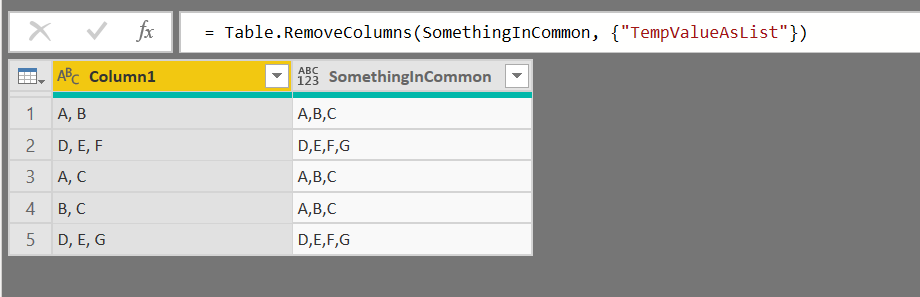
- Mark as New
- Bookmark
- Subscribe
- Mute
- Subscribe to RSS Feed
- Permalink
- Report Inappropriate Content
@Nolock absolutely brilliant!
I have a bit more complex scenarios:
Column1SomethingInCommon
| A, B | A,B,C,D,E,F |
| B, C | A,B,C,D,E,F |
| C, D | A,B,C,D,E,F |
| D, E | A,B,C,D,E,F |
| E, F | A,B,C,D,E,F |
it has a bridge between A,B and B,C and C, D --> B,C is the bridge --> result should be A,B,C,D
How can I achieve that?
Thank you very much for the above solution; it already helped me a lot.
- Mark as New
- Bookmark
- Subscribe
- Mute
- Subscribe to RSS Feed
- Permalink
- Report Inappropriate Content
Hi @Iamnvt,
if I understand you well you would like to find a transitive closure. Am I right?
- Mark as New
- Bookmark
- Subscribe
- Mute
- Subscribe to RSS Feed
- Permalink
- Report Inappropriate Content
@Nolock I am not sure what you meant, but here is the scenarious, and expected result:
Col1 Expected Result
| A, B | A,B,C,D,E,F |
| B, C | A,B,C,D,E,F |
| C, D | A,B,C,D,E,F |
| D, E | A,B,C,D,E,F |
| E, F | A,B,C,D,E,F |


- Mark as New
- Bookmark
- Subscribe
- Mute
- Subscribe to RSS Feed
- Permalink
- Report Inappropriate Content
Hi @Iamnvt ,
not sure about the pattern here. How would the desired result for these sample data look like?:
| A, B |
| B, C |
| C, D |
| D, E |
| E, F |
| M, N |
| D, Z |
Imke Feldmann (The BIccountant)
If you liked my solution, please give it a thumbs up. And if I did answer your question, please mark this post as a solution. Thanks!
How to integrate M-code into your solution -- How to get your questions answered quickly -- How to provide sample data -- Check out more PBI- learning resources here -- Performance Tipps for M-queries
- Mark as New
- Bookmark
- Subscribe
- Mute
- Subscribe to RSS Feed
- Permalink
- Report Inappropriate Content
@ImkeF here it is the pattern.
| A, B, C | A, B, C, D, E, F, Z |
| B, C | A, B, C, D, E, F, Z |
| C, D | A, B, C, D, E, F, Z |
| D, E | A, B, C, D, E, F, Z |
| E, F | A, B, C, D, E, F, Z |
| M, N | M, N |
| D, Z | A, B, C, D, E, F, Z |
- Mark as New
- Bookmark
- Subscribe
- Mute
- Subscribe to RSS Feed
- Permalink
- Report Inappropriate Content
@Nolock this is ok if I have only 2 value in a row.
How about the case I have multiple values in a row? Like:
| A, B, C | A, B, C, D, E, F, Z |
| B, C, E, F | A, B, C, D, E, F, Z |
| C, D | A, B, C, D, E, F, Z |
| D, E | A, B, C, D, E, F, Z |
| E, F | A, B, C, D, E, F, Z |
| M, N | M, N |
| D, Z | A, B, C, D, E, F, Z |
- Mark as New
- Bookmark
- Subscribe
- Mute
- Subscribe to RSS Feed
- Permalink
- Report Inappropriate Content
Hi @Iamnvt,
if you have many values on one row, split them into pairs and apply the code for relation pairs as suggested earlier.
This code splits many values on a row into pairs. For example: A,B,C => {{A,B}, {B,C}}
let
    Source = Table.FromRows(Json.Document(Binary.Decompress(Binary.FromText("i45WctRRcNJRcFaK1YlWAjF0FFx1FNzAXCDbBcxwAQqCGXApXx0FP5hUlFJsLAA=", BinaryEncoding.Base64), Compression.Deflate)), let _t = ((type text) meta [Serialized.Text = true]) in type table [Column1 = _t]),
    Pairs = Table.AddColumn(
        Source,
        "Pairs",
        (row) =>
            let
                lst =Text.Split(row[Column1], ", "),
                lstToPairs = List.Accumulate(
                    lst,
                    [lastElement = null, resultList = {}],
                    (state, current) =>
                        if state[lastElement] = null then
                            [
                                lastElement = current,
                                resultList = {}
                            ]
                        else
                            [
                                lastElement = current,
                                resultList = List.Combine(
                                    {
                                        state[resultList],
                                        {
                                            [
                                                First = state[lastElement],
                                                Second = current
                                            ]
                                        }
                                    }
                                )
                            ]
                )
            in
                lstToPairs
    ),
    #"Expanded Pairs" = Table.ExpandRecordColumn(Pairs, "Pairs", {"resultList"}, {"Pairs.resultList"}),
    #"Expanded Pairs.resultList" = Table.ExpandListColumn(#"Expanded Pairs", "Pairs.resultList"),
    #"Expanded Pairs.resultList1" = Table.ExpandRecordColumn(#"Expanded Pairs.resultList", "Pairs.resultList", {"First", "Second"})
in
    #"Expanded Pairs.resultList1"
- Mark as New
- Bookmark
- Subscribe
- Mute
- Subscribe to RSS Feed
- Permalink
- Report Inappropriate Content
@Nolock this gives the expected result!.
Just for further understanding, I am thinking for solution you gave at the first place, if I repeat the code for the "SomethingInCommon" column, it also gives me the result;
How can I make the code recursive with while loop until no further transformation of the value in the row?
let
    Source = Table.FromRows(Json.Document(Binary.Decompress(Binary.FromText("i45WctRRcNJRcNZRcFGK1YlWArHBDLiIi46CK5jhqqPgphQbCwA=", BinaryEncoding.Base64), Compression.Deflate)), let _t = ((type text) meta [Serialized.Text = true]) in type table [Column1 = _t]),
    // split text into a list of values
    TempValueAsList = Table.AddColumn(Source, "TempValueAsList", each Text.Split([Column1], ", ")),
    // create new a column with all rows' values in common
    SomethingInCommon = Table.AddColumn(
        TempValueAsList,
        "SomethingInCommon",
        (curRow) =>
            let
                // get all rows containing any of elements of the current record
                tableWithSameElements = Table.SelectRows(TempValueAsList, (nestedRow) => List.ContainsAny(curRow[TempValueAsList], nestedRow[TempValueAsList])),
                // get the column TempValueAsList
                listToUnion = tableWithSameElements[TempValueAsList],
                // union and sort all elements
                resultList = List.Sort(List.Union(listToUnion)),
                // convert the result list to a text
                resultAsText = Text.Combine(resultList, ",")
            in
                resultAsText
    ),
    // remove temp column
    RemoveTempColumn = Table.RemoveColumns(SomethingInCommon, {"TempValueAsList"}),
    TempValueAsList2 = Table.AddColumn(RemoveTempColumn, "TempValueAsList2", each Text.Split([SomethingInCommon], ",")),
    // create new a column with all rows' values in common
    SomethingInCommon2 = Table.AddColumn(
        TempValueAsList2,
        "SomethingInCommon2",
        (curRow) =>
            let
                // get all rows containing any of elements of the current record
                tableWithSameElements = Table.SelectRows(TempValueAsList2, (nestedRow) => List.ContainsAny(curRow[TempValueAsList2], nestedRow[TempValueAsList2])),
                // get the column TempValueAsList
                listToUnion = tableWithSameElements[TempValueAsList2],
                // union and sort all elements
                resultList = List.Sort(List.Union(listToUnion)),
                // convert the result list to a text
                resultAsText = Text.Combine(resultList, ",")
            in
                resultAsText
    ),
    // remove temp column
    RemoveTempColumn2 = Table.RemoveColumns(SomethingInCommon2, {"TempValueAsList2"})
in
    RemoveTempColumn2
s
- Mark as New
- Bookmark
- Subscribe
- Mute
- Subscribe to RSS Feed
- Permalink
- Report Inappropriate Content
Hi @Iamnvt,
I don't recommend using recursion because it can be very slow. Try to split your triples, quadruples, and so on into a list and then apply the solution for 2 columns. It should be straight forward to place these 2 steps one after another.
- Mark as New
- Bookmark
- Subscribe
- Mute
- Subscribe to RSS Feed
- Permalink
- Report Inappropriate Content
Hi @Iamnvt,
I've written a recursive function for a similar scenario earlier: https://community.powerbi.com/t5/Power-Query/Recursive-query-to-derive-indirect-relationships/td-p/7...
But because of the recursion it is painfully slow. If you have a smaller dataset it will be ok.
- Mark as New
- Bookmark
- Subscribe
- Mute
- Subscribe to RSS Feed
- Permalink
- Report Inappropriate Content
Hi @Iamnvt,
here we go, it was a nice exercise.
let
    Source = Table.FromRows(Json.Document(Binary.Decompress(Binary.FromText("i45WMlTSUTJSitWBsIzBLCMgywTMMgayLMAsUyDLDMwyA7LM4SygbCwA", BinaryEncoding.Base64), Compression.Deflate)), let _t = ((type text) meta [Serialized.Text = true]) in type table [From = _t, To = _t]),
    ChangedType = Table.TransformColumnTypes(Source,{{"From", type text}, {"To", type text}}),

    // buffer the source table
    BufferedTable = Table.Buffer(ChangedType),

    // create a distinct list of From values
    FromDistinctList = List.Sort(List.Distinct(Table.Column(BufferedTable, "From"))),

    // get all direct descendants as a record (key-value pairs)
    DirectDescendantsRecord = List.Accumulate(
        FromDistinctList,
        [],
        (state, current) =>
            state &
            Expression.Evaluate(
                "[" & current & "= Table.Column(Table.SelectRows(BufferedTable, each [From] = current), ""To"")]",
                [Table.Column = Table.Column, Table.SelectRows = Table.SelectRows, BufferedTable = BufferedTable, current = current]
            )
    ),

    // create a table of distict From values
    TableFromList = Table.RenameColumns(Table.FromList(FromDistinctList), {{"Column1", "From"}}),

    // get recursive all descendants of current value
    AllDescendantRelations = Table.AddColumn(TableFromList, "AllDescendantRelations", each fnTransitiveRelationList({[From]}, DirectDescendantsRecord), type list),

    // get recursively list of all descendants
    fnTransitiveRelationList = (toBeDoneList as list, directDescendantsRecord as record) as list =>
        let
            result =
                if List.IsEmpty(toBeDoneList) then
                    {}
                else
                    let
                        newToBeDoneList = List.RemoveItems(
                            List.Combine(
                                List.Transform(
                                    toBeDoneList,
                                    each Record.FieldOrDefault(directDescendantsRecord, _, {})
                                )
                            ),
                            toBeDoneList
                        )
                    in
                        List.Union({toBeDoneList, newToBeDoneList, @fnTransitiveRelationList(newToBeDoneList, directDescendantsRecord)})

        in
            result,

    // find also all ancestors
    AllRelations = Table.AddColumn(AllDescendantRelations, "AllRelations", (parent) =>
        List.Union(
            List.Select(
                Table.Column(AllDescendantRelations, "AllDescendantRelations"),
                (child) => List.Contains(child, parent[From])
            )
        )
    ),
    ExtractedValues = Table.TransformColumns(AllRelations, {"AllRelations", each Text.Combine(List.Transform(_, Text.From), ";"), type text}),

    // join the source table with new results
    JoinBufferedTableWithResult = Table.NestedJoin(BufferedTable, "From", ExtractedValues, "From", "TempTableToExpand"),
    ExpandResult = Table.ExpandTableColumn(JoinBufferedTableWithResult, "TempTableToExpand", {"AllRelations"})
in
    ExpandResult

Helpful resources

FabCon & SQLCon – Barcelona 2026
Join us in Barcelona for FabCon and SQLCon, the Fabric, Power BI, SQL, and AI community event. Save €200 with code FABCMTY200.

Power BI Monthly Update - July 2026
Check out the July 2026 Power BI update to learn about new features.

Data Days 2026
Join Data Days 2026: 60 days of free live/on-demand sessions, challenges, study groups, and certification opportunities.

Power BI DataViz World Championships - June 2026
A new Power BI DataViz World Championship is coming this June! Don't miss out on submitting your entry.


