Join us at FabCon Atlanta from March 16 - 20, 2026, for the ultimate Fabric, Power BI, AI and SQL community-led event. Save $200 with code FABCOMM.
Register now!The Power BI Data Visualization World Championships is back! Get ahead of the game and start preparing now! Learn more
Hey guys,
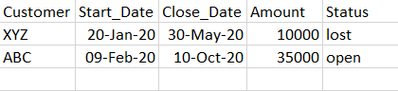
I have a sample data
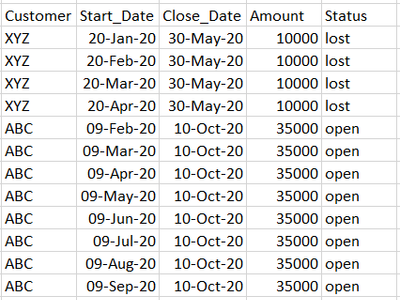
and I am trying to bring in additional rows for every month in between the start date and close date.
something like this:
Please help!!!
Solved! Go to Solution.
Hello @Anonymous
check out this approach. Uses Table.TransformRows to make duplicates of your rows, and apply then needed changes. Afterwards the data is transformed back from a list of records to a table.
let
Source = Table.FromRows(Json.Document(Binary.Decompress(Binary.FromText("i45WclTSUTIy0DMw1DMyADKNgUxTCNPQAAiAdE5+cYlSrE60khOQY2CpZ2AEk9cDIoguU4jS/ILUPKXYWAA=", BinaryEncoding.Base64), Compression.Deflate)), let _t = ((type nullable text) meta [Serialized.Text = true]) in type table [Customer = _t, #"Start Date" = _t, #"Close date" = _t, Amount = _t, Status = _t]),
#"Changed Type" = Table.TransformColumnTypes(Source,{{"Customer", type text}, {"Start Date", type date}, {"Close date", type date}, {"Amount", Int64.Type}, {"Status", type text}}, "de-DE"),
TransformRows= Table.TransformRows
(
#"Changed Type",
(row)=>
let
HoOftenDuplicate = Number.RoundDown(Duration.TotalDays(row[Close date]- row[Start Date])/30, 0),
Duplicate = List.Transform(List.Numbers(0, HoOftenDuplicate), (translist)=> Record.TransformFields(row, {{"Start Date", each Date.AddMonths(_, translist)}}))
in
Duplicate
),
CreateFinalTable = Table.FromRecords(List.Combine(TransformRows))
in
CreateFinalTable

Copy paste this code to the advanced editor in a new blank query to see how the solution works.
If this post helps or solves your problem, please mark it as solution (to help other users find useful content and to acknowledge the work of users that helped you)
Kudoes are nice too
Have fun
Jimmy
Hello @Anonymous
check out this approach. Uses Table.TransformRows to make duplicates of your rows, and apply then needed changes. Afterwards the data is transformed back from a list of records to a table.
let
Source = Table.FromRows(Json.Document(Binary.Decompress(Binary.FromText("i45WclTSUTIy0DMw1DMyADKNgUxTCNPQAAiAdE5+cYlSrE60khOQY2CpZ2AEk9cDIoguU4jS/ILUPKXYWAA=", BinaryEncoding.Base64), Compression.Deflate)), let _t = ((type nullable text) meta [Serialized.Text = true]) in type table [Customer = _t, #"Start Date" = _t, #"Close date" = _t, Amount = _t, Status = _t]),
#"Changed Type" = Table.TransformColumnTypes(Source,{{"Customer", type text}, {"Start Date", type date}, {"Close date", type date}, {"Amount", Int64.Type}, {"Status", type text}}, "de-DE"),
TransformRows= Table.TransformRows
(
#"Changed Type",
(row)=>
let
HoOftenDuplicate = Number.RoundDown(Duration.TotalDays(row[Close date]- row[Start Date])/30, 0),
Duplicate = List.Transform(List.Numbers(0, HoOftenDuplicate), (translist)=> Record.TransformFields(row, {{"Start Date", each Date.AddMonths(_, translist)}}))
in
Duplicate
),
CreateFinalTable = Table.FromRecords(List.Combine(TransformRows))
in
CreateFinalTable
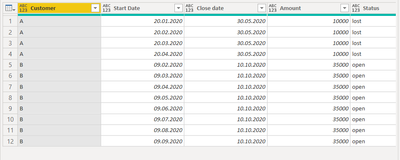
Copy paste this code to the advanced editor in a new blank query to see how the solution works.
If this post helps or solves your problem, please mark it as solution (to help other users find useful content and to acknowledge the work of users that helped you)
Kudoes are nice too
Have fun
Jimmy
Thanks a lot. Thats of great help.
The Power BI Data Visualization World Championships is back! Get ahead of the game and start preparing now!
| User | Count |
|---|---|
| 17 | |
| 9 | |
| 9 | |
| 7 | |
| 7 |