Join us at FabCon Atlanta from March 16 - 20, 2026, for the ultimate Fabric, Power BI, AI and SQL community-led event. Save $200 with code FABCOMM.
Register now!Get Fabric Certified for FREE during Fabric Data Days. Don't miss your chance! Request now
null
Hi,
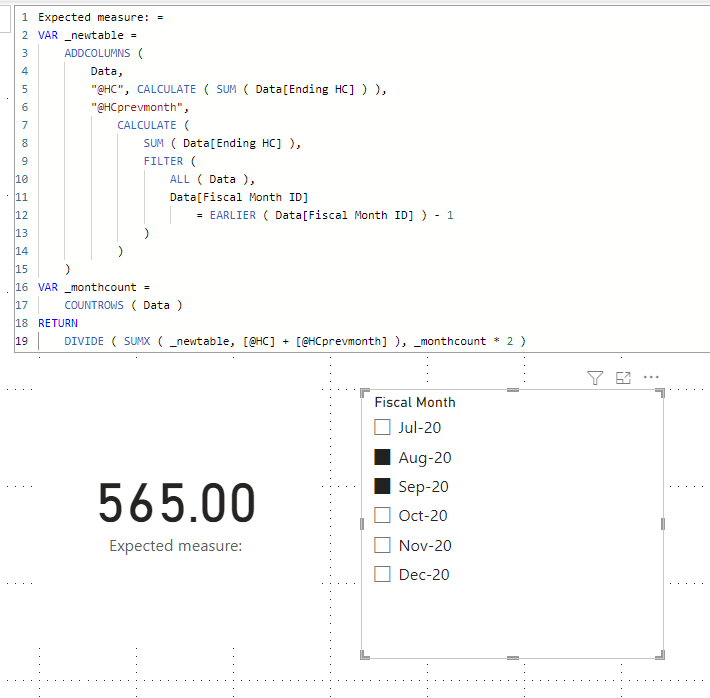
I am not sure if I understood your question correctly, but please check the below picture and the attached pbix file.
Expected measure: =
VAR _newtable =
ADDCOLUMNS (
Data,
"@HC", CALCULATE ( SUM ( Data[Ending HC] ) ),
"@HCprevmonth",
CALCULATE (
SUM ( Data[Ending HC] ),
FILTER (
ALL ( Data ),
Data[Fiscal Month ID]
= EARLIER ( Data[Fiscal Month ID] ) - 1
)
)
)
VAR _monthcount =
COUNTROWS ( Data )
RETURN
DIVIDE ( SUMX ( _newtable, [@HC] + [@HCprevmonth] ), _monthcount * 2 )
Do you have an alternative to the earlier function as that does not work
Hi,
Please try the below, and check the attached file.
Expected measure V2: =
VAR _newtable =
ADDCOLUMNS (
Data,
"@HC", CALCULATE ( SUM ( Data[Ending HC] ) ),
"@HCprevmonth",
CALCULATE (
SUMX (
FILTER (
ALL ( Data ),
Data[Fiscal Month ID]
= MAX ( Data[Fiscal Month ID] ) - 1
),
Data[Ending HC]
)
)
)
VAR _monthcount =
COUNTROWS ( Data )
RETURN
DIVIDE ( SUMX ( _newtable, [@HC] + [@HCprevmonth] ), _monthcount * 2 )
It works in the pbix file but getting odd results in my measure
Hi,
Please share your sample pbix file's link.
Thanks.
Check out the November 2025 Power BI update to learn about new features.
Advance your Data & AI career with 50 days of live learning, contests, hands-on challenges, study groups & certifications and more!