This time we’re going bigger than ever. Fabric, Power BI, SQL, AI and more. We're covering it all. You won't want to miss it.
Learn moreJoin the FabCon + SQLCon recap series. Up next: Power BI, Real-Time Intelligence, IQ and AI, and Data Factory take center stage. All sessions are available on-demand after the live show. Register now
null
Hi,
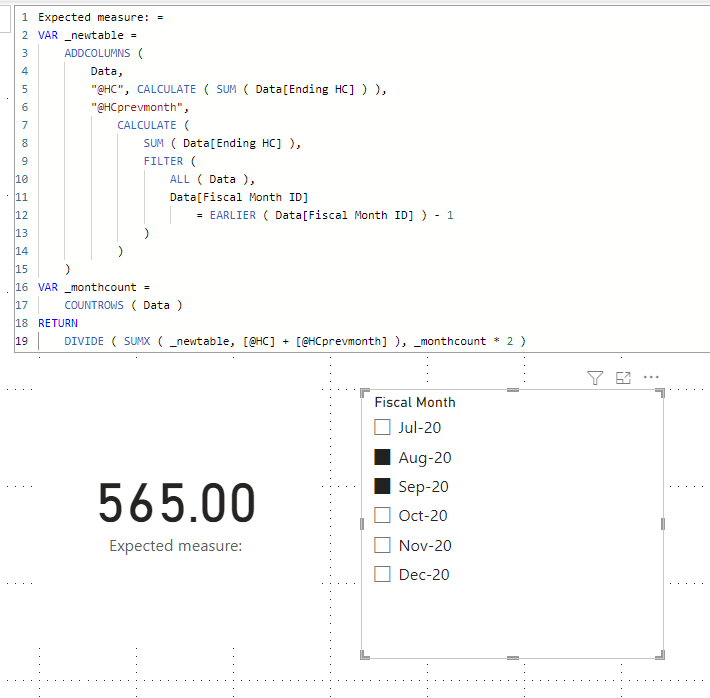
I am not sure if I understood your question correctly, but please check the below picture and the attached pbix file.
Expected measure: =
VAR _newtable =
ADDCOLUMNS (
Data,
"@HC", CALCULATE ( SUM ( Data[Ending HC] ) ),
"@HCprevmonth",
CALCULATE (
SUM ( Data[Ending HC] ),
FILTER (
ALL ( Data ),
Data[Fiscal Month ID]
= EARLIER ( Data[Fiscal Month ID] ) - 1
)
)
)
VAR _monthcount =
COUNTROWS ( Data )
RETURN
DIVIDE ( SUMX ( _newtable, [@HC] + [@HCprevmonth] ), _monthcount * 2 )
Do you have an alternative to the earlier function as that does not work
Hi,
Please try the below, and check the attached file.
Expected measure V2: =
VAR _newtable =
ADDCOLUMNS (
Data,
"@HC", CALCULATE ( SUM ( Data[Ending HC] ) ),
"@HCprevmonth",
CALCULATE (
SUMX (
FILTER (
ALL ( Data ),
Data[Fiscal Month ID]
= MAX ( Data[Fiscal Month ID] ) - 1
),
Data[Ending HC]
)
)
)
VAR _monthcount =
COUNTROWS ( Data )
RETURN
DIVIDE ( SUMX ( _newtable, [@HC] + [@HCprevmonth] ), _monthcount * 2 )
It works in the pbix file but getting odd results in my measure
Hi,
Please share your sample pbix file's link.
Thanks.
Check out the April 2026 Power BI update to learn about new features.
If you have recently started exploring Fabric, we'd love to hear how it's going. Your feedback can help with product improvements.
A new Power BI DataViz World Championship is coming this June! Don't miss out on submitting your entry.
| User | Count |
|---|---|
| 40 | |
| 37 | |
| 31 | |
| 23 | |
| 15 |
| User | Count |
|---|---|
| 76 | |
| 59 | |
| 31 | |
| 31 | |
| 25 |