Join us at FabCon Atlanta from March 16 - 20, 2026, for the ultimate Fabric, Power BI, AI and SQL community-led event. Save $200 with code FABCOMM.
Register now!The Power BI Data Visualization World Championships is back! It's time to submit your entry. Live now!
Hi, I have an issue I'm trying to work through.
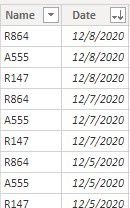
I have a list which is updated daily of bank balances, with numerous bank accounts. However, some bank accountants don't necessarily have a new bank balance all 5 working days but we need those missing days.
Also, after completing the list, I need a total balance of all bank balances per day.
Here is how the data currently looks including what I need (except total balance of all bank balances per day):
I's like to see a suggestion for how this can be done.
Thank you for any help you can provide!
Solved! Go to Solution.
Hi @EdJ ,
We can create a new table and two new columns to meet your requirement.
1. Create a new table that contains whole date and name.
Result table =
CROSSJOIN(
VALUES('Table'[Name]),
VALUES('Table'[Date]))
2. Then we need to add the value column.
Value =
CALCULATE(SUM('Table'[Value]),FILTER('Table','Table'[Date]='Result table'[Date] && 'Table'[Name]= 'Result table'[Name]))
3. At last we can create the result column.
Column =
VAR _date =
IF (
ISBLANK ( 'Result table'[Value] ),
MAXX (
FILTER (
'Result table',
'Result table'[Date] < EARLIER ( 'Result table'[Date] )
&& 'Result table'[Value] <> BLANK ()
&& 'Result table'[Name] = EARLIER ( 'Result table'[Name] )
),
'Result table'[Date]
),
'Result table'[Date]
)
RETURN
IF (
ISBLANK ( 'Result table'[Value] ),
CALCULATE (
SUM ( 'Result table'[Value] ),
FILTER (
'Result table',
'Result table'[Date] = _date
&& 'Result table'[Name] = EARLIER ( 'Result table'[Name] )
)
),
CALCULATE ( SUM ( 'Result table'[Value] ) )
)
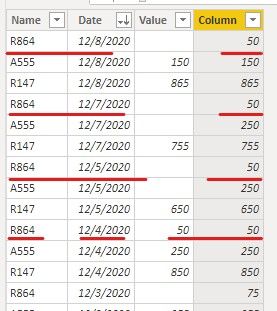
If it doesn’t meet your requirement, could you please show the exact expected result based on the table that you have shared?
Best regards,
Community Support Team _ zhenbw
If this post helps, then please consider Accept it as the solution to help the other members find it more quickly.
BTW, pbix as attached.
Hi @EdJ ,
We can create a new table and two new columns to meet your requirement.
1. Create a new table that contains whole date and name.
Result table =
CROSSJOIN(
VALUES('Table'[Name]),
VALUES('Table'[Date]))
2. Then we need to add the value column.
Value =
CALCULATE(SUM('Table'[Value]),FILTER('Table','Table'[Date]='Result table'[Date] && 'Table'[Name]= 'Result table'[Name]))
3. At last we can create the result column.
Column =
VAR _date =
IF (
ISBLANK ( 'Result table'[Value] ),
MAXX (
FILTER (
'Result table',
'Result table'[Date] < EARLIER ( 'Result table'[Date] )
&& 'Result table'[Value] <> BLANK ()
&& 'Result table'[Name] = EARLIER ( 'Result table'[Name] )
),
'Result table'[Date]
),
'Result table'[Date]
)
RETURN
IF (
ISBLANK ( 'Result table'[Value] ),
CALCULATE (
SUM ( 'Result table'[Value] ),
FILTER (
'Result table',
'Result table'[Date] = _date
&& 'Result table'[Name] = EARLIER ( 'Result table'[Name] )
)
),
CALCULATE ( SUM ( 'Result table'[Value] ) )
)
If it doesn’t meet your requirement, could you please show the exact expected result based on the table that you have shared?
Best regards,
Community Support Team _ zhenbw
If this post helps, then please consider Accept it as the solution to help the other members find it more quickly.
BTW, pbix as attached.
Hi @EdJ
This can be best done in Power Query
Can you paste the current table in text-tabular format here, instead of a screen cap, so that the contents can be copied easily?
Please mark the question solved when done and consider giving a thumbs up if posts are helpful.
Contact me privately for support with any larger-scale BI needs, tutoring, etc.
Cheers
The Power BI Data Visualization World Championships is back! It's time to submit your entry.
Check out the January 2026 Power BI update to learn about new features.
| User | Count |
|---|---|
| 61 | |
| 48 | |
| 35 | |
| 25 | |
| 23 |
| User | Count |
|---|---|
| 134 | |
| 110 | |
| 59 | |
| 39 | |
| 32 |