FabCon is coming to Atlanta
Join us at FabCon Atlanta from March 16 - 20, 2026, for the ultimate Fabric, Power BI, AI and SQL community-led event. Save $200 with code FABCOMM.
Register now!- Power BI forums
- Get Help with Power BI
- Desktop
- Service
- Report Server
- Power Query
- Mobile Apps
- Developer
- DAX Commands and Tips
- Custom Visuals Development Discussion
- Health and Life Sciences
- Power BI Spanish forums
- Translated Spanish Desktop
- Training and Consulting
- Instructor Led Training
- Dashboard in a Day for Women, by Women
- Galleries
- Data Stories Gallery
- Themes Gallery
- Contests Gallery
- QuickViz Gallery
- Quick Measures Gallery
- Visual Calculations Gallery
- Notebook Gallery
- Translytical Task Flow Gallery
- TMDL Gallery
- R Script Showcase
- Webinars and Video Gallery
- Ideas
- Custom Visuals Ideas (read-only)
- Issues
- Issues
- Events
- Upcoming Events
The Power BI Data Visualization World Championships is back! Get ahead of the game and start preparing now! Learn more
- Power BI forums
- Forums
- Get Help with Power BI
- Desktop
- Re: countifs based multiple columns criteria
- Subscribe to RSS Feed
- Mark Topic as New
- Mark Topic as Read
- Float this Topic for Current User
- Bookmark
- Subscribe
- Printer Friendly Page


- Mark as New
- Bookmark
- Subscribe
- Mute
- Subscribe to RSS Feed
- Permalink
- Report Inappropriate Content
countifs based multiple columns criteria
Hi, I am not sure this can be done in PowerBI DAX but trying to find some countif equivalent from Excel like below (Range 10, range20 and range30)
| col1 | col2 | col3 | col4 | col5 | col6 | col7 | col8 | col9 | col10 | range10 | range20 | range30 |
| 35 | 91 | 12 | 57 | 90 | 60 | 7 | 10 | 29 | 27 | COUNTIF(A2:J2,"<"&11) | COUNTIFS(A2:J2,">"&10,A2:J2,"<"&21) | COUNTIFS(A2:J2,">"&20,A2:J2,"<"&31) |
| 100 | 17 | 78 | 12 | 3 | 79 | 56 | 11 | 6 | 58 | COUNTIF(A3:J3,"<"&11) | COUNTIFS(A3:J3,">"&10,A3:J3,"<"&21) | COUNTIFS(A3:J3,">"&20,A3:J3,"<"&31) |
| 50 | 58 | 50 | 20 | 71 | 34 | 95 | 25 | 68 | 94 | COUNTIF(A4:J4,"<"&11) | COUNTIFS(A4:J4,">"&10,A4:J4,"<"&21) | COUNTIFS(A4:J4,">"&20,A4:J4,"<"&31) |
| 98 | 32 | 67 | 15 | 39 | 67 | 21 | 2 | 18 | 41 | COUNTIF(A5:J5,"<"&11) | COUNTIFS(A5:J5,">"&10,A5:J5,"<"&21) | COUNTIFS(A5:J5,">"&20,A5:J5,"<"&31) |
| 76 | 33 | 15 | 49 | 80 | 62 | 38 | 44 | 22 | 94 | COUNTIF(A6:J6,"<"&11) | COUNTIFS(A6:J6,">"&10,A6:J6,"<"&21) | COUNTIFS(A6:J6,">"&20,A6:J6,"<"&31) |
| 13 | 33 | 48 | 28 | 9 | 11 | 47 | 84 | 16 | 29 | COUNTIF(A7:J7,"<"&11) | COUNTIFS(A7:J7,">"&10,A7:J7,"<"&21) | COUNTIFS(A7:J7,">"&20,A7:J7,"<"&31) |
eventually the 3 columns will have following results:
| range10 | range20 | range30 |
| 2 | 1 | 2 |
| 2 | 3 | 0 |
| 0 | 1 | 1 |
| 1 | 2 | 1 |
| 0 | 1 | 1 |
| 1 | 3 | 2 |
can this be done?
Solved! Go to Solution.

- Mark as New
- Bookmark
- Subscribe
- Mute
- Subscribe to RSS Feed
- Permalink
- Report Inappropriate Content
Hi @theo ,
I created a sample pbix file(see attachment), please check whether that is what you want.
let
    Source = Table.FromRows(Json.Document(Binary.Decompress(Binary.FromText("RZDJDUQhDEN74czhZ2OpBdF/G8MLQnOxnMSOA2sVi1LLlAOiB6JTfgcaQCUQnUAvu67ToCPM+nhGo0IUjRYLITHSEt/l9TLN3WjMyeMGBRqS6emZcGN3yzOY23yl4mYoyFzS0ok0e2pHPfIxeWIqCVT9x4g9jzPXvOA9wYkaWKTdX9j7Bw==", BinaryEncoding.Base64), Compression.Deflate)), let _t = ((type nullable text) meta [Serialized.Text = true]) in type table [col1 = _t, col2 = _t, col3 = _t, col4 = _t, col5 = _t, col6 = _t, col7 = _t, col8 = _t, col9 = _t, col10 = _t]),
    #"Changed Type" = Table.TransformColumnTypes(Source,{{"col1", Int64.Type}, {"col2", Int64.Type}, {"col3", Int64.Type}, {"col4", Int64.Type}, {"col5", Int64.Type}, {"col6", Int64.Type}, {"col7", Int64.Type}, {"col8", Int64.Type}, {"col9", Int64.Type}, {"col10", Int64.Type}}),
    MyCols = List.Buffer(List.Select(Table.ColumnNames(#"Changed Type"), each Text.StartsWith(_, "col"))),
    #"Added Custom" = Table.AddColumn(#"Changed Type" , "Range10", each List.Count(List.Select(Record.ToList(Record.SelectFields(_,MyCols)), each _<11))   ,Int64.Type),
    #"Added Custom1" = Table.AddColumn(#"Added Custom", "Range20", each List.Count(List.Select(Record.ToList(Record.SelectFields(_,MyCols)), each _<21 and _>=11))),
    #"Added Custom2" = Table.AddColumn(#"Added Custom1", "Range30", each List.Count(List.Select(Record.ToList(Record.SelectFields(_,MyCols)), each _<31 and _>=20)))
 in
 #"Added Custom2"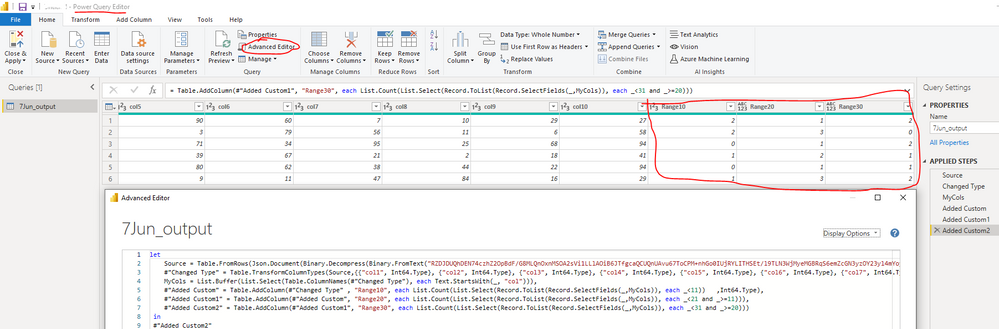
Of course, you can also follow the suggestion by @Greg_Deckler , add index column in Power Query Editor and unpivot these value columns. Finally, create 3 measures to get the counts...
Note: This method will destroy the original structure of the table...
let
    Source = Table.FromRows(Json.Document(Binary.Decompress(Binary.FromText("RZDJDUQhDEN74czhZ2OpBdF/G8MLQnOxnMSOA2sVi1LLlAOiB6JTfgcaQCUQnUAvu67ToCPM+nhGo0IUjRYLITHSEt/l9TLN3WjMyeMGBRqS6emZcGN3yzOY23yl4mYoyFzS0ok0e2pHPfIxeWIqCVT9x4g9jzPXvOA9wYkaWKTdX9j7Bw==", BinaryEncoding.Base64), Compression.Deflate)), let _t = ((type nullable text) meta [Serialized.Text = true]) in type table [col1 = _t, col2 = _t, col3 = _t, col4 = _t, col5 = _t, col6 = _t, col7 = _t, col8 = _t, col9 = _t, col10 = _t]),
    #"Changed Type" = Table.TransformColumnTypes(Source,{{"col1", Int64.Type}, {"col2", Int64.Type}, {"col3", Int64.Type}, {"col4", Int64.Type}, {"col5", Int64.Type}, {"col6", Int64.Type}, {"col7", Int64.Type}, {"col8", Int64.Type}, {"col9", Int64.Type}, {"col10", Int64.Type}}),
     #"Added Index" = Table.AddIndexColumn(#"Changed Type", "Index", 0, 1, Int64.Type),
    #"Added Custom" = Table.AddColumn(#"Added Index", "Custom", each List.Count(List.Select( #"Added Index"[Index], each _<11))),
    #"Unpivoted Only Selected Columns" = Table.Unpivot(#"Added Custom", {"col10", "col9", "col8", "col7", "col6", "col5", "col4", "col3", "col2", "col1"}, "Cols", "Value")
    in
    #"Unpivoted Only Selected Columns"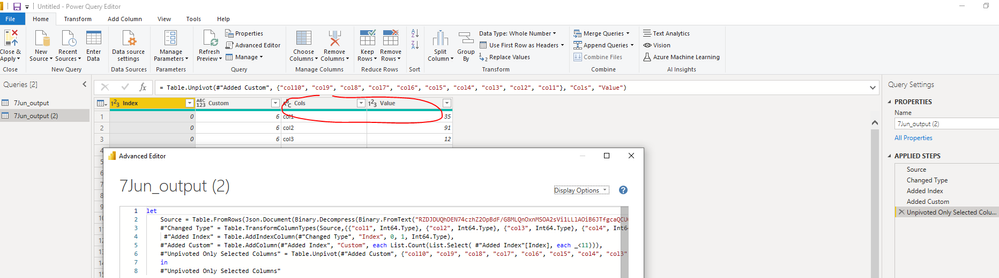
Range10_1 = CALCULATE(COUNT('7Jun_output (2)'[Cols]),FILTER('7Jun_output (2)','7Jun_output (2)'[Index]=SELECTEDVALUE('7Jun_output (2)'[Index])&&'7Jun_output (2)'[Value]<11))Range20_1 = CALCULATE(COUNT('7Jun_output (2)'[Cols]),FILTER('7Jun_output (2)','7Jun_output (2)'[Index]=SELECTEDVALUE('7Jun_output (2)'[Index])&&'7Jun_output (2)'[Value]<21))Range30_1 = CALCULATE(COUNT('7Jun_output (2)'[Cols]),FILTER('7Jun_output (2)','7Jun_output (2)'[Index]=SELECTEDVALUE('7Jun_output (2)'[Index])&&'7Jun_output (2)'[Value]<31))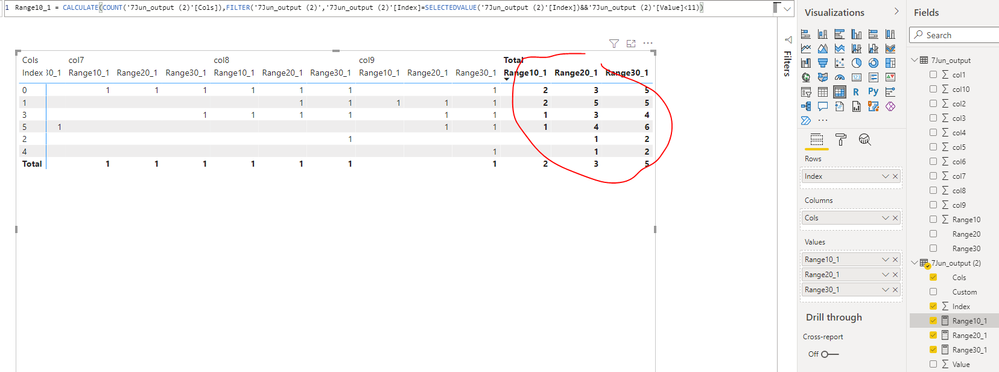
Best Regards
- Mark as New
- Bookmark
- Subscribe
- Mute
- Subscribe to RSS Feed
- Permalink
- Report Inappropriate Content
Hi @theo ,
I created a sample pbix file(see attachment), please check whether that is what you want.
let
    Source = Table.FromRows(Json.Document(Binary.Decompress(Binary.FromText("RZDJDUQhDEN74czhZ2OpBdF/G8MLQnOxnMSOA2sVi1LLlAOiB6JTfgcaQCUQnUAvu67ToCPM+nhGo0IUjRYLITHSEt/l9TLN3WjMyeMGBRqS6emZcGN3yzOY23yl4mYoyFzS0ok0e2pHPfIxeWIqCVT9x4g9jzPXvOA9wYkaWKTdX9j7Bw==", BinaryEncoding.Base64), Compression.Deflate)), let _t = ((type nullable text) meta [Serialized.Text = true]) in type table [col1 = _t, col2 = _t, col3 = _t, col4 = _t, col5 = _t, col6 = _t, col7 = _t, col8 = _t, col9 = _t, col10 = _t]),
    #"Changed Type" = Table.TransformColumnTypes(Source,{{"col1", Int64.Type}, {"col2", Int64.Type}, {"col3", Int64.Type}, {"col4", Int64.Type}, {"col5", Int64.Type}, {"col6", Int64.Type}, {"col7", Int64.Type}, {"col8", Int64.Type}, {"col9", Int64.Type}, {"col10", Int64.Type}}),
    MyCols = List.Buffer(List.Select(Table.ColumnNames(#"Changed Type"), each Text.StartsWith(_, "col"))),
    #"Added Custom" = Table.AddColumn(#"Changed Type" , "Range10", each List.Count(List.Select(Record.ToList(Record.SelectFields(_,MyCols)), each _<11))   ,Int64.Type),
    #"Added Custom1" = Table.AddColumn(#"Added Custom", "Range20", each List.Count(List.Select(Record.ToList(Record.SelectFields(_,MyCols)), each _<21 and _>=11))),
    #"Added Custom2" = Table.AddColumn(#"Added Custom1", "Range30", each List.Count(List.Select(Record.ToList(Record.SelectFields(_,MyCols)), each _<31 and _>=20)))
 in
 #"Added Custom2"
Of course, you can also follow the suggestion by @Greg_Deckler , add index column in Power Query Editor and unpivot these value columns. Finally, create 3 measures to get the counts...
Note: This method will destroy the original structure of the table...
let
    Source = Table.FromRows(Json.Document(Binary.Decompress(Binary.FromText("RZDJDUQhDEN74czhZ2OpBdF/G8MLQnOxnMSOA2sVi1LLlAOiB6JTfgcaQCUQnUAvu67ToCPM+nhGo0IUjRYLITHSEt/l9TLN3WjMyeMGBRqS6emZcGN3yzOY23yl4mYoyFzS0ok0e2pHPfIxeWIqCVT9x4g9jzPXvOA9wYkaWKTdX9j7Bw==", BinaryEncoding.Base64), Compression.Deflate)), let _t = ((type nullable text) meta [Serialized.Text = true]) in type table [col1 = _t, col2 = _t, col3 = _t, col4 = _t, col5 = _t, col6 = _t, col7 = _t, col8 = _t, col9 = _t, col10 = _t]),
    #"Changed Type" = Table.TransformColumnTypes(Source,{{"col1", Int64.Type}, {"col2", Int64.Type}, {"col3", Int64.Type}, {"col4", Int64.Type}, {"col5", Int64.Type}, {"col6", Int64.Type}, {"col7", Int64.Type}, {"col8", Int64.Type}, {"col9", Int64.Type}, {"col10", Int64.Type}}),
     #"Added Index" = Table.AddIndexColumn(#"Changed Type", "Index", 0, 1, Int64.Type),
    #"Added Custom" = Table.AddColumn(#"Added Index", "Custom", each List.Count(List.Select( #"Added Index"[Index], each _<11))),
    #"Unpivoted Only Selected Columns" = Table.Unpivot(#"Added Custom", {"col10", "col9", "col8", "col7", "col6", "col5", "col4", "col3", "col2", "col1"}, "Cols", "Value")
    in
    #"Unpivoted Only Selected Columns"
Range10_1 = CALCULATE(COUNT('7Jun_output (2)'[Cols]),FILTER('7Jun_output (2)','7Jun_output (2)'[Index]=SELECTEDVALUE('7Jun_output (2)'[Index])&&'7Jun_output (2)'[Value]<11))Range20_1 = CALCULATE(COUNT('7Jun_output (2)'[Cols]),FILTER('7Jun_output (2)','7Jun_output (2)'[Index]=SELECTEDVALUE('7Jun_output (2)'[Index])&&'7Jun_output (2)'[Value]<21))Range30_1 = CALCULATE(COUNT('7Jun_output (2)'[Cols]),FILTER('7Jun_output (2)','7Jun_output (2)'[Index]=SELECTEDVALUE('7Jun_output (2)'[Index])&&'7Jun_output (2)'[Value]<31))Best Regards


- Mark as New
- Bookmark
- Subscribe
- Mute
- Subscribe to RSS Feed
- Permalink
- Report Inappropriate Content
@theo COUNTIF equivalent can be found here: Excel to DAX Translation - Microsoft Power BI Community
|
COUNTX(FILTER(...)...) or CALCULATE(COUNT(),FILTER(...)) |
For example, if you wanted range0 as a column in your table:
range10 =
    COUNTX(FILTER({ [col1], [col2], [col3], [col4], [col5], [col6], [col7], [col8], [col9], [col10] },[Value]<11),[Value])+0
Follow on LinkedIn
@ me in replies or I'll lose your thread!!!
Instead of a Kudo, please vote for this idea
Become an expert!: Enterprise DNA
External Tools: MSHGQM
YouTube Channel!: Microsoft Hates Greg
Latest book!: DAX For Humans
DAX is easy, CALCULATE makes DAX hard...
- Mark as New
- Bookmark
- Subscribe
- Mute
- Subscribe to RSS Feed
- Permalink
- Report Inappropriate Content
@Greg_Deckler thanks for sharing your post. It is very helpful, however, when I try it to filter 2 col for now, the measure is blank. Anything I missed?
- Mark as New
- Bookmark
- Subscribe
- Mute
- Subscribe to RSS Feed
- Permalink
- Report Inappropriate Content
@theo Assuming you have some type of Index column or other identifier for your rows, you can do this:
range10 measure =
    VAR __Table = UNION( { MAX([col1]) }, { MAX([col2]) }, { MAX([col3]) }, { MAX([col4]) }, { MAX([col5]) }, { MAX([col6]) }, { MAX([col7]) }, { MAX([col8]) }, { MAX([col9]) }, { MAX([col10]) } )
RETURN
    COUNTX(FILTER(__Table,[Value]<11),[Value])+0
That said, are you sure you don't want to unpivot your columns? Makes things soooo much easier. Otherwise it is the MC Aggregations pattern. Multi-Column Aggregations (MC Aggregations) - Microsoft Power BI Community
Follow on LinkedIn
@ me in replies or I'll lose your thread!!!
Instead of a Kudo, please vote for this idea
Become an expert!: Enterprise DNA
External Tools: MSHGQM
YouTube Channel!: Microsoft Hates Greg
Latest book!: DAX For Humans
DAX is easy, CALCULATE makes DAX hard...
- Mark as New
- Bookmark
- Subscribe
- Mute
- Subscribe to RSS Feed
- Permalink
- Report Inappropriate Content
@Greg_Deckler can you share how to unpivot columns? I ran out of memory using the column while for summry, while there's error in visual using measure. Filtering based on group of 60 columns
- Mark as New
- Bookmark
- Subscribe
- Mute
- Subscribe to RSS Feed
- Permalink
- Report Inappropriate Content
@theo Sure, let's say you do have an Index column or just add one. Right-click the header of the Index column in Power Query and then choose Unpivot other columns.
Follow on LinkedIn
@ me in replies or I'll lose your thread!!!
Instead of a Kudo, please vote for this idea
Become an expert!: Enterprise DNA
External Tools: MSHGQM
YouTube Channel!: Microsoft Hates Greg
Latest book!: DAX For Humans
DAX is easy, CALCULATE makes DAX hard...
- Mark as New
- Bookmark
- Subscribe
- Mute
- Subscribe to RSS Feed
- Permalink
- Report Inappropriate Content
thanks for providing options. So far, only the measure works for me since I ran into memory issue when using columns since I am doing countif on 60col with 14mil rows
When using measure, although it works, should I be able to filter it? Since when I tried, it provides empty results.
- Mark as New
- Bookmark
- Subscribe
- Mute
- Subscribe to RSS Feed
- Permalink
- Report Inappropriate Content
@theo Well, I would think you would want to use or's || but not sure what you are doing in that measure will work, let me test as a measure. I thought you wanted a column.
Follow on LinkedIn
@ me in replies or I'll lose your thread!!!
Instead of a Kudo, please vote for this idea
Become an expert!: Enterprise DNA
External Tools: MSHGQM
YouTube Channel!: Microsoft Hates Greg
Latest book!: DAX For Humans
DAX is easy, CALCULATE makes DAX hard...
Helpful resources

Power BI Dataviz World Championships
The Power BI Data Visualization World Championships is back! Get ahead of the game and start preparing now!

Power BI Monthly Update - December 2025
Check out the December 2025 Power BI Holiday Recap!

FabCon Atlanta 2026
Join us at FabCon Atlanta, March 16-20, for the ultimate Fabric, Power BI, AI and SQL community-led event. Save $200 with code FABCOMM.

| User | Count |
|---|---|
| 37 | |
| 37 | |
| 33 | |
| 32 | |
| 29 |


| User | Count |
|---|---|
| 130 | |
| 88 | |
| 82 | |
| 68 | |
| 64 |


