Get certified for free when you join Fabric Data Days 2026 and dive into Fabric, Power BI, SQL, AI, and other essential data skills.
Join nowData Days is here! Join us now for 60+ days of learning, challenges, and connection. Learn more
Hello!
I'm new user of PBI and I'm trying to create a graphic were shows me the range of KM per Item based on a Data Filter.
The range I'm trying to get is:
1. >= 1.000 KM
2. Between 1001 to 2000 KM
3. Above 2001 KM
For exemple, if I select the Data Filter from 01/jan to 05/feb the range of item 1 must be 2. Between 1001 to 2000 KM ( 1.000 + 600 = 1.600). But if I select the Data Filter from 01/jan to 18/feb the range must be 3. Above 2001 KM (1.000 + 600 + 3.000 = 4.600).
| Data Base | ||
| Item | Date | Amount KM |
| 1 | 01/jan | 1.000 |
| 2 | 02/feb | 500 |
| 3 | 03/feb | 600 |
| 4 | 04/feb | 800 |
| 1 | 05/feb | 600 |
| 2 | 12/feb | 750 |
| 1 | 18/feb | 3.000 |
| 2 | 20/feb | 1.200 |
| 3 | 24/feb | 1.600 |
| 4 | 26/feb | 1.000 |
| 4 | 01/mar | 1.600 |
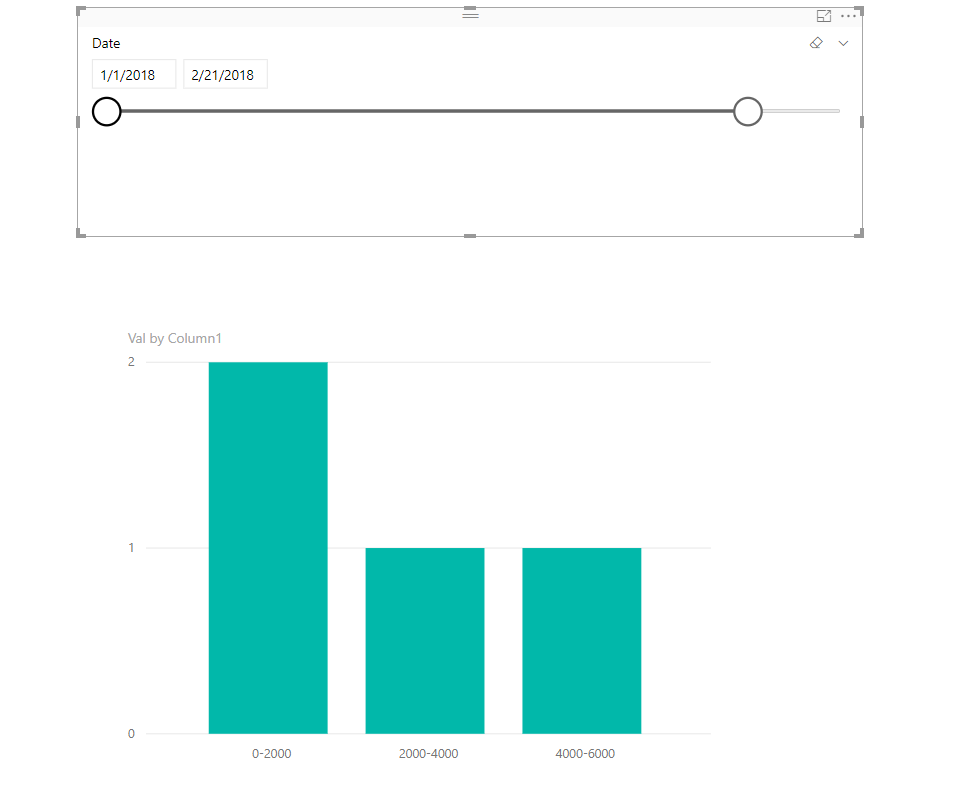
The graphic I'm trying to create is something like this:
Thanks!
Solved! Go to Solution.
Hi @Anonymous,
Based on my test, you can refer to below steps:
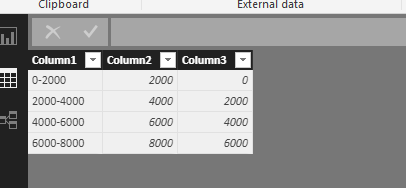
1.Create a new table to record your range of amount KM.
2.Create a measure to calculate the changed amount KM.
Val = var t=SUMMARIZE('Data Base','Data Base'[Item],"t7",CALCULATE(if(SUM('Data Base'[Amount KM])<=MAX('Table1'[Column2]) && SUM('Data Base'[Amount KM])>MIN('Table1'[Column3]),1)))
return
COUNTX(t,[t7])
3.Create a Table visual and add the [Val] and [Column1] field.
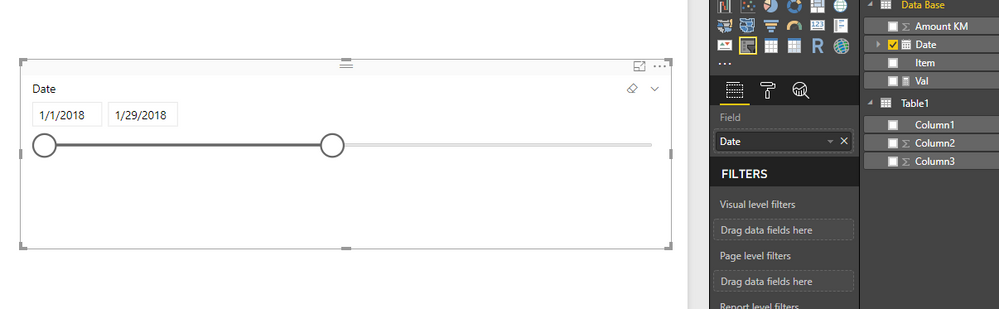
4.Create a Slicer visual and add the [Date] filed.
Now you can see the result.
You can also download the PBIX file to have a view.
https://www.dropbox.com/s/eln6cm74539n2kl/Variable-Range-based-on-date-filter.pbix?dl=0
Regards,
Daniel He
Hi @Anonymous,
Based on my test, you can refer to below steps:
1.Create a new table to record your range of amount KM.
2.Create a measure to calculate the changed amount KM.
Val = var t=SUMMARIZE('Data Base','Data Base'[Item],"t7",CALCULATE(if(SUM('Data Base'[Amount KM])<=MAX('Table1'[Column2]) && SUM('Data Base'[Amount KM])>MIN('Table1'[Column3]),1)))
return
COUNTX(t,[t7])
3.Create a Table visual and add the [Val] and [Column1] field.
4.Create a Slicer visual and add the [Date] filed.
Now you can see the result.
You can also download the PBIX file to have a view.
https://www.dropbox.com/s/eln6cm74539n2kl/Variable-Range-based-on-date-filter.pbix?dl=0
Regards,
Daniel He
That's excactly what I need! Thank you !
Don't miss out on Data Days, June 15 through August 7. Learn Fabric, Power BI, SQL, AI and more.
Check out the May 2026 Power BI update to learn about new features.
| User | Count |
|---|---|
| 22 | |
| 21 | |
| 20 | |
| 19 | |
| 13 |
| User | Count |
|---|---|
| 58 | |
| 52 | |
| 37 | |
| 31 | |
| 27 |