Get certified for free when you join Fabric Data Days 2026 and dive into Fabric, Power BI, SQL, AI, and other essential data skills.
Join nowJuly 7 - July 17 | Round 2 of the Power BI Dataviz World Championships. Don't miss your chance! Learn more
Looking to create a measure or a column that identifies when a value reoccurs within a data set but isolates the multiple times it shows up in one unique occurance.
Basically i am looking to return the column (again this could be in a measure) that identifies when a customer # is new. The issue with just doing a distinctcount is that it removes the times the customer reoccurs. By doing a simple count though, it is taking into consideration the # of items that customer bought which I dont want. For example, customer ABC is listed 6 times in this data set but a distinctcount would just give it a value of 1. I want the first time this customer orders, that customer to be considered new, but the second time (there is a date table related as well) that ABC customer to be tagged as a recurring customer. The result of this data would be 6 orders (1001 - 1006) featuring 4 new customer (ABC, XYZ, LMNO, & QRS) and 2 returning customers (ABC & XYZ).
| Item | Order # | Customer # | Customer Type |
| Item 1 | 1001 | ABC | New |
| Item 2 | 1001 | ABC | |
| Item 3 | 1001 | ABC | |
| Item 4 | 1001 | ABC | |
| Item 1 | 1002 | XYZ | New |
| Item 2 | 1002 | XYZ | |
| Item 3 | 1002 | XYZ | |
| Item 4 | 1002 | XYZ | |
| Item 5 | 1002 | XYZ | |
| Item 1 | 1003 | ABC | Returning |
| Item 2 | 1003 | ABC | |
| Item 1 | 1004 | LMNO | New |
| Item 2 | 1004 | LMNO | |
| Item 3 | 1004 | LMNO | |
| Item 1 | 1005 | XYZ | Returning |
| Item 2 | 1005 | XYZ | |
| Item 3 | 1005 | XYZ | |
| Item 1 | 1006 | QRS | New |
| Item 2 | 1006 | QRS | |
| Item 3 | 1006 | QRS | |
| Item 4 | 1006 | QRS | |
| Item 5 | 1006 | QRS | |
| Item 6 | 1006 | QRS |
Solved! Go to Solution.
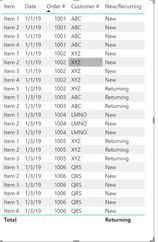
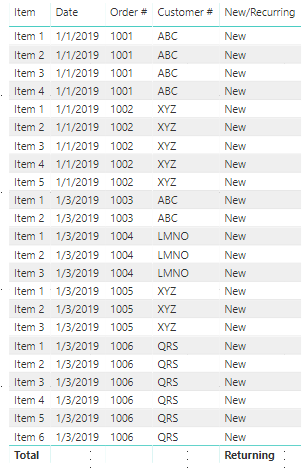
I just reproduced your data set and, using this code, see this:
New/Recurring =
VAR EarliestDate =
CALCULATE(
MIN( Table2[date] ),
ALLEXCEPT( Table2,Table2[Customer #] )
)
RETURN
IF(
SELECTEDVALUE( Table2[date] ) = EarliestDate,
"New",
"Returning"
)
Are you using the date column in the table with the rest of the data or a date table? The way the measure works is to find the the unique earliest date for each Customer. Not sure how a date table would impact this.
Will this measure work?
New/Recurring =
VAR EarliestDate =
CALCULATE(
MIN( Table1[date] ),
ALLEXCEPT( Table1,Table1[company] )
)
RETURN
IF(
SELECTEDVALUE( Table1[date] ) = EarliestDate,
"New",
"Returning"
)
No - unfortunately that is showing everything as new.
I just reproduced your data set and, using this code, see this:
New/Recurring =
VAR EarliestDate =
CALCULATE(
MIN( Table2[date] ),
ALLEXCEPT( Table2,Table2[Customer #] )
)
RETURN
IF(
SELECTEDVALUE( Table2[date] ) = EarliestDate,
"New",
"Returning"
)
Are you using the date column in the table with the rest of the data or a date table? The way the measure works is to find the the unique earliest date for each Customer. Not sure how a date table would impact this.
I think relating the date table is messing something up. When i use the data within this specifc data, your solution works. Thanks!
Join us in Barcelona for FabCon and SQLCon, the Fabric, Power BI, SQL, and AI community event. Save €200 with code FABCMTY200.
Join Data Days 2026: 60 days of free live/on-demand sessions, challenges, study groups, and certification opportunities.
| User | Count |
|---|---|
| 27 | |
| 23 | |
| 18 | |
| 18 | |
| 15 |
| User | Count |
|---|---|
| 53 | |
| 44 | |
| 42 | |
| 39 | |
| 34 |