Get certified for free when you join Fabric Data Days 2026 and dive into Fabric, Power BI, SQL, AI, and other essential data skills.
Join nowData Days is here! Join us now for 60+ days of learning, challenges, and connection. Learn more
Looking to create a measure or a column that identifies when a value reoccurs within a data set but isolates the multiple times it shows up in one unique occurance.
Basically i am looking to return the column (again this could be in a measure) that identifies when a customer # is new. The issue with just doing a distinctcount is that it removes the times the customer reoccurs. By doing a simple count though, it is taking into consideration the # of items that customer bought which I dont want. For example, customer ABC is listed 6 times in this data set but a distinctcount would just give it a value of 1. I want the first time this customer orders, that customer to be considered new, but the second time (there is a date table related as well) that ABC customer to be tagged as a recurring customer. The result of this data would be 6 orders (1001 - 1006) featuring 4 new customer (ABC, XYZ, LMNO, & QRS) and 2 returning customers (ABC & XYZ).
| Item | Order # | Customer # | Customer Type |
| Item 1 | 1001 | ABC | New |
| Item 2 | 1001 | ABC | |
| Item 3 | 1001 | ABC | |
| Item 4 | 1001 | ABC | |
| Item 1 | 1002 | XYZ | New |
| Item 2 | 1002 | XYZ | |
| Item 3 | 1002 | XYZ | |
| Item 4 | 1002 | XYZ | |
| Item 5 | 1002 | XYZ | |
| Item 1 | 1003 | ABC | Returning |
| Item 2 | 1003 | ABC | |
| Item 1 | 1004 | LMNO | New |
| Item 2 | 1004 | LMNO | |
| Item 3 | 1004 | LMNO | |
| Item 1 | 1005 | XYZ | Returning |
| Item 2 | 1005 | XYZ | |
| Item 3 | 1005 | XYZ | |
| Item 1 | 1006 | QRS | New |
| Item 2 | 1006 | QRS | |
| Item 3 | 1006 | QRS | |
| Item 4 | 1006 | QRS | |
| Item 5 | 1006 | QRS | |
| Item 6 | 1006 | QRS |
Solved! Go to Solution.
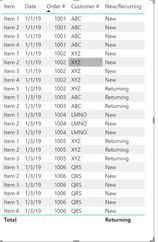
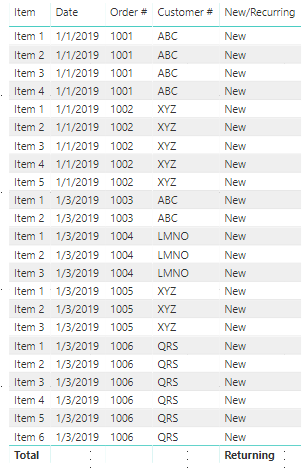
I just reproduced your data set and, using this code, see this:
New/Recurring =
VAR EarliestDate =
CALCULATE(
MIN( Table2[date] ),
ALLEXCEPT( Table2,Table2[Customer #] )
)
RETURN
IF(
SELECTEDVALUE( Table2[date] ) = EarliestDate,
"New",
"Returning"
)
Are you using the date column in the table with the rest of the data or a date table? The way the measure works is to find the the unique earliest date for each Customer. Not sure how a date table would impact this.
Will this measure work?
New/Recurring =
VAR EarliestDate =
CALCULATE(
MIN( Table1[date] ),
ALLEXCEPT( Table1,Table1[company] )
)
RETURN
IF(
SELECTEDVALUE( Table1[date] ) = EarliestDate,
"New",
"Returning"
)
No - unfortunately that is showing everything as new.
I just reproduced your data set and, using this code, see this:
New/Recurring =
VAR EarliestDate =
CALCULATE(
MIN( Table2[date] ),
ALLEXCEPT( Table2,Table2[Customer #] )
)
RETURN
IF(
SELECTEDVALUE( Table2[date] ) = EarliestDate,
"New",
"Returning"
)
Are you using the date column in the table with the rest of the data or a date table? The way the measure works is to find the the unique earliest date for each Customer. Not sure how a date table would impact this.
I think relating the date table is messing something up. When i use the data within this specifc data, your solution works. Thanks!
Don't miss out on Data Days, June 15 through August 7. Learn Fabric, Power BI, SQL, AI and more.
Check out the May 2026 Power BI update to learn about new features.
| User | Count |
|---|---|
| 23 | |
| 21 | |
| 20 | |
| 19 | |
| 13 |
| User | Count |
|---|---|
| 58 | |
| 52 | |
| 37 | |
| 31 | |
| 27 |