This time we’re going bigger than ever. Fabric, Power BI, SQL, AI and more. We're covering it all. You won't want to miss it.
Learn moreJoin the FabCon + SQLCon recap series. Up next: Power BI, Real-Time Intelligence, IQ and AI, and Data Factory take center stage. All sessions are available on-demand after the live show. Register now
Hi guys,
I have 2 tables:
1. Available Hours across Teams/Roles for Week1 – Week3
| Team | Role | Week1 | Week2 | Week3 |
| Red | A | 40 | 40 | 40 |
| Red | B | 40 | 40 | 40 |
| Red | C | 40 | 40 | 40 |
| Blue | A | 40 | 40 | 40 |
| Blue | D | 40 | 40 | 40 |
2. Required Hours allocation:
| Team | Role | Week1 | Week2 | Week3 |
| Red | A | -20 | -20 | -20 |
| Blue | A | -40 | -40 | -40 |
| Blue | D | -10 | -10 | -10 |
| Green | A | -20 | -20 | -20 |
What I want to get is an Hours Balance table calculated as Available Hours - Required Hours :
| Team | Role | Week1 | Week2 | Week3 |
| Red | A | 20 | 20 | 20 |
| Red | B | 40 | 40 | 40 |
| Red | C | 40 | 40 | 40 |
| Blue | A | 0 | 0 | 0 |
| Blue | D | 30 | 30 | 30 |
| Green | A | -20 | -20 | -20 |
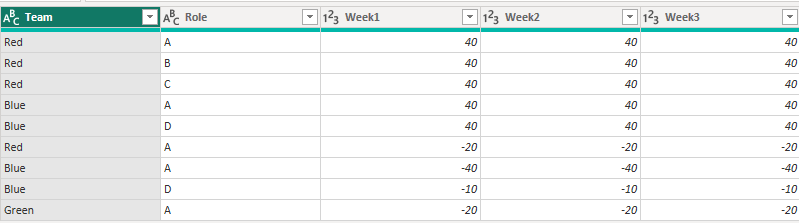
What I did was append these two tables with Available Hours and Required Hours, however, the output table does not summarize calculations and shows each entry as a separate row:
| Team | Role | Week1 | Week2 | Week3 |
| Red | A | 40 | 40 | 40 |
| Red | A | -20 | -20 | -20 |
| Red | B | 40 | 40 | 40 |
| Red | C | 40 | 40 | 40 |
| Blue | A | 40 | 40 | 40 |
| Blue | A | -40 | -40 | -40 |
| Blue | D | 40 | 40 | 40 |
| Blue | D | -10 | -10 | -10 |
| Green | A | -20 | -20 | -20 |
Could you pls help me to get the described desired Hours Balance table.
Thank you! Have a great day!
Solved! Go to Solution.
Hi @Serj ,
Here are the steps you can follow:
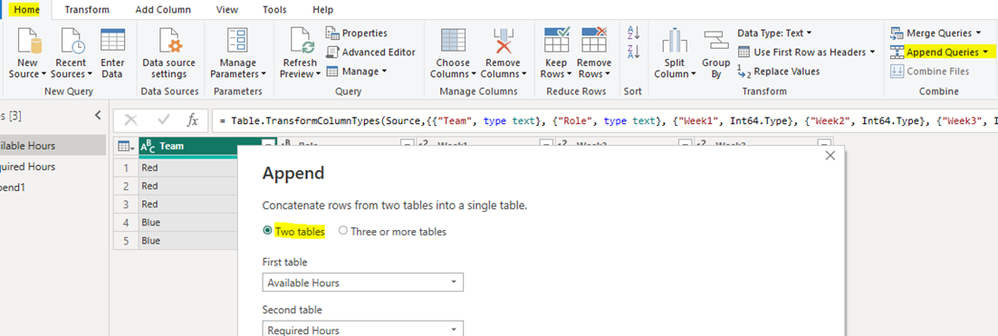
1. In Power Query – Home – Append Queries -- Append Queries as new.
Result:
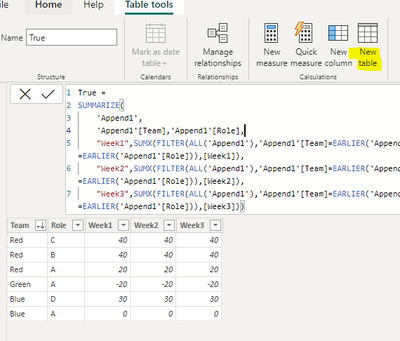
2. Create calculated table.
True =
SUMMARIZE(
'Append1',
'Append1'[Team],'Append1'[Role], "Week1",SUMX(FILTER(ALL('Append1'),'Append1'[Team]=EARLIER('Append1'[Team])&&'Append1'[Role]=EARLIER('Append1'[Role])),[Week1]), "Week2",SUMX(FILTER(ALL('Append1'),'Append1'[Team]=EARLIER('Append1'[Team])&&'Append1'[Role]=EARLIER('Append1'[Role])),[Week2]), "Week3",SUMX(FILTER(ALL('Append1'),'Append1'[Team]=EARLIER('Append1'[Team])&&'Append1'[Role]=EARLIER('Append1'[Role])),[Week3]))
3. Result:
Best Regards,
Liu Yang
If this post helps, then please consider Accept it as the solution to help the other members find it more quickly
Hi @Serj ,
Here are the steps you can follow:
1. In Power Query – Home – Append Queries -- Append Queries as new.
Result:
2. Create calculated table.
True =
SUMMARIZE(
'Append1',
'Append1'[Team],'Append1'[Role], "Week1",SUMX(FILTER(ALL('Append1'),'Append1'[Team]=EARLIER('Append1'[Team])&&'Append1'[Role]=EARLIER('Append1'[Role])),[Week1]), "Week2",SUMX(FILTER(ALL('Append1'),'Append1'[Team]=EARLIER('Append1'[Team])&&'Append1'[Role]=EARLIER('Append1'[Role])),[Week2]), "Week3",SUMX(FILTER(ALL('Append1'),'Append1'[Team]=EARLIER('Append1'[Team])&&'Append1'[Role]=EARLIER('Append1'[Role])),[Week3]))
3. Result:
Best Regards,
Liu Yang
If this post helps, then please consider Accept it as the solution to help the other members find it more quickly
Check out the April 2026 Power BI update to learn about new features.
If you have recently started exploring Fabric, we'd love to hear how it's going. Your feedback can help with product improvements.
A new Power BI DataViz World Championship is coming this June! Don't miss out on submitting your entry.
| User | Count |
|---|---|
| 40 | |
| 39 | |
| 31 | |
| 22 | |
| 15 |
| User | Count |
|---|---|
| 76 | |
| 61 | |
| 34 | |
| 30 | |
| 25 |