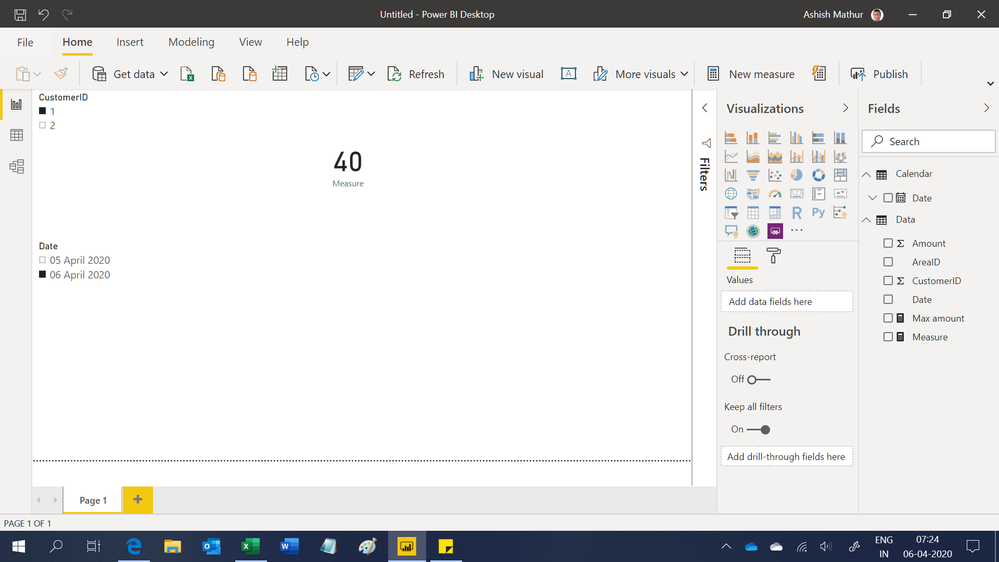
Hi,
I have below table ,note it is just the smaple data
I want to calculate SUM on top of MAX.
Max is calculated on grouping CustomerID,AreaID and date,and once max is calulated need to sum of data based on CUstomerID and Date.
| CustomerID | AreaID | Date | Amount | Max Amount | SUM Amount |
| 1 | x | 6/04/2020 | 10 | 10 | 40 |
| 1 | y | 6/04/2020 | 20 | 30 | 40 |
| 1 | y | 6/04/2020 | 30 | 30 | 40 |
| 1 | x | 5/04/2020 | 10 | 20 | 20 |
| 1 | x | 5/04/2020 | 20 | 20 | 20 |
| 2 | u | 6/04/2020 | 10 | 20 | 50 |
| 2 | z | 6/04/2020 | 5 | 30 | 50 |
| 2 | u | 6/04/2020 | 20 | 20 | 50 |
| 2 | z | 6/04/2020 | 30 | 30 | 50 |
| 2 | z | 6/04/2020 | 15 | 30 | 50 |
in my reports I will have card which will display Total Amount for a day for a customer.
So if CustomerID=1 and date is 6/04/2020 then card should display 40
if CustomerID=1 and date is 5/04/2020 then card should display 20
if CustomerID=2 and date is 6/04/2020 then card should display 50
I am able to calculate MAX,below is my measure:
MaxAmount =
CALCULATE(MAX(RealReport[Amount]),ALLEXCEPT(RealReport,RealReport[CustomerID],RealReport[AreaID],RealReport[Date]))
I tried to calculate SUM,but it is not coming as expected:
TotalCalculatedAmount =
SUMX(ALLEXCEPT(RealReport,RealReport[CustomerID],RealReport[Date]),[MaxAmount])
I also tried :
Measure =
SUMX
(SUMMARIZE(RealReport,RealReport[CustomerID],RealReport[Date],"Max Amount",CALCULATE(MAX(RealReport[Amount]),ALLEXCEPT(RealReport,RealReport[CustomerID],RealReport[date],RealReport[AreaID]))),[Max Amount])
How to get sum?