Join us at FabCon Atlanta from March 16 - 20, 2026, for the ultimate Fabric, Power BI, AI and SQL community-led event. Save $200 with code FABCOMM.
Register now!The Power BI Data Visualization World Championships is back! Get ahead of the game and start preparing now! Learn more
Hi, I am trying to convert the below python script to DAX Calculated column:
import numpy as np
dataset["OBV"] = np.where(dataset['close'] > dataset['close'].shift(1), dataset['volume'] ,
np.where(dataset['close'] < dataset['close'].shift(1), -dataset['volume'], 0)).cumsum()
Reason:
I am not able to add python to my on-premise gateway to enable scheduled refreshes.
Sample Data:
| AsofDate | close | Volume |
| 2/1/1990 | 328 | 50000 |
| 2/2/1990 | 330 | 45000 |
| 2/3/1990 | 342 | 65000 |
| 2/4/1990 | 352 | 45000 |
| 2/5/1990 | 320 | 20000 |
| 2/6/1990 | 365 | 35000 |
| 2/7/1990 | 652 | 45600 |
I appreceate any help with DAX! Thanks
Solved! Go to Solution.
hi @Anonymous
for your requirement, you need to create two column to get your requirement:
judgecolumn = var _yesterdaydate=CALCULATE(MAX('Table'[As of Date]),FILTER('Table','Table'[As of Date]<EARLIER('Table'[As of Date])))
var _yesterdayclose=CALCULATE(SUM('Table'[Close]),FILTER('Table','Table'[As of Date] = _yesterdaydate))
return
DIVIDE('Table'[Close]-_yesterdayclose,ABS('Table'[Close]-_yesterdayclose)) *'Table'[Volume]OBV =
SUMX(FILTER('Table','Table'[As of Date]<=EARLIER('Table'[As of Date])),[judgecolumn])
Result:
For first date of your sample data, there is no yesterday OBV, so I have give a fixed value
OBV =
SUMX(FILTER('Table','Table'[As of Date]<=EARLIER('Table'[As of Date])),[judgecolumn])+287025018164
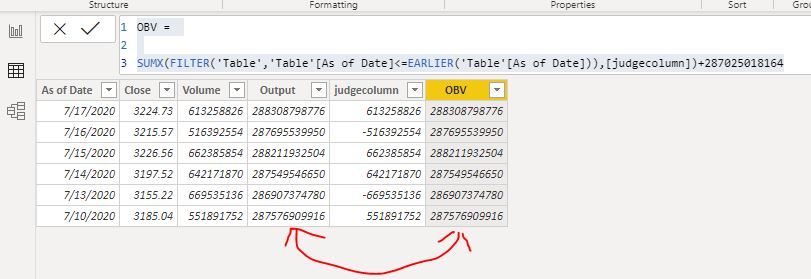
here is sample pbix file, please try it.
Regards,
Lin
Hello @amitchandak
Thanks for your response.
Sample Data: Sample Data
Input Columns: As of Date, Close, Volume
Output Column: OBV
Business Logic:
If today's close is greater than yesterday's close then:
OBV = Yesterday’s OBV + Today’s Volume
If today’s close is less than yesterday’s close then:
OBV = Yesterday’s OBV – Today’s Volume
If today’s close is equal to yesterday’s close then:
OBV = Yesterday’s OBV
Execution using Python:
import numpy as np
dataset["OBV"] = np.where(dataset['close'] > dataset['close'].shift(1), dataset['volume'] ,
np.where(dataset['close'] < dataset['close'].shift(1), -dataset['volume'], 0)).cumsum()
I am trying to execute the same using DAX.
Let me know if you have questions!
Thanks,
SV
hi @Anonymous
for your requirement, you need to create two column to get your requirement:
judgecolumn = var _yesterdaydate=CALCULATE(MAX('Table'[As of Date]),FILTER('Table','Table'[As of Date]<EARLIER('Table'[As of Date])))
var _yesterdayclose=CALCULATE(SUM('Table'[Close]),FILTER('Table','Table'[As of Date] = _yesterdaydate))
return
DIVIDE('Table'[Close]-_yesterdayclose,ABS('Table'[Close]-_yesterdayclose)) *'Table'[Volume]OBV =
SUMX(FILTER('Table','Table'[As of Date]<=EARLIER('Table'[As of Date])),[judgecolumn])
Result:
For first date of your sample data, there is no yesterday OBV, so I have give a fixed value
OBV =
SUMX(FILTER('Table','Table'[As of Date]<=EARLIER('Table'[As of Date])),[judgecolumn])+287025018164
here is sample pbix file, please try it.
Regards,
Lin
Hi i need to convert this python script into dax any idea?
The Power BI Data Visualization World Championships is back! Get ahead of the game and start preparing now!
| User | Count |
|---|---|
| 56 | |
| 44 | |
| 35 | |
| 34 | |
| 21 |
| User | Count |
|---|---|
| 143 | |
| 123 | |
| 100 | |
| 80 | |
| 55 |