This time we’re going bigger than ever. Fabric, Power BI, SQL, AI and more. We're covering it all. You won't want to miss it.
Learn moreLevel up your Power BI skills this month - build one visual each week and tell better stories with data! Get started
Hello there
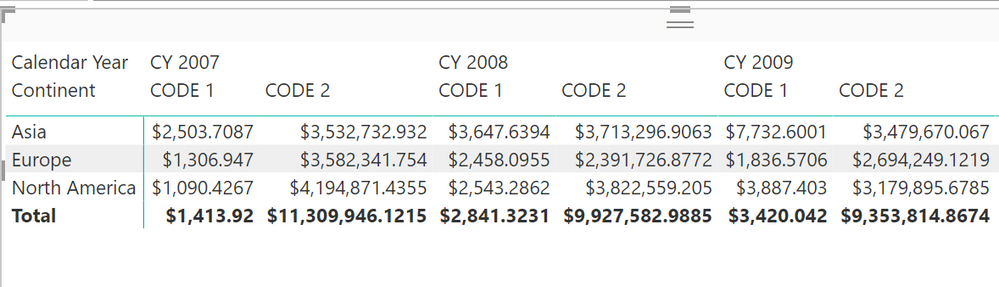
I am very new to DAX. I just couldn't figure our the difference between below two codes. Why they produce different results?
Code 1:
Sales Amount= SUMX(Sales, Sales[Quantity]*Sales[Net Price]) // Calculate sales amount first
Avg Sales by Customer = AVERAGEX(Customer, [Sales Amount]) // then calculate average
Code 2: Combine them together
Avg Sales by Customer=
AVERAGEX(
Customer,
SUMX(
Sales,
Sales[Quantity]*Sales[Net Price]
)
)
Solved! Go to Solution.
Hi,
I think, if you write the second one like below,
Avg Sales by Customer =
AVERAGEX (
Customer,
CALCULATE ( SUMX ( Sales, Sales[Quantity] * Sales[Net Price] ) )
)
it will show the same result as the first one.
If the measure itself is referenced by another measures (like the first one), CALCULATE is auto-created in order to execute context transition.
Instead of referencing the measure itself, if you write the whole formula, CALCULATE has to be included in order to execute context transition.
I hope it helps.
Hi,
I think, if you write the second one like below,
Avg Sales by Customer =
AVERAGEX (
Customer,
CALCULATE ( SUMX ( Sales, Sales[Quantity] * Sales[Net Price] ) )
)
it will show the same result as the first one.
If the measure itself is referenced by another measures (like the first one), CALCULATE is auto-created in order to execute context transition.
Instead of referencing the measure itself, if you write the whole formula, CALCULATE has to be included in order to execute context transition.
I hope it helps.
Check out the April 2026 Power BI update to learn about new features.
Sign up to receive a private message when registration opens and key events begin.
If you have recently started exploring Fabric, we'd love to hear how it's going. Your feedback can help with product improvements.
| User | Count |
|---|---|
| 36 | |
| 28 | |
| 28 | |
| 20 | |
| 18 |
| User | Count |
|---|---|
| 66 | |
| 36 | |
| 33 | |
| 26 | |
| 24 |