Join us at FabCon Atlanta from March 16 - 20, 2026, for the ultimate Fabric, Power BI, AI and SQL community-led event. Save $200 with code FABCOMM.
Register now!Vote for your favorite vizzies from the Power BI Dataviz World Championship submissions. Vote now!
Hi,
I am trying to find the peak/concurrent usage of an application during the day.
From my table named: wrl_tbl_log_1
| luid | begin_time | end_time |
| 2099 | 3/5/2020 4:03:02 PM | 3/5/2020 4:06:45 PM |
| 2099 | 3/5/2020 4:25:32 PM | 3/5/2020 4:27:25 PM |
| 2100 | 3/5/2020 1:11:57 PM | 3/5/2020 8:42:07 PM |
| 2099 | 3/5/2020 3:29:30 PM | null |
| 2100 | 3/5/2020 3:35:38 PM | null |
| 2099 | 3/5/2020 6:38:09 PM | 3/5/2020 7:04:04 PM |
I am stumped trying to determine how the dates all overlap over eachother.
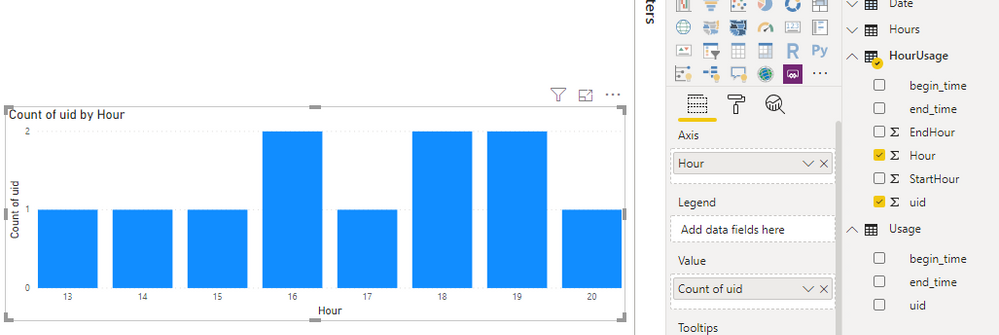
My end goal is to find the overlap during a day and make a graph like the following.
If someone could point me in the correct direction, I would really appreciate it.
-M
Solved! Go to Solution.
You could create a list of all the hours with an active Usage record.
You can either have a table of hours or generate them in M
let
Source = List.Generate(()=>0, each _ < 24, each _ + 1),
#"Converted to Table" = Table.FromList(Source, Splitter.SplitByNothing(), null, null, ExtraValues.Error),
#"Changed Type" = Table.TransformColumnTypes(#"Converted to Table",{{"Column1", Int64.Type}}),
#"Renamed Columns" = Table.RenameColumns(#"Changed Type",{{"Column1", "Hour"}})
in
#"Renamed Columns"
Now we can cross join the Usage data and filter just the hours that are between the start and end.
Create a New Dax Table (under Modeling)
HourUsage = FILTER(CROSSJOIN(Hours,'Usage'), AND(Hours[Hour]>=Hour(Usage[begin_time]), Hours[Hour]<=HOUR(Usage[end_time]) ))
You can then chart the hours and count distinct uids.
You could create a list of all the hours with an active Usage record.
You can either have a table of hours or generate them in M
let
Source = List.Generate(()=>0, each _ < 24, each _ + 1),
#"Converted to Table" = Table.FromList(Source, Splitter.SplitByNothing(), null, null, ExtraValues.Error),
#"Changed Type" = Table.TransformColumnTypes(#"Converted to Table",{{"Column1", Int64.Type}}),
#"Renamed Columns" = Table.RenameColumns(#"Changed Type",{{"Column1", "Hour"}})
in
#"Renamed Columns"
Now we can cross join the Usage data and filter just the hours that are between the start and end.
Create a New Dax Table (under Modeling)
HourUsage = FILTER(CROSSJOIN(Hours,'Usage'), AND(Hours[Hour]>=Hour(Usage[begin_time]), Hours[Hour]<=HOUR(Usage[end_time]) ))
You can then chart the hours and count distinct uids.
Thanks! This solves the small problem. You taught me how CROSSJOIN works. Now I can expand the problem and learn how to perform my larger task.
Glad it works.
Curbal has some more details/videos on the different dax joins
https://curbal.com/blog/glossary/crossjoin-dax
Check out Open Tickets. It was designed for this. https://community.powerbi.com/t5/Quick-Measures-Gallery/Open-Tickets/m-p/409364#M147
Vote for your favorite vizzies from the Power BI World Championship submissions!
If you love stickers, then you will definitely want to check out our Community Sticker Challenge!
Check out the January 2026 Power BI update to learn about new features.
| User | Count |
|---|---|
| 62 | |
| 50 | |
| 41 | |
| 20 | |
| 16 |
| User | Count |
|---|---|
| 125 | |
| 108 | |
| 46 | |
| 29 | |
| 27 |