Get Fabric certified for FREE!
Don't miss your chance to take the Fabric Data Engineer (DP-600) exam for FREE! Find out how by watching the DP-600 session on-demand now through April 28th.
Learn more- Power BI forums
- Get Help with Power BI
- Desktop
- Service
- Report Server
- Power Query
- Mobile Apps
- Developer
- DAX Commands and Tips
- Custom Visuals Development Discussion
- Health and Life Sciences
- Power BI Spanish forums
- Translated Spanish Desktop
- Training and Consulting
- Instructor Led Training
- Dashboard in a Day for Women, by Women
- Galleries
- Data Stories Gallery
- Themes Gallery
- Contests Gallery
- QuickViz Gallery
- Quick Measures Gallery
- Visual Calculations Gallery
- Notebook Gallery
- Translytical Task Flow Gallery
- TMDL Gallery
- R Script Showcase
- Webinars and Video Gallery
- Ideas
- Custom Visuals Ideas (read-only)
- Issues
- Issues
- Events
- Upcoming Events
Join the FabCon + SQLCon recap series. Up next: Power BI, Real-Time Intelligence, IQ and AI, and Data Factory take center stage. All sessions are available on-demand after the live show. Register now
- Power BI forums
- Forums
- Get Help with Power BI
- Desktop
- Filter table based on two columns
- Subscribe to RSS Feed
- Mark Topic as New
- Mark Topic as Read
- Float this Topic for Current User
- Bookmark
- Subscribe
- Printer Friendly Page

- Mark as New
- Bookmark
- Subscribe
- Mute
- Subscribe to RSS Feed
- Permalink
- Report Inappropriate Content
Filter table based on two columns
Hi,
I have Payroll data for all years in a table. I am trying to create a custom table which should bring me the last payroll i.e, max(salary_year) and max(salary_month)
I tried creating it as below, but I can use only one filter, I need to add 'PAYROLL'[Salary_YEAR] = MAX('PAYROLL'[Salary_YEAR]). Please support.
--------------------------------------------
Solved! Go to Solution.


- Mark as New
- Bookmark
- Subscribe
- Mute
- Subscribe to RSS Feed
- Permalink
- Report Inappropriate Content
Try this calculated table:
Last Sal =
VAR _MaxYearMonth =
    MAXX (
        ALL ( 'PAYROLL'[Salary_month], 'PAYROLL'[Salary_YEAR] ),
        'PAYROLL'[Salary_YEAR] * 100 + 'PAYROLL'[Salary_Month]
    )
RETURN
    FILTER (
        'PAYROLL',
        'PAYROLL'[Salary_YEAR] * 100 + 'PAYROLL'[Salary_month] = _MaxYearMonth
    )
You could also create a calculated column in the original table with YearMonth and then filter based on that.
Please always show your sample data in text-tabular format in addition to (or instead of) the screen captures. That allows people trying to help to readily copy the data and run a quick test, plus it increases the likelihood of your question being answered. Just use 'Copy table' in Power BI and paste it here.


- Mark as New
- Bookmark
- Subscribe
- Mute
- Subscribe to RSS Feed
- Permalink
- Report Inappropriate Content
Salary Filter = IF ( 'PAYROLL'[Salary_month] = MAX ( 'PAYROLL'[Salary_month] ) && 'PAYROLL'[Salary_YEAR] = MAX ( 'PAYROLL'[Salary_YEAR] ), "Las Sal", Blank() )
You can add this filter to your table visual filters pane and check only Last Sal.
- Mark as New
- Bookmark
- Subscribe
- Mute
- Subscribe to RSS Feed
- Permalink
- Report Inappropriate Content
Hi @mussaenda
Could you elaborate on this please...
I need a filtered table giving me only the fields from max salary month and max salary year filters.
- Mark as New
- Bookmark
- Subscribe
- Mute
- Subscribe to RSS Feed
- Permalink
- Report Inappropriate Content

This is what I meant with the formula. If I am not mistaken, this is what you need, right? @shoebhakeem123
- Mark as New
- Bookmark
- Subscribe
- Mute
- Subscribe to RSS Feed
- Permalink
- Report Inappropriate Content
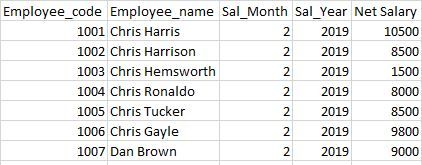
Please see snapshots of the sample table and the expected resultant table.
Here in the table you will find years 2018 and 2019 in the sal_year Column, and month 12, 1, 2 in the Sal_month column. I need a filtered table which gives me the last salary year and salary month. Here in this case, year 2019 and month = 02 as shown in the expected table below.
Please support.

- Mark as New
- Bookmark
- Subscribe
- Mute
- Subscribe to RSS Feed
- Permalink
- Report Inappropriate Content
Try this calculated table:
Last Sal =
VAR _MaxYearMonth =
    MAXX (
        ALL ( 'PAYROLL'[Salary_month], 'PAYROLL'[Salary_YEAR] ),
        'PAYROLL'[Salary_YEAR] * 100 + 'PAYROLL'[Salary_Month]
    )
RETURN
    FILTER (
        'PAYROLL',
        'PAYROLL'[Salary_YEAR] * 100 + 'PAYROLL'[Salary_month] = _MaxYearMonth
    )
You could also create a calculated column in the original table with YearMonth and then filter based on that.
Please always show your sample data in text-tabular format in addition to (or instead of) the screen captures. That allows people trying to help to readily copy the data and run a quick test, plus it increases the likelihood of your question being answered. Just use 'Copy table' in Power BI and paste it here.


- Mark as New
- Bookmark
- Subscribe
- Mute
- Subscribe to RSS Feed
- Permalink
- Report Inappropriate Content
How about this:
ADDCOLUMNS (
    ADDCOLUMNS (
        SUMMARIZECOLUMNS (
            'Table'[Employee_code],
            'Table'[Employee_name],
            "Sal_Year", MAX ( 'Table'[Sal_Year] )
        ),
        "Sal_Month",
        VAR LastYear = [Sal_Year]
        RETURN
            CALCULATE ( MAX ( 'Table'[Sal_Month] ), 'Table'[Sal_Year] = LastYear )
    ),
    "Net Salary",
    VAR LastYear = [Sal_Year]
    VAR LastMonth = [Sal_Month]
    RETURN
        CALCULATE (
            MAX ( 'Table'[Net Salary] ),
            'Table'[Sal_Year] = LastYear,
            'Table'[Sal_Month] = LastMonth
        )
)
- Mark as New
- Bookmark
- Subscribe
- Mute
- Subscribe to RSS Feed
- Permalink
- Report Inappropriate Content
How about this:
Last Sal =
FILTER (
    'PAYROLL',
    'PAYROLL'[Salary_month] = MAX ( 'PAYROLL'[Salary_month] )
        && 'PAYROLL'[Salary_YEAR] = MAX ( 'PAYROLL'[Salary_YEAR] )
)
or if you want it a bit more efficient:
Last Sal =
VAR _MaxMonth =
    MAX ( 'PAYROLL'[Salary_month] )
VAR _MaxYear =
    MAX ( 'PAYROLL'[Salary_YEAR] )
RETURN
    FILTER (
        'PAYROLL',
        'PAYROLL'[Salary_month] = _MaxMonth
            && 'PAYROLL'[Salary_YEAR] = _MaxYear
    )
- Mark as New
- Bookmark
- Subscribe
- Mute
- Subscribe to RSS Feed
- Permalink
- Report Inappropriate Content
Hey, thank you for your response.
But I did try this method before but somehow the &&s do not work with filter.
Returns a blank table. Maybe I am doing something wrong.

Helpful resources

Power BI Monthly Update - April 2026
Check out the April 2026 Power BI update to learn about new features.

New to Fabric Survey
If you have recently started exploring Fabric, we'd love to hear how it's going. Your feedback can help with product improvements.

Power BI DataViz World Championships - June 2026
A new Power BI DataViz World Championship is coming this June! Don't miss out on submitting your entry.

FabCon &SQLCon Highlights
Experience the highlights from FabCon & SQLCon, available live and on-demand starting April 14th.

| User | Count |
|---|---|
| 42 | |
| 35 | |
| 35 | |
| 22 | |
| 15 |


| User | Count |
|---|---|
| 65 | |
| 58 | |
| 28 | |
| 27 | |
| 25 |


