Join us at FabCon Atlanta from March 16 - 20, 2026, for the ultimate Fabric, Power BI, AI and SQL community-led event. Save $200 with code FABCOMM.
Register now!The Power BI Data Visualization World Championships is back! It's time to submit your entry. Live now!
Hi all,
I have a question, i have this table, and im trying to know how long spesific escalation was in each event type. For example- escalation 168 opened-->moved to on hold-->reopened---> moved to on hold again---> reoepened again and then closed.
i want to know for how long it was on hold and open?
Thanks in advanced!
Solved! Go to Solution.
Hi @gkakun ,
You are correct, I have made the contrary logic how long does it take to get from the previous status.
Replace the calculations by:
Duration =
DATEDIFF (
'Table'[Date Time],
CALCULATE (
MIN ( 'Table'[Date Time] ),
FILTER (
ALL ( 'Table' ),
'Table'[EscalationID] = EARLIER ( 'Table'[EscalationID] )
&& 'Table'[Date Time] > EARLIER ( 'Table'[Date Time] )
)
),
DAY
) + 1
try if #"Added Index"[EscalationID]{[Index] + 1} = [EscalationID] then Duration.Days( ( #"Added Index"[Date Time]{[Index] + 1}) - [Date Time]) + 1 else null otherwise null
Regards
Miguel Félix
Proud to be a Super User!
Check out my blog: Power BI em PortuguêsThanks a lot! its working.
Hi @gkakun ,
Try to add the following column to your model:
Duration =
DATEDIFF (
CALCULATE (
MAX ( 'Table'[Date Time] ),
FILTER (
ALL ( 'Table' ),
'Table'[EscalationID] = EARLIER ( 'Table'[EscalationID] )
&& 'Table'[Date Time] < EARLIER ( 'Table'[Date Time] )
)
),
'Table'[Date Time],
DAY
)
This is in days but you can the use it in hours months, and so on.
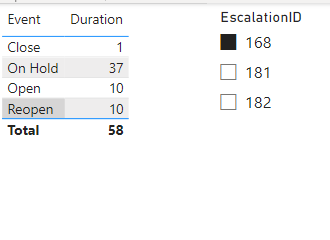
Now just use the status to get the sum of that value:
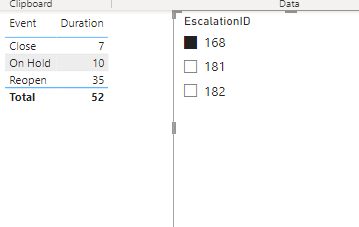
You can also do this on M Query:
try if #"Added Index"[EscalationID]{[Index] - 1} = [EscalationID] then Duration.Days( ([Date Time] - #"Added Index"[Date Time]{[Index] - 1})) else null otherwise null
Result below:
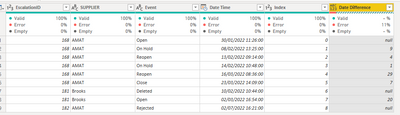
Has you can see below both of the columns have similar results:
The variations has to do with the time conversion on DAX and Power Query.
Regards
Miguel Félix
Proud to be a Super User!
Check out my blog: Power BI em PortuguêsHi Friend,
Thanks a lot for your help.
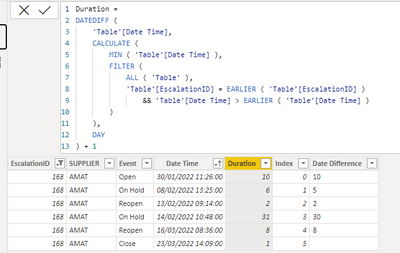
The logic is not working well. For example, escalation number 168 was on hold from Feb 8 until Feb 13 (on hold, and then reopened, 5 days), and then was o hold from Feb 14 until March 16, and then reopened, and closedf on March 23 (32 days). Overall 37 days and not 10
Hi @gkakun ,
You are correct, I have made the contrary logic how long does it take to get from the previous status.
Replace the calculations by:
Duration =
DATEDIFF (
'Table'[Date Time],
CALCULATE (
MIN ( 'Table'[Date Time] ),
FILTER (
ALL ( 'Table' ),
'Table'[EscalationID] = EARLIER ( 'Table'[EscalationID] )
&& 'Table'[Date Time] > EARLIER ( 'Table'[Date Time] )
)
),
DAY
) + 1
try if #"Added Index"[EscalationID]{[Index] + 1} = [EscalationID] then Duration.Days( ( #"Added Index"[Date Time]{[Index] + 1}) - [Date Time]) + 1 else null otherwise null
Regards
Miguel Félix
Proud to be a Super User!
Check out my blog: Power BI em PortuguêsThe Power BI Data Visualization World Championships is back! It's time to submit your entry.
Check out the January 2026 Power BI update to learn about new features.
| User | Count |
|---|---|
| 56 | |
| 42 | |
| 40 | |
| 21 | |
| 20 |
| User | Count |
|---|---|
| 142 | |
| 105 | |
| 63 | |
| 36 | |
| 35 |